


Article by
Peterson Huang DMD, MS, FACP, FRCDC
Dr. Peterson Huang is a dual board-certified prosthodontist serving Falls Church and Northern Virginia. He has been recognized as a Top Prosthodontist by Northern Virginia Magazine and Arlington Magazine and is affiliated with the Inova Fairfax Hospital Tumor Board. Dr. Huang focuses on dental implants, full mouth reconstruction, and complex restorative dentistry for patients who need advanced, comprehensive care.
A removable denture can be an important part of rebuilding after oral cancer, not simply a fallback when implants aren’t suitable. A prosthodontist can assess how surgery, healing, and radiation have affected the teeth, jaw, and oral tissues, then plan care around the patient’s needs. Options may include complete or partial dentures, implants, or a custom obturator to close an opening created by surgery.
Appearance is only one part of oral cancer reconstruction, though restoring self-image remains a vital piece of healing—much like how patients coping with therapy-related hair loss turn to resources like Creative Wigs & Hair Replacement. In dental care, treatment planning also considers chewing, speech, comfort, and how a prosthesis will be supported and maintained. This article explains how dental assessment guides care, when removable dentures may be appropriate, and how implants or other prostheses can fit into rehabilitation after surgery or radiation. Treatment history and the location of a surgical defect also shape tooth-replacement decisions.
Key Takeaways
- Implant planning after radiation weighs the treatment field and dose alongside bone healing and the intended prosthesis.
- The location and extent of a jaw defect influence how a prosthesis can restore oral function and fit.
- Dental assessment before cancer treatment can identify oral health needs and inform rehabilitation planning.
- Complete and partial dentures are options for replacing missing teeth; their design depends on the remaining teeth and the condition of the oral tissues.
Osseointegrated implants after reconstruction or radiation
Dental implants can support fixed teeth or removable dentures after jaw reconstruction, but radiation history and bone condition affect planning. Assessment considers the surgical defect, available bone, healing, and the type of prosthesis needed to support oral function.
Implants and Restorations After Treatment
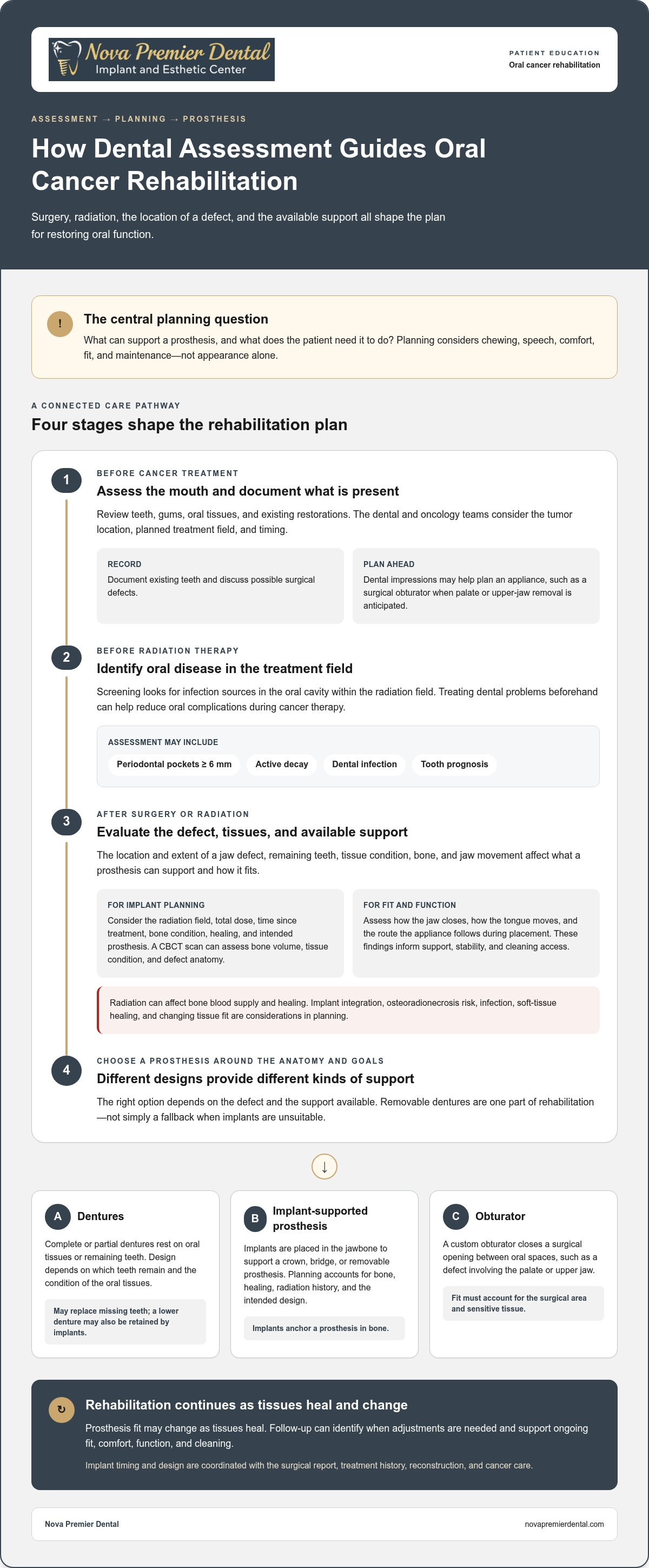
Dental implants are placed in the jawbone to support a crown, bridge, or removable prosthesis. After cancer treatment, the radiation field, total dose, and time since treatment help guide planning. A CBCT scan can assess bone volume, tissue condition, and the anatomy of a surgical defect. Implant placement may also be planned alongside tumor-removal surgery, with timing coordinated with reconstruction and cancer care.
Comparing Implants, Dentures, and Obturators
Implants anchor a prosthesis in bone; dentures rest on oral tissues or remaining teeth; an obturator closes a surgical opening between oral spaces. The right option depends on the defect and the support available. For example, implants may retain a lower denture, while a custom obturator can close a palate or jaw defect. Osseointegration became an option for maxillofacial prosthetic retention in the 1970s and 1980s. Learn about oral reconstruction approaches.
Timing and Risks of Rehabilitation
Oral rehabilitation planning should begin before head and neck surgery, even when definitive tooth replacement comes later. Radiation can affect bone blood supply and healing, influencing implant integration and osteoradionecrosis risk. Other concerns include infection, soft-tissue healing problems, and prosthesis fit as tissues change. The radiation field, dose, elapsed time, surgical report, and planned restoration all inform implant timing and design.
Reconstruction and Rehabilitation Costs
In the United States, oral cancer reconstruction and prosthodontic rehabilitation costs depend on the case and are provided after a quote request. Factors include the extent of surgery, bone reconstruction, implant number and placement, prosthesis type, and follow-up needs. A removable denture, implant-retained denture, and fixed restoration involve different clinical steps. A treatment plan separates these components so patients can understand what each stage includes.
Mandibular defect rehabilitation
When cancer surgery removes part of the mandible, rehabilitation must account for the defect’s location, remaining teeth, and changes in jaw movement. The plan may combine surgical reconstruction with a prosthesis designed for the healed tissues. These factors matter because a lower-jaw defect can change how the teeth meet and how a patient manages oral function.
Assessment considers the remaining jaw and teeth, the tissue covering the defect, and the path a prosthesis would follow during placement. A prosthodontist also evaluates how the jaw closes and whether the tongue can move comfortably around the proposed appliance. These findings guide decisions about support, stability, and cleaning access. A design suited to one mandibular defect may not work for another.
For defects involving the palate or upper jaw, an obturator can fill and seal an opening between the oral and nasal cavities. Its borders must fit the surgical area without putting undue pressure on sensitive tissue. Changes in the defect or surrounding tissue can affect the fit, so adjustments may be needed during follow-up. An obturator serves a different purpose from mandibular reconstruction, although both approaches can support oral function.
Maxillary and midface defects may involve structures beyond the teeth, so the plan needs to reflect the extent of tissue loss and any surgical reconstruction. The oncology team’s surgical report helps describe the defect and remaining anatomy. For insurance or Medicare questions, request a coverage determination for the specific prosthesis and proposed treatment, following the payer’s documentation requirements.
For patients considering complex restorative care after cancer surgery, oral cancer rehabilitation planning can relate prosthesis design to the defect and remaining oral structures.
A maxillofacial prosthodontist can make a surgical obturator in advance to support oral function from the time of surgery. Maxillofacial prosthetics restores or replaces structures of the mouth, jaw, and face with prostheses. Head and neck cancer treatment may damage the jawbone and cause difficulty chewing, swallowing, or speaking, oral infections, soft tissue damage, and changes in taste.
Approximately 150 practitioners in the United States have the maxillofacial prosthodontist credential. Dr. Nicholas Goetz completed a Maxillofacial Prosthodontics Fellowship at UCLA and served as a civilian maxillofacial prosthodontist in U.S. Army and VA medical hospital settings. The First International Congress on Maxillofacial Prosthetics took place in 1994.
Preoperative dental assessment and treatment
Dental assessment before head and neck cancer treatment identifies oral disease and helps inform plans for surgery, chemotherapy, or radiation. Early review also gives the restorative team time to document existing teeth and discuss possible surgical defects.
The initial assessment reviews the teeth, gums, oral tissues, and existing restorations. The oncology and dental teams consider the tumor’s location, planned treatment field, and timing. A prosthodontist can contribute to initial planning and take dental impressions before surgery. These records help plan appliances, including a surgical obturator, when removal of the palate or upper jaw is anticipated.
Before radiation therapy, screening focuses on infection sources in the oral cavity within the treatment field. This can include periodontal pockets measuring at least 6 mm, as well as teeth with active decay or infection. Treating dental problems beforehand helps reduce oral complications during cancer therapy. The treatment plan also considers whether damaged teeth can be restored or have a poor prognosis.
Radiation to the head and neck can reduce salivary gland function, leaving teeth more vulnerable to radiation-related caries. Custom fluoride trays with prescription-strength fluoride are a primary preventive tool after head and neck radiation. A practical daily oral hygiene plan is also important, since dry mouth can make regular cleaning less comfortable. The dental team can review preventive measures before therapy begins, while healthcare providers and community services like Merali Pharmacy & Clinic can assist patients in managing prescription oral rinses and daily symptom-relief products.
Sequencing matters. A maxillofacial prosthodontist can plan a surgical obturator before resection, while radiation stents are designed before radiation and worn during each treatment session. In some cases, most preoperative dental procedures can be completed within 24 hours of initial referral. Dental implants are planned around the surgical and radiation sequence, bone condition, and intended restoration, rather than treated as a separate decision. Early planning connects preservation, defect management, and later oral rehabilitation.
Dentures and partial dentures
After oral cancer treatment, complete dentures replace all teeth in an arch, while partial dentures replace selected missing teeth. For patients after cancer treatment, denture design must account for changes to the jaw, gums, and other tissues after surgery or radiation. A removable prosthesis can be adjusted as healing changes its fit, offering one way to restore oral function without relying on implants.
The remaining teeth help determine a partial denture’s support and retention. A prosthodontic assessment considers which teeth can bear forces, where the denture rests, and whether the surgical area is sensitive. For example, a partial denture replacing several teeth needs a stable path of placement that avoids pressure on healing tissue. Complete dentures rely on the contours of the mouth for support, so changes to the jaw or soft tissues can affect stability.
Head and neck cancer treatment can significantly affect eating, speaking, and swallowing, according to the National Cancer Institute. When surgery involves the tongue, soft palate, or throat, a carefully designed oral prosthesis may support speech and swallowing. A denture can replace missing teeth, but it cannot replace tissue removed during surgery or address every functional change. Facial prostheses replace external structures and are distinct from dental dentures.
Maintenance matters as tissues and prostheses change. Removable intraoral maxillofacial prostheses generally need replacement every 5 to 7 years; fit may also require attention sooner as oral tissues change. Patients should clean the prosthesis and remaining teeth as directed, and report sore areas, looseness, or difficulty speaking. Those changes can signal that the appliance needs adjustment rather than continued use without review.
For patients considering tooth replacement after cancer treatment, complete and partial dentures can address fit, support, and function with a removable design.
The 50 study participants included 35 men and 15 women; their mean age was 61.5 ± 11.2 years, and they ranged in age from 41-81 years. Fifteen patients could not receive functional implant-retained lower dentures for various reasons, while the other 35 patients who received functional implant-retained lower dentures functioned well.
Nova Premier Dental: Dental Implants
Nova Premier Dental provides dental implants and restorative options for patients considering tooth replacement after cancer treatment. Planning considers surgical history, the radiation field, bone condition, and the intended restoration. Implants may support individual crowns, bridges, or removable dentures when clinical conditions support that approach. Complete and partial dentures are alternatives, while full mouth reconstruction can address multiple restorative needs together.
A prosthodontic evaluation helps clarify how implant placement, bite forces, remaining teeth, and prosthesis design relate. It also distinguishes implant planning from designing and maintaining the crown, bridge, or denture attached to an implant. Each component has its own care needs over time.
To discuss restorative options after cancer surgery or radiation, contact Nova Premier Dental.
Take the Next Step in Your Restorative Care
A useful first step is to identify what matters most in daily life, such as comfortable chewing, clearer speech, or a stable replacement for missing teeth. For oral cancer reconstruction, a prosthodontist can assess how treatment history and remaining oral structures shape restorative choices. The aim is a plan suited to your health needs, functional priorities, and preferences.
Nova Premier Dental offers dental implants, crowns and bridges, and complete and partial dentures. These options can be considered in light of your dental condition and restorative goals. An evaluation can clarify which questions to address next and whether a fixed or removable approach merits consideration.
If you’re ready to discuss your restorative needs, contact Nova Premier Dental. A clear next step can make planning feel more manageable.
Frequently Asked Questions
What does a maxillofacial prosthodontist do after oral cancer treatment?
A maxillofacial prosthodontist assesses how a prosthesis works during daily activities, not just how it looks. For example, evaluation can consider whether you can insert and remove an appliance, clean around it, and speak comfortably. Changes in tongue movement or mouth opening can affect the design and the instructions for using the prosthesis.
What are the steps for dental rehabilitation after oral cancer treatment?
Rehabilitation often progresses from temporary support toward a more definitive restoration as tissues heal and treatment needs become clearer. An interim appliance can help assess comfort and function before a final design is made. Follow-up visits allow adjustments for pressure areas, retention, or changes in how the teeth meet. Ongoing maintenance addresses the prosthesis’s fit, cleaning, and wear.
How does radiation therapy affect dental implants and prosthodontic treatment?
Radiation can also contribute to trismus, or restricted mouth opening, which can make dental care and prosthesis use more difficult. When cancer therapy causes trismus, jaw-opening and stretching exercises should be taught early to help maintain access for oral hygiene and later rehabilitation. Changes in mouth opening can affect how an appliance is inserted, removed, and cleaned, so they are important to consider during treatment planning.
Disclaimer
The information provided on this website and blog is intended for general educational and informational purposes only and should not be considered dental or medical advice, diagnosis, or treatment. Reading content on this website does not establish a doctor-patient relationship with Nova Premier Dental or Dr. Peterson Huang. Dental conditions and treatment needs vary from patient to patient. Individuals should consult directly with a qualified dental professional for personalized evaluation, diagnosis, and treatment recommendations. Do not delay seeking professional dental care based on information found on this website. While we strive to provide accurate and up-to-date information, no guarantee is made regarding the completeness, accuracy, or applicability of the content. Treatment outcomes may vary depending on individual circumstances. If you are experiencing a dental emergency or urgent oral health concern, please contact a licensed dental professional immediately or call 911 in the event of a medical emergency.


