


Article by
Peterson Huang DMD, MS, FACP, FRCDC
Dr. Peterson Huang is a dual board-certified prosthodontist serving Falls Church and Northern Virginia. He has been recognized as a Top Prosthodontist by Northern Virginia Magazine and Arlington Magazine and is affiliated with the Inova Fairfax Hospital Tumor Board. Dr. Huang focuses on dental implants, full mouth reconstruction, and complex restorative dentistry for patients who need advanced, comprehensive care.
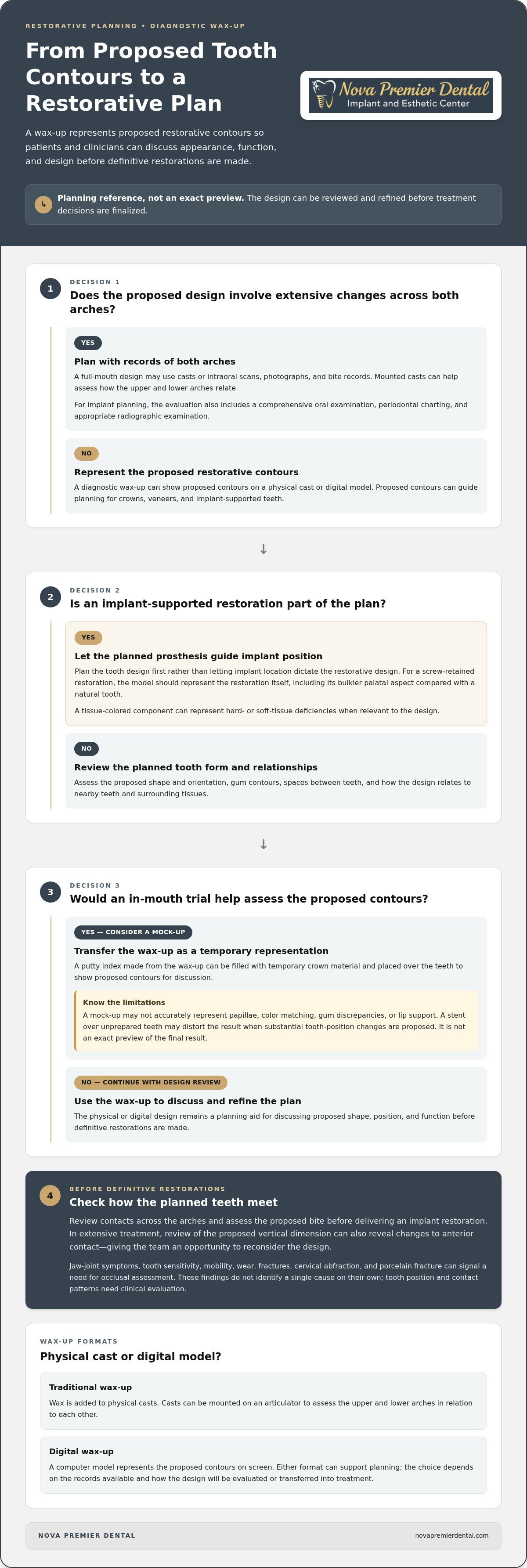
A diagnostic dental wax-up gives a physical or digital representation of proposed restorative contours. It helps patients and clinicians consider appearance and function before treatment, making it a useful planning aid for extensive restorative care in Falls Church and Northern Virginia.
It’s natural to want a clear picture of what restorative treatment could change. A dental wax-up is a planning reference, not an exact preview, and makes design choices easier to discuss. It can support communication, bite assessment, and full-mouth rehabilitation.
Key Takeaways
- Review proposed tooth shapes and positions to understand what treatment is intended to change.
- Clear laboratory directions help translate treatment goals into a restorative design that accounts for alignment, form, and bite.
- Assessing contacts before final implant restorations can identify functional concerns while the plan can still be refined.
- A model of both arches can help evaluate extensive restorative changes; Nova Premier Dental provides full-mouth reconstruction and implant care.
What is a dental diagnostic wax up?
A diagnostic wax-up records a proposed restorative design on physical casts or a digital model. Its components can be adjusted and reviewed before treatment decisions are finalized.
Esthetic and Functional Assessment
Assessment considers whether the proposed tooth arrangement accounts for each tooth’s shape and orientation, gum contours, and spaces between teeth. These details affect how the design relates to nearby teeth and surrounding tissues.
For implant planning, a tissue-colored component can represent hard- or soft-tissue deficiencies. For removable prostheses, adding a flange to the tooth arrangement can help assess lip support during a trial insertion. These features give the team specific design details to discuss instead of relying only on a general visual impression.
Traditional and Digital Wax-Ups
A traditional wax-up adds wax to physical casts; a digital wax-up uses a computer model to represent proposed contours. The difference lies in how the design is created and reviewed.
Physical casts can be mounted on an articulator to assess the upper and lower arches in relation to each other. A digital model displays the proposed design on screen. Either format can support planning; the choice depends on the records available and how the design will be evaluated or transferred into treatment.
Records for a Full-Mouth Wax-Up
A full-mouth design depends on records showing the teeth and their relationship across both arches. These may include casts or intraoral scans, photographs, and bite records.
Implant planning also includes a comprehensive oral examination, periodontal charting, and appropriate radiographic examination. When casts are mounted in centric relation, the laboratory uses a centric relation record; a facebow or transfer device can help mount the upper cast. Accurate records help the laboratory represent the intended relationships.
Planning Restorations and Bite Changes
Proposed contours can guide restorative planning for crowns, veneers, and implant-supported teeth. For an implant restoration, the planned prosthesis guides implant position, rather than the implant location dictating the tooth design.
For a screw-retained implant restoration, the model should represent the restoration itself, including its bulkier palatal aspect compared with a natural tooth. In extensive treatment, reviewing the proposed vertical dimension can also reveal changes to anterior contact. These findings give the team an opportunity to reconsider the design before making definitive restorations.
Communicating treatment goals to the dental laboratory
A laboratory prescription translates clinical findings and patient priorities into a proposed restorative design. Clear directions help the dental technician shape the wax-up to address both appearance and function.
Treatment Goals for the Laboratory
A laboratory prescription is the clinician’s written description of the intended tooth positions, contours, and bite. It should reflect the patient’s expectations as well as clinical requirements discussed during treatment planning.
Useful instructions identify the desired alignment, inclination, morphology, and occlusal scheme. For example, the clinician can specify the proposed incisal edge position and describe how the front teeth should meet the opposing teeth. The laboratory can then develop the wax-up according to those directions, without guessing at the intended result.
Patient communication matters before the prescription is finalized. The clinician and patient can review the proposed shape and discuss priorities, such as changing visible tooth contours while preserving a functional bite. A shared understanding can reveal differences between patient preferences and the clinical plan. The prescription should record the agreed goals, giving the laboratory a clear design reference.
Transferring a Wax-Up with a Mock-Up
A mock-up is a temporary in-mouth representation of the proposed tooth contours, transferred from the wax-up. Much like how custom fabrication specialists such as Absolute Stone Design use precise templating to verify dimensions before installation, a dental mock-up lets the patient and clinician assess the design directly before definitive restorations are made.
One method uses a putty index made from an implant diagnostic wax-up. Filled with temporary crown material, the index is placed over the teeth to show the proposed restoration. For minor changes, this can make planned contours easier to visualize and discuss. The mock-up supports evaluation, but it is not an exact preview of the final result.
A mock-up may not accurately represent papillae, color matching, gum discrepancies, or lip support. A stent placed over unprepared teeth may also distort it when substantial tooth-position changes are proposed. The clinician should explain these limitations and document treatment discussions in the patient’s notes. If provisional restorations are adjusted during trial therapy, those changes should inform the definitive design. This feedback connects the patient’s experience with the laboratory’s final instructions.
Occlusal scheme and functional refinement
A wax-up lets the clinician inspect how planned tooth shapes meet across the arches. This review can guide functional adjustments before restorations are made.
Occlusion Evaluation and Correction
Occlusion evaluation assesses how the upper and lower teeth contact during biting and jaw movement. The clinician assesses these contacts before delivering an implant restoration, because correcting an unsuitable bite at delivery may be too late.
Jaw-joint symptoms, tooth sensitivity, mobility, wear, fractures, cervical abfraction, and porcelain fracture can signal a need for occlusal assessment. These findings do not identify a single cause on their own. The clinician evaluates tooth position and contact patterns to determine where interference occurs and how it affects the proposed restorations.
The approach to correcting a deflective contact depends on its location and severity. Options include selective odontoplasty, restoring a tooth with a crown, or extracting a tooth when its position is significantly incorrect. The wax-up helps compare proposed contours with opposing teeth before an approach is selected. This planning is particularly relevant when bruxism has worn down incisal guidance or when a single denture opposes natural teeth.
Occlusal Scheme and Tooth Morphology
An occlusal scheme is the planned pattern of contacts between opposing teeth, shaped by each tooth’s morphology. In the wax-up, cusp height, cusp length, and surface contours must coordinate across both arches.
Waxing the mandibular posterior teeth establishes buccal cusp height, the occlusal plane, the curves of Spee and Wilson, and overall occlusal morphology. Completing the maxillary posterior teeth helps establish centric occlusion contacts and lingual cusp length. These details affect how the arches meet, not just how the teeth look.
Once the anatomy is established, the technician refines the occlusal scheme across both arches. Clear directions on tooth position, alignment, inclination, morphology, and intended contacts reduce guesswork. Reviewing these relationships on the wax-up helps the clinician identify conflicts between a proposed contour and the desired bite before finalizing restorations.
Full-mouth rehabilitation and vertical dimension
A full-mouth wax-up helps assess a coordinated plan across both arches before extensive restorative treatment. It is especially useful when the proposed plan changes the vertical dimension, or the space between the jaws when the teeth meet.
Indications for a Full-Mouth Wax-Up
A full-mouth wax-up models proposed restorations across the upper and lower arches. It is particularly useful when rehabilitation involves multiple teeth or changes to vertical dimension.
For example, severe tooth wear may leave limited restorative space or alter how the front teeth contact. A wax-up can show whether raising the bite creates the intended space while preserving useful anterior contact. The laboratory mounts casts in centric relation before waxing the anterior teeth, then moves on to the posterior teeth. This sequence lets the team assess the plan across both arches instead of considering each restoration in isolation.
Risks of Wax-Up-Planned Rehabilitation
A wax-up-planned rehabilitation is a proposed design, so its limitations matter when interpreting the plan. A change in vertical dimension can remove anterior contact and may require a revised restorative approach.
A wax-up is a planning model, not proof that every proposed contour will work in the mouth. Tooth prognosis, restorative space, and the relationship between the arches remain clinical considerations. Trial restorations can provide information during treatment, and changes to provisionals should be incorporated into definitive restorations. This carries useful findings forward instead of treating the initial wax-up as final.
Treatment Duration and Appointments
The timing and appointments for a full-mouth wax-up depend on the records, laboratory work, and clinical review needed for the plan. The process includes collecting records, mounting casts, completing the wax-up, and assessing the proposed contacts and contours.
Further review may be needed if the design changes or provisional restorations are used for trial therapy. The wax-up’s complexity, the completeness of the records, and any need to revise tooth positions or vertical dimension shape the workflow. Each review helps confirm the proposed design before treatment advances and carries trial changes into the final plan.
For extensive restorative planning, explore full-mouth rehabilitation at Nova Premier Dental.
Nova Premier Dental: Dental Implants
Nova Premier Dental provides dental implants and full mouth reconstruction for patients planning complex tooth replacement or restorative care in Falls Church and Northern Virginia. A diagnostic wax-up can help organize the proposed restoration before implant placement, bringing tooth position, appearance, and bite into the same discussion. Implant planning focuses on the intended prosthesis, not simply the location of missing teeth. This restorative-first approach clarifies how implant position relates to the planned crown or other prosthesis.
For a single missing tooth, dental implant treatment may be considered alongside other restorative options. More extensive needs may call for a coordinated plan involving crowns and bridges, dentures, or full mouth reconstruction. The appropriate approach depends on the oral examination, remaining teeth, and restorative goals.
To discuss a restorative concern or learn more about care, contact Nova Premier Dental.
Bring Your Priorities Into the Next Discussion
Before discussing treatment, consider which changes matter most to you and what you want to preserve. You might note concerns about chewing, worn edges, visible tooth shape, or how your bite feels. These priorities can keep the conversation focused on practical goals, not appearance alone.
A dental wax-up can support prosthodontic treatment planning, including a discussion of whether a full-mouth wax-up suits your proposed care. Use the review to ask how proposed changes relate to comfort, tooth preservation, maintenance, and treatment sequence. You can also ask which parts of the design can be adjusted and what a temporary trial may clarify before definitive restorations are made.
For a restorative concern or questions about treatment planning, contact Nova Premier Dental. A thoughtful discussion can help you understand your options and take the next step with greater clarity.
Frequently Asked Questions
What is a diagnostic dental wax-up in prosthodontic treatment planning?
A diagnostic wax-up models proposed restorative contours to evaluate a treatment design before restorations are made. It can also represent details beyond tooth shape. For implant cases, a tissue-colored component may show hard- or soft-tissue deficiencies; for removable prostheses, a flange can help assess lip support. These features clarify what the proposed design needs to address.
What are the steps for creating a diagnostic wax-up?
A diagnostic wax-up moves from clinical records to a reviewed restorative design. The clinician and laboratory use the records to develop and assess the plan.
- Examine the mouth and gather models, bite records, and relevant imaging.
- Mount casts in the planned jaw relationship; duplicate an existing prosthesis if it already provides suitable function and appearance.
- Establish tooth position and contours, adding needed soft-tissue forms or prosthesis extensions.
- Review the design and use it to create a mock-up or procedural guide when appropriate.
Disclaimer
The information provided on this website and blog is intended for general educational and informational purposes only and should not be considered dental or medical advice, diagnosis, or treatment. Reading content on this website does not establish a doctor-patient relationship with Nova Premier Dental or Dr. Peterson Huang. Dental conditions and treatment needs vary from patient to patient. Individuals should consult directly with a qualified dental professional for personalized evaluation, diagnosis, and treatment recommendations. Do not delay seeking professional dental care based on information found on this website. While we strive to provide accurate and up-to-date information, no guarantee is made regarding the completeness, accuracy, or applicability of the content. Treatment outcomes may vary depending on individual circumstances. If you are experiencing a dental emergency or urgent oral health concern, please contact a licensed dental professional immediately or call 911 in the event of a medical emergency.


