


Article by
Peterson Huang DMD, MS, FACP, FRCDC
Dr. Peterson Huang is a dual board-certified prosthodontist serving Falls Church and Northern Virginia. He has been recognized as a Top Prosthodontist by Northern Virginia Magazine and Arlington Magazine and is affiliated with the Inova Fairfax Hospital Tumor Board. Dr. Huang focuses on dental implants, full mouth reconstruction, and complex restorative dentistry for patients who need advanced, comprehensive care.
Grinding your teeth doesn’t automatically rule out dental implants. But bruxism can increase mechanical stress on implant crowns, bridges, and full-arch restorations because implants lack the periodontal ligament that cushions natural teeth. How bite forces travel through a restoration matters as much as the presence of grinding.
If you clench or grind your teeth, it’s reasonable to wonder whether crowns could fracture or an implant could loosen. This article explains how teeth grinding affects crowns, how bruxism influences implants, how bite forces differ across single implants, bridges, and full-arch designs, and which prosthetic complications to discuss with your dentist. You’ll learn what clinicians assess when planning a restoration, why full-arch design deserves particular attention, and how monitoring and protective measures may reduce avoidable strain. The goal is to help you understand the risks and design choices, not offer a blanket yes-or-no rule.
Key Takeaways
- Bite assessment looks at where teeth contact and whether pressure is concentrated on a restoration.
- A single implant, a bridge, and a full-arch restoration distribute chewing loads differently, so design affects where strain may build.
- Grinding doesn’t automatically rule out implants, but repeated force can contribute to wear, loosened components, or fractured restorations.
- Full-arch treatment requires attention to how the restoration and supporting implants share force, along with ongoing evaluation for signs of overload.
Are Full-Arch Implants More Affected by Bite Force?
Not automatically. The effect depends on where the teeth meet and how the restoration distributes pressure. Back teeth experience stronger, more concentrated forces, while grinding can add repeated sideways loading.
Bite Force and Occlusion Assessment
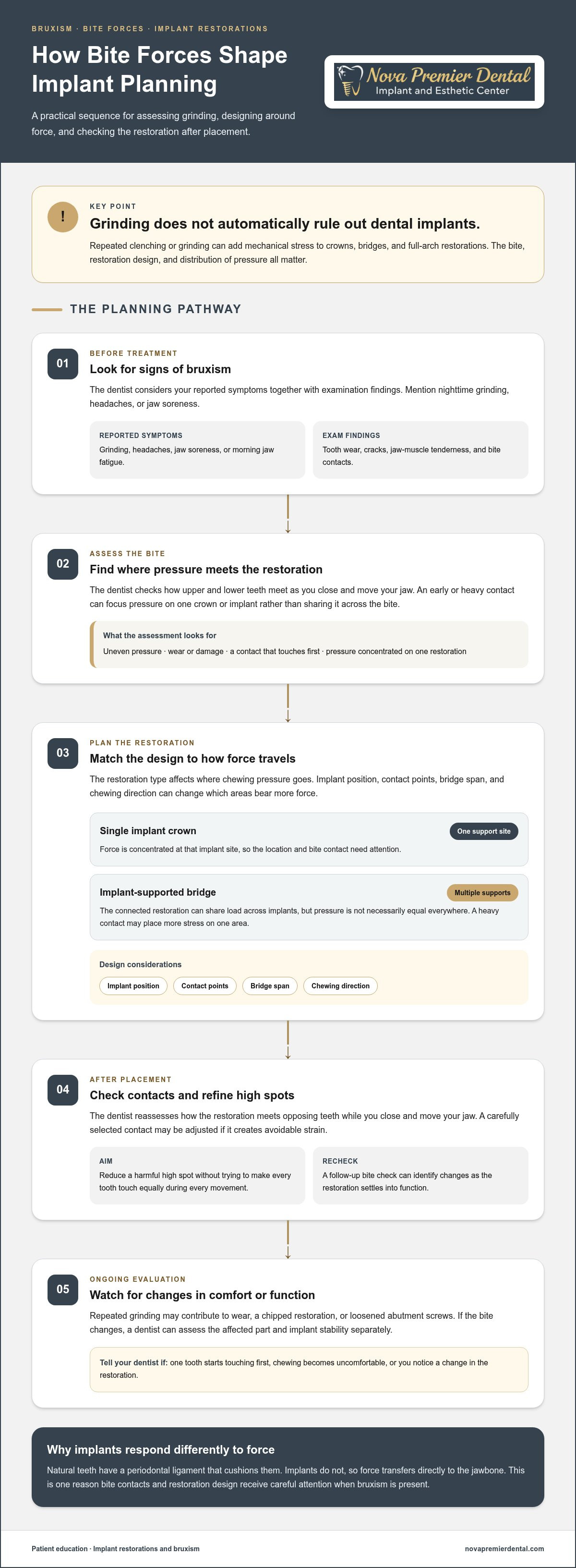
An occlusion assessment examines how your upper and lower teeth meet when you bite and chew. It matters because an early or heavy contact can focus pressure on one crown or implant instead of distributing it across your bite.
A dentist checks how your teeth contact as you close and move your jaw, looking for uneven pressure, wear, or damage. After placing a restoration, the dentist can repeat the assessment and refine any contact that could contribute to avoidable strain.
Bite Adjustment and Balanced Occlusion
Bite adjustment carefully reshapes selected contact points so opposing teeth meet more evenly. Balanced occlusion matters because concentrated pressure can overload a restoration or the supporting jawbone.
For example, if a new crown touches before neighboring teeth, a dentist can assess the contact and make a precise adjustment. The goal isn’t to make every tooth touch equally during every movement, but to remove a harmful high spot. A follow-up bite check can also identify changes as the restoration settles into function.
Force Tolerance of Teeth and Crowns
There is no single bite-force limit that applies to every natural tooth or dental crown. Tolerance depends on tooth condition, crown material and shape, contact location, and whether force is vertical or sideways.
Normal chewing puts roughly 20 to 40 pounds per square inch on a tooth. Teeth grinding can reach 200 to 300 pounds per square inch, but those figures don't define a safe threshold for an individual crown. Repeated clenching, a cracked underlying tooth, or a concentrated contact can affect how a restoration responds.
Bruxism Diagnosis Before Restorations
Dentists diagnose bruxism by combining your reported symptoms with examination findings. Before crown or implant treatment, they assess wear, cracks, jaw-muscle tenderness, bite contacts, and signs such as morning jaw fatigue.
Tell your dentist about nighttime grinding, headaches, or jaw soreness; these details help guide planning. A bruxism evaluation can inform decisions about bite design and a night guard. The clinician also considers whether clenching should be addressed before treatment, then reassesses occlusion after the restoration is placed.
Bite force distribution across single implants and bridges
A single implant supports one replacement tooth. An implant-supported bridge connects several replacement teeth across multiple implants. The design affects where chewing pressure travels, especially when you clench.
Load Distribution Across Implant Anchors
Load distribution describes how a restoration transfers biting pressure to its supporting implants. It matters because concentrated force can strain one implant more than the others.
For example, a bridge supported by multiple implants shares the load across those supports, unlike a single implant crown, where force is concentrated at one site. Sharing the load doesn’t make pressure identical everywhere. Implant position, bridge span, contact points, and chewing direction all affect which areas bear more force.
Planning takes into account which teeth are missing and where implants can support the restoration. If an implant sits beneath a heavy contact, it may bear disproportionate stress even as part of a connected bridge. The dentist considers the planned tooth positions alongside implant placement, rather than using the number of implants as the only design factor.
Balanced Pressure Across Implants
Balanced pressure means arranging contacts to avoid concentrating force on one implant or restoration segment. This matters because uneven loading may contribute to wear, loose components, or strain around a supporting implant.
After placement, the dentist checks how the bridge meets opposing teeth when you close and move your jaw. For instance, a high contact on one bridge tooth can direct pressure toward the nearest implant instead of distributing it across the supporting structure. Adjustments refine those contacts while preserving the restoration’s shape and function.
If you clench, regular follow-up can reveal changes in your bite or restoration. Report a new sensation that one tooth touches first, or discomfort when chewing, so the dentist can focus the examination. If you’re considering an implant-supported bridge, learning about fixed bridge treatment can help you understand your replacement options.
Pressure Problems: Can I Get Dental Implants with Bruxism?
Bruxism doesn’t automatically rule out dental implants, but repeated grinding can stress implant components and restorations. When planning treatment, the dentist considers your grinding pattern, bite, and restoration design.
Wear and Damage to Restorations
Bruxism-related wear is damage from repeated clenching or grinding against teeth or restorations. It matters because a chipped crown can change bite contacts and place new pressure on surrounding components.
Grinding can wear implant crowns, loosen abutment screws, or chip a restoration. Implants lack the periodontal ligament that cushions natural teeth, so force transfers directly to the jawbone. Damage isn’t inevitable: the dentist assesses the affected part and the implant’s stability separately.
Implant Design and Restorative Materials
Implant design and restorative materials affect how chewing forces reach the implant and surrounding tissues. The restoration’s shape, position, and contact points can concentrate or spread pressure.
For someone who grinds, treatment planning considers implant position, the number and location of supporting implants, and the restoration material. A custom night guard can protect restorations, but it doesn’t stop bruxism. It can be planned before treatment and made or adjusted after the final crown or prosthesis is placed, so it fits the completed bite.
Crown Longevity and Bruxism
Bruxism can increase crown wear and the risk of chips or cracks, but no fixed lifespan applies to every crown. The condition of the underlying tooth, the material, bite contacts, and maintenance all matter.
A night guard’s price depends on the case and is provided after a quote request. Coverage varies: some plans cover custom lab-made guards but not store-bought ones; plans may limit coverage to one every three to five years or include a waiting period.
Responding to Loose or Damaged Restorations
A loose, cracked, or painful crown or implant restoration needs a dental evaluation to identify the cause. Prompt assessment matters because chewing on a damaged restoration can make the problem worse.
Avoid chewing on that side, and don’t try to glue or tighten the restoration yourself. Contact your dentist and describe whether it moves, hurts when you chew, or has a visible chip. A bruxism assessment can help evaluate grinding and guide protective care alongside repair.
For more on bruxism and teeth grinding, including how it can affect restorative planning, explore the related clinical information.
Bite forces on full-arch implants
A full-arch implant restoration replaces a complete upper or lower row of teeth, connecting prosthetic teeth across several implants. In an All-on-4 design, four strategically placed implants support the arch. The number of implants is only one part of the plan; tooth position, restoration shape, and bite contacts all influence how force travels.
Treatment planning considers how implant supports relate to the replacement teeth and opposing bite. Back teeth experience stronger, more concentrated chewing forces. If the prosthesis extends beyond its last supporting implant, the cantilever can increase leverage on that extension. Clinicians assess its length, implant positions, available restorative space, and your grinding pattern when evaluating the design.
Natural teeth have a periodontal ligament that provides sensory feedback; implants don’t. Repeated clenching or side-to-side grinding can load the prosthesis and its components. Shape and contact patterns matter: an early contact on one back tooth, for example, can direct more pressure to that area instead of spreading it across the arch.
After placement, the dentist assesses comfort and function. A bite that suddenly feels uneven, soreness when chewing, or a chipped prosthetic tooth gives the dentist a specific change to investigate. These symptoms alone don’t establish implant failure. The clinician examines the restoration, bite contacts, and supporting tissues together to determine whether adjustment or repair is needed.
Patients considering full-arch implant treatment can discuss how their bite and restoration design affect load distribution. The main point is that multiple implants share support, but the distribution depends on the complete prosthetic design and how the teeth meet during function.
Nova Premier Dental: Dental Implants
Nova Premier Dental helps patients consider tooth replacement and restorative options when bruxism or missing teeth complicate treatment planning. In Falls Church, the practice serves patients across Northern Virginia, including McLean, Great Falls, Arlington, Fairfax, Tysons, and Annandale. Its prosthodontic care helps patients understand how implant position, bite, and restoration design inform treatment choices.
For patients considering dental implant treatment, Dr. Peterson Huang’s prosthodontic background is relevant to complex restorative planning; learn about Dr. Huang’s training and background. Contact Nova Premier Dental to discuss your options through the practice website.
Make Your Next Restoration Conversation More Specific
Understanding how teeth grinding affects crowns, how bruxism relates to implants, how bite forces influence design, and which prosthetic complications to watch for can help you take a more informed role in treatment planning. To prepare, note any morning jaw soreness, changes in how your teeth meet, or repairs to past restorations.
At your evaluation, bring those observations and ask how the proposed restoration will be assessed after placement, what signs should prompt follow-up, and whether a protective appliance belongs in your care plan. These questions keep the discussion focused on function and maintenance, not just the appearance of your new teeth. Your dentist can explain which considerations matter most in your situation and which options fit your goals.
For a thoughtful discussion of restorative care, contact Nova Premier Dental to discuss your options. A clear conversation is a practical place to begin.
Frequently Asked Questions
Can You Get Dental Implants If You Grind Your Teeth?
Possibly. Candidacy depends on more than whether you grind your teeth. An evaluation considers jawbone and surrounding tissue health, existing restorations, and the severity of grinding. If you actively clench, the treatment sequence may include protective measures before the final prosthesis is planned. Tell your dentist about daytime clenching, sleep-related grinding, and any previous crown or tooth fractures when discussing implant treatment.
What is Bruxism?
Bruxism is involuntary or habitual clenching or grinding that occurs during sleep, while awake, or both. It can have multiple contributing factors, so a dentist may ask about sleep patterns, medications, caffeine, and jaw symptoms rather than assume a single cause. Some people notice jaw fatigue; others learn about grinding when a partner hears it or an examination reveals signs.
How do I find out what my bite requires?
Tell your dentist what feels different and when it happens. Note whether discomfort follows waking, meals, or a particular movement, and bring any night guard you use. Previous dental records or details about repairs can also provide useful context. The dentist considers this history alongside an examination to discuss whether observation, adjustment, or restorative treatment is appropriate.
What bridge material is best if I grind my teeth?
Monolithic zirconia is commonly considered for bridges in patients with heavy grinding, but the best choice depends on the restoration’s design and clinical demands. The dentist weighs the span, available thickness, support, opposing teeth, and appearance. Material choice alone can’t address every mechanical concern, so the bridge must be planned as a complete restoration, not selected by strength alone.
What happens if I grind after getting implants?
Grinding may accelerate wear or contribute to technical problems, so keep scheduled implant-maintenance visits and report changes rather than waiting for a routine appointment. If you use a night guard, bring it to follow-up visits so the dentist can assess its fit against your current restoration. While a guard protects teeth and restorations from physical contact, addressing underlying tension through targeted exercise and medical training, such as through FitRevolution, can help manage overall muscular strain and stress.
What is the cantilever effect and why does it matter for grinders?
A cantilever is the part of a bridge that projects beyond its supporting implant or tooth. For example, a replacement back tooth extending past the last implant can act as a lever during chewing. Repeated grinding may increase the mechanical demand on the extension and its support, so its length and position matter when assessing the bridge design.
Disclaimer
The information provided on this website and blog is intended for general educational and informational purposes only and should not be considered dental or medical advice, diagnosis, or treatment. Reading content on this website does not establish a doctor-patient relationship with Nova Premier Dental or Dr. Peterson Huang. Dental conditions and treatment needs vary from patient to patient. Individuals should consult directly with a qualified dental professional for personalized evaluation, diagnosis, and treatment recommendations. Do not delay seeking professional dental care based on information found on this website. While we strive to provide accurate and up-to-date information, no guarantee is made regarding the completeness, accuracy, or applicability of the content. Treatment outcomes may vary depending on individual circumstances. If you are experiencing a dental emergency or urgent oral health concern, please contact a licensed dental professional immediately or call 911 in the event of a medical emergency.


