

Article by
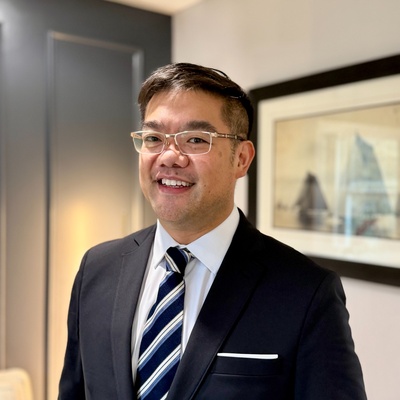
Peterson Huang DMD, MS, FACP, FRCDC
Dr. Peterson Huang is a dual board-certified prosthodontist serving Falls Church and Northern Virginia. He has been recognized as a Top Prosthodontist by Northern Virginia Magazine and Arlington Magazine and is affiliated with the Inova Fairfax Hospital Tumor Board. Dr. Huang focuses on dental implants, full mouth reconstruction, and complex restorative dentistry for patients who need advanced, comprehensive care.
Living with complete tooth loss or ill-fitting conventional dentures presents profound challenges to mastication, speech articulation, and self-confidence. For patients evaluating long-term restorative options, implant supported dentures in Virginia represent an established prosthodontic approach to restoring function and stabilizing the dental arches. Unlike traditional prostheses that rest solely on the mucosal tissue of the alveolar ridge, implant-retained and implant-supported systems utilize biocompatible titanium posts integrated directly into the jawbone. This mechanical anchorage transforms the mechanics of a denture from a friction-dependent appliance into a secure, physiologically integrated restoration.
At Nova Premier Dental, located in Falls Church, complex dental rehabilitation is approached through comprehensive diagnostics and prosthodontic principles. Led by dual board-certified prosthodontist Dr. Peterson Huang, our practice focuses on restoring optimal masticatory efficiency, facial support, and occlusal balance for patients across Northern Virginia. Understanding how these systems function, the clinical science behind bone preservation, and the distinctions between removable and fixed designs enables patients to make informed decisions regarding their oral health.
What Are Implant-Supported Dentures? A Specialized Prosthodontic View
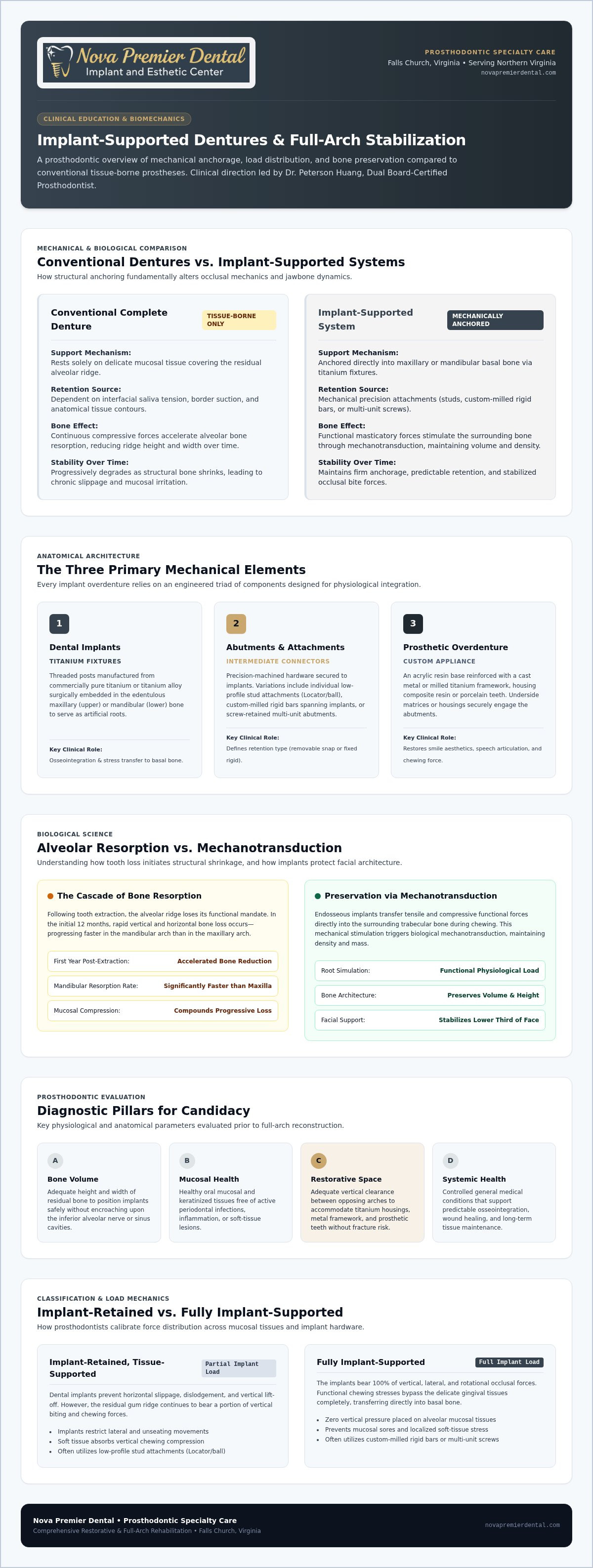
In clinical prosthodontics, an implant-supported denture—frequently classified as an overdenture—is a dental prosthesis that receives its retention, stability, and support either partially or entirely from dental implants. Conventional complete dentures rely strictly on suction, saliva interfacial surface tension, and the contours of the underlying residual alveolar ridge for retention. Over time, physical resorption of the ridge reduces this surface contact, leading to chronic slippage, mucosal irritation, and compromised chewing mechanics.
In contrast, an implant-supported system transfers functional occlusal loads away from delicate gum tissue and distributes them directly into the underlying basal bone. A prosthodontist evaluates whether a patient requires an implant-retained, tissue-supported overdenture (where implants prevent horizontal and upward movement, but the gums still absorb vertical chewing forces) or a fully implant-supported prosthesis (where the implants bear all vertical and lateral forces). Establishing the correct load distribution prevents mechanical failure of the hardware and minimizes local stress concentrations within the surrounding bone.
The Components of an Implant-Supported System
An implant-retained or supported restoration consists of three primary mechanical elements:
- The Dental Implants: Threaded fixtures, typically manufactured from commercially pure titanium or titanium alloy, surgically placed within the edentulous maxillary (upper) or mandibular (lower) bone to serve as artificial roots.
- The Abutments and Attachments: Precision-machined intermediate components that screw directly into the implants. Depending on the planned prosthesis, these may consist of individual low-profile stud attachments (such as Locator or ball attachments), a custom-milled rigid metal bar spanning the implants, or multi-unit abutments engineered for screw retention.
- The Prosthetic Overdenture: A custom-fabricated appliance composed of an acrylic resin base reinforced with a cast metal or milled titanium framework, housing prosthetic teeth made of composite resin or porcelain. The underside of the base houses receptive housings or matrices that securely engage the abutments.
Evaluating Candidacy: Anatomical and Restorative Factors
Determining whether a patient is a candidate for full-arch implant stabilization requires a thorough examination of both systemic and localized oral health factors. Favorable candidates typically present with:
- Adequate residual bone volume (height and width) to accommodate implants without impinging on critical anatomic structures, such as the inferior alveolar nerve in the mandible or the maxillary sinus cavities.
- Healthy oral mucosal tissues free of active periodontal infections or mucosal lesions.
- Sufficient interarch restorative space—the vertical distance between the opposing dental arch and the soft tissue—allowing enough room for the implant components, structural framework, and denture teeth without making the prosthetic overly thick or prone to fracture.
- Manageable systemic health, with controlled conditions that do not significantly impair bone healing or osseointegration.
Patients currently experiencing instability with existing appliances may review our clinical guide on fixing loose dentures to understand how anatomical ridge changes directly influence prosthetic fit.
Clinical Benefits: Stability, Occlusion, and Jawbone Preservation
The clinical rationale for transition to an implant-supported system extends well beyond eliminating denture adhesives. While improved retention enhances daily comfort, the primary biological and structural benefits involve force distribution and the mitigation of ongoing structural bone loss.
The Science of Bone Preservation and Alveolar Resorption
When natural teeth are extracted, the alveolar bone that once supported the tooth roots loses its primary physiological role. Alveolar bone resorption is the biological process where the jawbone shrinks and diminishes in density due to the absence of mechanical stimulation. In the first year following complete extraction, significant horizontal and vertical bone reduction occurs, accelerating more rapidly in the mandible than in the maxilla.
Conventional dentures accelerate this resorptive pattern by placing continuous compressive forces on the mucosal surface of the ridge. Conversely, endosseous dental implants mimic natural roots. When masticatory loads are applied, the implants transfer tensile and compressive strains to the surrounding trabecular bone through a process known as mechanotransduction. This physiological stimulation helps maintain bone volume and density over time, stabilizing the structural foundation of the lower third of the face.
Occlusal Stability and Functional Chewing Capacity
Conventional full lower dentures often provide only a fraction of the maximum bite force generated by natural dentition. This physiological limitation forces individuals to alter their dietary choices, often eliminating high-fiber vegetables, lean meats, and nutritious dense foods. By anchoring the prosthesis directly to bone, an overdenture significantly elevates maximal bite force and restores chewing efficiency, while eliminating the painful shear forces and recurring sore spots typical of shifting tissue-borne bases.
Prosthetic Design and Aesthetic Balance
Severe tooth loss is frequently accompanied by a loss of vertical dimension of occlusion (the measured height of the face when the teeth are fully closed together). When the bite collapses, the lips lose their internal support, the corners of the mouth turn downward, and nasolabial folds deepen. During specialized prosthodontic care in Northern Virginia, prostheses are meticulously calibrated to restore proper vertical dimension, re-establish lip fullness, and ensure that tooth display during speech and smiling harmonizes naturally with the patient's individual facial proportions.
The Clinical Process: Diagnostic Planning and Treatment Sequencing
A successful prosthodontic outcome depends upon precise backward planning. In modern prosthodontics, the ideal position of the finished teeth dictates where the implants must be placed, rather than simply inserting implants wherever bone is easiest to find. This prosthetically driven approach ensures optimal aesthetics, cleanability, and structural longevity.
- Comprehensive Diagnostic Evaluation: The clinical evaluation begins with diagnostic impressions, a thorough occlusal examination, and high-resolution three-dimensional Cone Beam Computed Tomography (CBCT). The CBCT scan allows precise assessment of bone density, cortical thickness, and vital anatomical structures in three dimensions.
- Virtual Implant Planning and Surgical Guides: Utilizing specialized software, the digital representation of the patient's future denture is merged with the CBCT volume. Implants are positioned digitally with exact angulation and depth relative to the planned prosthetic housings. A computer-generated surgical guide is then created to transfer this virtual plan directly to the surgical site, minimizing surgical duration and reducing procedural morbidity.
- Surgical Placement of Dental Implants: The fixtures are placed into the bone under sterile conditions with local anesthesia. In cases presenting with deficient bone dimensions, site development procedures such as ridge preservation, guided bone regeneration, or sinus floor elevation may be sequenced concurrently or prior to fixture placement.
- Osseointegration and Soft Tissue Maturation: A healing period—typically spanning three to six months—allows the bone cells to physically bond to the micro-textured titanium surface (osseointegration). During this interval, patients wear a carefully adjusted transitional denture that protects the healing implants from excessive, premature loading.
- Prosthetic Design, Try-In, and Final Delivery: Following successful osseointegration, precision transfer impressions capture the exact spatial positions of the implants. A verified master cast is fabricated, upon which the prosthodontist tests tooth arrangements in wax to confirm occlusion, phonetic articulation, and facial aesthetics. Once verified, the final prosthesis is processed, polished, delivered, and adjusted for balanced occlusion.
Comparing Overdenture Configurations: Removable Snap-On vs. Fixed Solutions
Selecting the optimal implant restorative design involves weighing anatomical bone availability, hygiene access, aesthetic goals, and budgetary considerations. The two primary categories utilized in complex reconstruction are removable overdentures and completely fixed full-arch bridges.
| Feature | Stud-Retained (Snap-On) | Bar-Retained Overdenture | Fixed Full-Arch (Screw-Retained) |
|---|---|---|---|
| Implants Required | 2 to 4 (typically mandible) | 4 or more per arch | 4 to 6 or more per arch |
| Removal for Hygiene | Removed daily by patient | Removed daily by patient | Removed only by clinician |
| Tissue Support | Implant-retained, tissue-borne | Implant and bar supported | Entirely implant-supported |
| Palate Coverage (Maxilla) | Usually requires partial palate | Often horse-shoe (palateless) | Completely open palate |
| Maintenance Requirements | Periodic nylon cap replacement | Clip replacement, bar checks | Professional cleaning, screw checks |
Stud-Retained (Snap-On) Overdentures
Often considered an effective, baseline standard of care for an unstable lower arch, a snap-on denture utilizes independent locator-style abutments anchored to two to four implants. The prosthesis snaps securely onto these attachments via retentive nylon caps housed in the denture base. This system dramatically reduces movement during chewing while remaining easy to remove, brush, and maintain. Over time, the internal retentive nylon inserts experience routine wear and require simple replacement during routine recall visits.
Bar-Retained Overdentures
When additional structural rigidity is required—particularly in the upper jaw or in patients with irregular ridge anatomy—a custom metal splinting bar is fabricated to physically connect four or more implants. The removable overdenture clips firmly over this bar using internal retention clips or complementary attachments. This configuration offers superior cross-arch stability and eliminates nearly all rocking motions, making it an excellent choice for individuals who want maximum stability but still prefer the ease of removing their appliance for daily cleaning.
Fixed Full-Arch Prostheses
For individuals who desire teeth that remain rigidly anchored in the mouth at all times, a screw-retained solution such as an All-on-4 permanent denture or zirconia hybrid bridge may be indicated. These restorations do not snap on and off; they are fastened securely into multi-unit abutments with prosthetic screws and are only removed by a prosthodontist during comprehensive annual examinations. Fixed prostheses feel and function most like natural teeth, though they require meticulous oral hygiene underneath the bridge using floss threaders, interdental brushes, and oral irrigators.
To learn more about the broader array of full-mouth prosthetic options, explore our comprehensive services for complete and partial dentures.
Treatment Value and In-House Payment Considerations
Rehabilitating an entire dental arch with implant-supported prosthetics is a significant healthcare investment that reflects complex surgical planning, advanced materials, and custom laboratory fabrication. Because overall costs depend on the number of implants, necessity of bone grafting, and material choice (acrylic vs. high-strength monolithic zirconia), treatment plans are customized to clinical needs rather than generalized solutions.
Transparent discussion of financial planning is an essential part of the diagnostic phase. Nova Premier Dental offers in-house payment plans for qualifying patients, allowing treatment costs to be paid over several months while patients enjoy their new smile. Establishing these arrangements directly with our practice ensures that patients can sequence their care predictably without relying on external corporate financing programs.
The Role of a Dual Board-Certified Prosthodontist in Full-Arch Reconstruction
Prosthodontics is one of the specialized dental disciplines recognized by the American Dental Association, requiring three additional years of intensive residency training beyond standard dental school. Dual board certification represents an advanced level of professional credentialing, involving rigorous written and clinical case examinations administered by specialty boards.
While many dental providers place or restore implants, complex full-arch reconstructions involve technical challenges that benefit directly from specialty prosthodontic training:
- Managing Compromised Restorative Space: Incorrectly diagnosing vertical dimension can result in prosthetic teeth shearing off, fractured frameworks, or speech pathology. A prosthodontist precisely engineers the prosthetic envelope before surgery ever begins.
- Compensating for Severe Bone Angulations: Bone resorption rarely occurs in a perfectly symmetrical pattern. Placing implants in compromised ridges often requires angling fixtures and selecting specialized corrective abutments to ensure prosthetic screw channels emerge in aesthetically and functionally sound locations.
- Managing Occlusal Force and Bruxism: Patients with a history of severe clenching or grinding generate significant mechanical stresses that can loosen retention screws or cause component fatigue. Prosthodontists balance the bite using specific occlusal schemes (such as mutually protected or lingualized occlusion) that protect the implants from destructive lateral forces.
Whether navigating complex anatomic resorption or managing restorative failures from previous treatment, specialized care ensures that each component of the reconstruction works together harmoniously.
Maintaining Your Implant-Supported Restoration
Although dental implants cannot develop decay, they remain vulnerable to biological complications if plaque bacteria accumulate around their cervical margins. Peri-implant mucositis involves localized inflammation of the soft tissues surrounding an implant, comparable to gingivitis. If left unmanaged, it can progress to peri-implantitis, characterized by progressive marginal bone loss around the implant threads that threatens the stability of the fixture.
Long-term maintenance protocols for an implant-supported overdenture include:
- Daily Prosthetic Cleansing: Removable overdentures should be detached twice daily and cleaned thoroughly with an overdenture brush and a non-abrasive cleanser. Standard abrasive toothpastes should be avoided, as they scratch acrylic surfaces and encourage microscopic bacterial colonization.
- Hygiene Around Abutments: The locator studs or splinting bars emerging from the gum tissue must be cleaned with soft-bristled brushes, specialized interproximal brushes, or cleaning gauze to prevent calculus buildup around the abutment margins.
- Routine Professional Maintenance: Patients should attend professional prophylaxis appointments at intervals recommended by their prosthodontist (typically every three to six months). These visits allow clinicians to evaluate soft tissue health, verify torque on retaining screws, inspect mucosal matrices, replace worn retentive nylon inserts, and track bone levels via diagnostic radiographs.
Frequently Asked Questions
How long do implant-supported dentures typically last?
The titanium implants integrated within the bone are designed to be long-term, stable fixtures when maintained through diligent hygiene and routine check-ups. The prosthetic overdenture, however, is subject to mechanical wear from daily chewing. Acrylic teeth and bases typically require relining, adjustment, or replacement every 5 to 10 years, and the small nylon attachment caps inside snap-on dentures are usually changed every 12 to 18 months during standard recall visits.
Is the surgical placement of dental implants painful?
Implant placement is performed under profound local anesthesia, ensuring that patients remain comfortable throughout the procedure. Post-operative discomfort is generally mild to moderate and is typically managed effectively with over-the-counter anti-inflammatory analgesics or mild prescription medications for a few days following surgery. Many patients report that implant placement involves less post-operative tenderness than a routine tooth extraction.
Can my current conventional denture be converted into an implant denture?
In select cases where an existing conventional denture is structurally sound, exhibits proper vertical dimension, and possesses well-aligned teeth, it can be retrofitted temporarily to connect to newly placed implants. However, because older dentures may exhibit tooth wear or structural fatigue, most patients benefit from fabricating a purpose-built overdenture engineered with internal metal reinforcement specifically designed to handle dynamic implant forces.
How many implants are required to hold a full denture securely?
The number of implants required depends upon the specific arch and the prosthetic design. In the lower jaw (mandible), where bone is typically dense, a snap-on overdenture can function reliably on as few as two implants, though three or four provide enhanced stability. In the upper jaw (maxilla), bone is softer and less dense; therefore, a minimum of four implants—and frequently six—is recommended to support an overdenture or allow for a palate-free horseshoe design.
Can I wear my implant-supported denture while sleeping?
For removable snap-on or bar-retained overdentures, it is strongly recommended to remove the appliance overnight. Leaving the prosthesis out allows the oral mucosal tissues to rest, promotes normal salivary flow across the palate and ridge, and prevents micro-vascular compression. It also helps prevent accidental damage caused by nocturnal clenching or bruxism. Fixed, screw-retained bridges remain in place continuously, but patients should wear a custom night guard if they tend to grind their teeth at night.
Schedule a Prosthodontic Evaluation in Falls Church
Restoring a complete arch of teeth requires a careful balance between biological health, surgical precision, and mechanical engineering. If you are experiencing difficulty with loose conventional dentures or are facing complete tooth loss, specialized diagnostics can help identify the most appropriate restorative pathway for your specific anatomy and lifestyle.
Nova Premier Dental in Falls Church provides comprehensive prosthodontic specialty care for patients throughout Northern Virginia, including McLean, Arlington, Vienna, and Great Falls. To schedule a comprehensive consultation and learn more about stable implant-supported restorations, contact our office today to take the next step toward a secure, functional smile.
Disclaimer
The information provided on this website and blog is intended for general educational and informational purposes only and should not be considered dental or medical advice, diagnosis, or treatment. Reading content on this website does not establish a doctor-patient relationship with Nova Premier Dental or Dr. Peterson Huang. Dental conditions and treatment needs vary from patient to patient. Individuals should consult directly with a qualified dental professional for personalized evaluation, diagnosis, and treatment recommendations. Do not delay seeking professional dental care based on information found on this website. While we strive to provide accurate and up-to-date information, no guarantee is made regarding the completeness, accuracy, or applicability of the content. Treatment outcomes may vary depending on individual circumstances. If you are experiencing a dental emergency or urgent oral health concern, please contact a licensed dental professional immediately or call 911 in the event of a medical emergency.


