


Article by
Peterson Huang DMD, MS, FACP, FRCDC
Dr. Peterson Huang is a dual board-certified prosthodontist serving Falls Church and Northern Virginia. He has been recognized as a Top Prosthodontist by Northern Virginia Magazine and Arlington Magazine and is affiliated with the Inova Fairfax Hospital Tumor Board. Dr. Huang focuses on dental implants, full mouth reconstruction, and complex restorative dentistry for patients who need advanced, comprehensive care.
Missing teeth can compromise normal chewing, alter speech, and lead to shifting of adjacent teeth. When considering tooth replacement options, patients seeking dental implants in Falls Church often have questions about how implants work, who is a candidate, what the process entails, and how specialists plan complex restorations. Understanding the biological mechanisms, surgical-restorative workflow, and clinical tradeoffs allows you to make an informed decision about your long-term oral health.
Understanding Dental Implants: More Than Just a Tooth Replacement
A Dental implant is a biocompatible prosthetic replacement for a missing natural tooth root. Unlike traditional tooth-replacement methods that rest on the surface of the gums or rely on adjacent teeth for support, a dental implant integrates directly into the jawbone. This biological integration provides a stable foundation for a replacement tooth, bridge, or full-arch prosthesis.
When a natural tooth is extracted or lost to trauma or periodontal disease, the alveolar bone—the portion of the jawbone that surrounds and supports tooth roots—no longer receives functional stimulation from chewing forces. Over time, the body resorbs this unused bone tissue, which can reduce ridge height and width and eventually influence facial soft-tissue support. Dental implants transfer functional occlusal loads into the bone, which helps maintain alveolar ridge volume in the treated area.
Osseointegration is the direct structural and functional connection between living bone tissue and the surface of a load-bearing artificial implant, providing stable anchorage without intervening soft tissue. First documented in modern clinical literature by Swedish orthopedist Per-Ingvar Brånemark, this biological process forms the clinical foundation for all modern implant dentistry.
The Anatomy of a Modern Dental Implant
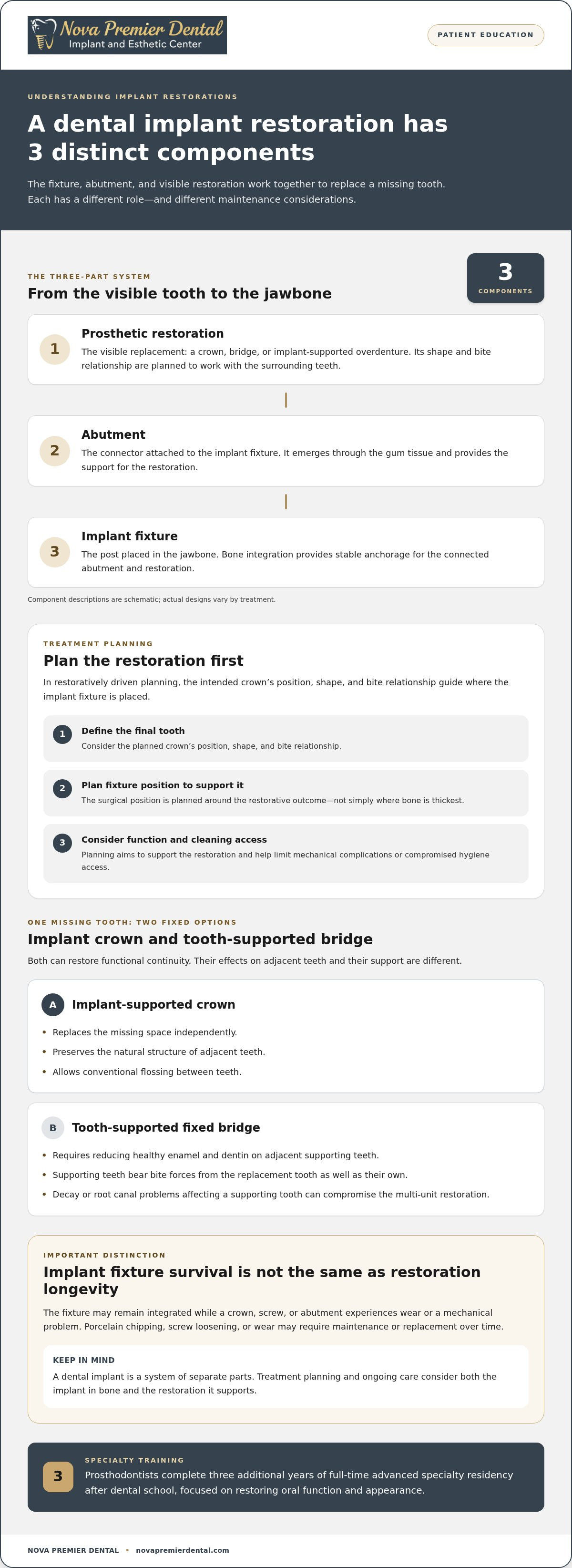
A complete dental implant restoration consists of three distinct components, each serving a specific mechanical and biological purpose:
- The Implant Fixture (Post): Typically manufactured from commercially pure titanium or titanium alloy (and in select cases, zirconia ceramic), the fixture is surgically positioned within the jawbone. Its threaded, microscopically textured surface is engineered to facilitate bone cell attachment during the osseointegration period.
- The Abutment: The connector component that attaches securely to the internal chamber of the implant fixture. The abutment emerges through the gum tissue and serves as the structural core onto which the visible dental crown, bridge, or denture is anchored. Abutments can be prefabricated (stock) or custom-milled to establish a natural emergence profile through the gingival margin.
- The Prosthetic Restoration: The visible portion of the tooth replacement, such as a custom ceramic crown, fixed bridge, or implant-supported overdenture. Crafted from materials such as monolithic zirconia or lithium disilicate porcelain, the restoration is engineered to match the shade, contour, and bite relationships (occlusion) of the surrounding dentition.
Comparing Dental Implants and Tooth-Supported Fixed Bridges
Patients with a single missing tooth are frequently presented with two primary fixed options: a dental implant or a tooth-supported fixed partial denture (commonly called a dental bridge). Both approaches restore functional continuity, but their clinical tradeoffs differ significantly.
A traditional dental bridge requires the reduction (shaving down) of healthy enamel and dentin on the teeth adjacent to the gap, known as abutment teeth. These teeth must bear the functional bite forces of the missing tooth in addition to their own. If an abutment tooth subsequently develops recurrent decay or root canal pathology beneath a bridge retainer, the entire multi-unit restoration is compromised. In contrast, an implant-supported crown restores the missing space independently, preserving the natural structural integrity of adjacent teeth and allowing conventional dental flossing between teeth.
From a longevity perspective, peer-reviewed clinical studies demonstrate that dental implant fixtures exhibit high survival rates over 10 to 15 years. However, clinical distinction must always be made between the survival of the titanium implant fixture in bone and the longevity of the mechanical prosthetic components (crowns, screws, and abutments). While the implant fixture may remain stably integrated indefinitely, prosthetic crowns may experience porcelain chipping, screw loosening, or wear over time, requiring periodic maintenance or replacement.
The Role of Prosthodontic Training in Dental Implant Treatment
While many dental professionals place or restore implants, prosthodontists receive specialized education specifically dedicated to diagnosis, treatment planning, rehabilitation, and maintenance of oral function and appearance. Recognized by the American Dental Association as one of the dental specialties, prosthodontics focuses on complex restorative cases involving missing teeth and deficient oral tissues.
In comprehensive implant dentistry, a prosthodontist operates with a "restoratively driven" treatment philosophy. Rather than placing an implant solely where bone happens to be thickest, the prosthodontist first determines the ideal three-dimensional position, shape, and bite relationship of the final crown. The surgical position of the implant fixture is then planned precisely to support that prosthetic outcome, minimizing mechanical complications such as screw loosening, porcelain fracture, or compromised hygiene access.
Prosthodontist vs. General Dentist: Understanding Specialty Training
General dentists provide foundational preventive, diagnostic, and restorative dental care, including exams, restorations, and often uncomplicated single-tooth replacements. They play a vital frontline role in maintaining patient oral health and may perform implant procedures based on elective continuing education courses.
A prosthodontist completes dental school followed by three additional years of rigorous, full-time advanced specialty residency accredited by the Commission on Dental Accreditation (CODA). This specialty training encompasses advanced surgical and restorative concepts, bone biology, head and neck anatomy, biomaterials science, and complex occlusion. Prosthodontists frequently manage multifaceted clinical situations, including:
- Severe jawbone resorption requiring coordinated bone grafting or specialized implant configurations;
- Full-arch reconstructions and complex vertical dimension loss;
- Extensive dental wear caused by severe bruxism (parafunctional grinding and clenching);
- Maxillofacial defects resulting from trauma or surgical treatment of oral malignancies;
- Revision of compromised or failing restorations from previous treatments.
Board Certification in Prosthodontics
Board certification represents a voluntary commitment to rigorous peer review and continuous professional examination beyond formal specialty residency. In the United States, certification is awarded by the American Board of Prosthodontics (ABP); in Canada, by the Royal College of Dentists of Canada (RCDC).
At Nova Premier Dental, care is led by Dr. Peterson Huang, DMD, MS, FACP, FRCDC. Dr. Huang completed his specialty training in prosthodontics and holds dual board certification through both the American Board of Prosthodontics and the Royal College of Dentists of Canada. To learn more about his background, hospital affiliations, and prosthodontic education, visit our page on Dr. Peterson Huang's credentials and clinical background.
The Implant Journey: Precision Planning and Restoration
Successful implant therapy relies on systematic planning and execution across clear clinical phases. Moving deliberately through diagnostics, surgery, healing, and prosthetic fabrication minimizes risks and supports healthy long-term function.
- Diagnostic Evaluation and 3D Imaging: Comprehensive clinical examination combined with high-resolution Cone Beam Computed Tomography (CBCT) imaging and digital intraoral scans.
- Virtual Surgical Planning: Digital alignment of bone volume, nerve anatomy, and planned crown position to design computer-generated surgical guides.
- Surgical Implant Placement: Atraumatic insertion of the titanium implant fixture into the alveolar bone, accompanied by bone augmentation if localized deficiencies exist.
- Osseointegration and Healing: A biological rest period typically ranging from 3 to 6 months, allowing stable bone remodeling around the implant surface.
- Soft Tissue Maturation and Impression: Verification of osseointegration, placement of a healing abutment to sculpt the gingival cuff, and high-precision digital or elastomeric impressions.
- Prosthetic Delivery: Torquing of the final abutment to manufacturer-specified mechanical standards, followed by the delivery and occlusal verification of the custom restoration.
Diagnostic Imaging and Restorative-Driven Planning
Modern implant treatment relies heavily on three-dimensional Cone Beam Computed Tomography (CBCT). Traditional two-dimensional dental radiographs provide limited height information and fail to reveal bone thickness, ridge topography, or precise proximity to critical anatomical structures such as the inferior alveolar nerve in the lower jaw or the maxillary sinus cavity in the upper jaw.
By pairing 3D radiographic scans with digital optical impressions, the prosthodontist can evaluate restorative space, crown height space, and angulation before making an incision. Using computer-aided design and computer-aided manufacturing (CAD/CAM), a custom surgical template can be fabricated. To understand why three-dimensional alignment directly dictates restorative longevity, read our detailed analysis on why implant position matters. In cases with deficient bone volume, guided bone regeneration (bone grafting) or sinus augmentation may be performed prior to or concurrently with implant placement to establish a sound foundation.
Healing, Recovery, and Long-Term Maintenance
Post-surgical recovery following single-implant placement is typically manageable with mild analgesics such as ibuprofen or acetaminophen. Most patients return to routine non-strenuous activities within 24 to 48 hours. During the initial recovery window, soft dietary modifications protect the surgical site from direct mechanical trauma.
Although dental implants cannot develop dental caries (cavities), they remain vulnerable to biological complications caused by bacterial biofilm accumulation. The most common inflammatory conditions affecting implants are:
- Peri-implant Mucositis: A reversible inflammatory condition confined to the soft gum tissues surrounding the implant, characterized by redness, swelling, and bleeding upon probing, without loss of supporting bone.
- Peri-implantitis: A more severe condition in which bacterial inflammation extends deeper, resulting in progressive loss of the supporting alveolar bone around the fixture. If unmanaged, peri-implantitis can lead to implant mobility and eventual failure.
Prognostic studies show that systematic maintenance—including twice-daily home oral hygiene, interdental cleaning aids, and professional hygiene evaluations every three to six months—is crucial to preventing peri-implant disease. Review our clinical guidelines on common causes of implant restoration failure to understand how risk factors like smoking, uncontrolled diabetes, and parafunctional grinding affect long-term outcomes.
Evaluating the Cost and Longevity of Implants in Northern Virginia
The total investment for implant treatment reflects surgical complexity, anatomical requirements, diagnostic imaging, and laboratory fabrication costs. Rather than viewing an implant as an isolated commodity, patients should recognize that fees correspond directly to the customized medical and restorative care required for their individual anatomy.
| Clinical Phase | Key Cost Factors | Clinical Purpose |
|---|---|---|
| Diagnostics & Planning | CBCT 3D scans, digital scans, surgical guides | Identifies anatomy, prevents nerve injury, ensures ideal prosthetic angle |
| Site Preparation | Atraumatic extraction, bone graft, sinus lift | Builds adequate vertical and horizontal bone volume for integration |
| Surgical Placement | Implant fixture type, surgical protocol | Establishes biocompatible titanium-to-bone contact |
| Restorative Phase | Custom vs. stock abutment, ceramic crown, lab fees | Restores chewing function, bite alignment, and natural aesthetics |
Materials and Restorative Components
The materials selected for both the internal components and the external crown substantially influence durability and tissue response. Stock abutments are mass-produced in standardized cylindrical shapes; while cost-effective, they often fail to support the natural scalloped contour of the gum tissue. Custom CAD/CAM abutments are individually designed to mimic the cross-sectional shape of a natural tooth root, supporting healthy soft tissue margins and preventing excess dental cement from being forced below the gumline.
For the visible restoration, high-strength restorative ceramics such as monolithic zirconia provide high fracture toughness, making them well-suited for posterior molar areas where chewing forces are greatest. Layered lithium disilicate or feldspathic ceramics offer greater optical translucency and are commonly selected for anterior restorations where aesthetic blending with natural adjacent teeth is the primary consideration.
Navigating Insurance and In-House Payment Options
Dental insurance plans vary widely in their coverage of implant therapy. Some policies provide partial benefits for specific stages—such as diagnostic radiographs, tooth extractions, or the final crown restoration—while excluding surgical placement of the fixture. Our administrative team assists patients by reviewing policy terms, identifying covered benefits, and submitting pre-treatment estimates.
To help patients manage treatment investments over time, Nova Premier Dental offers in-house payment plans for qualifying patients, allowing treatment costs to be paid over several months while patients enjoy their new smile. Financial arrangements are reviewed transparently during the consultation phase so that clinical decisions can be made without administrative confusion.
Prosthodontic Dental Implant Care in Falls Church
Nova Premier Dental is a private prosthodontic specialty dental office in Falls Church serving Northern Virginia. The clinical focus of our practice centers on comprehensive diagnosis, treatment sequencing, and reconstructive therapy for individuals with complex dental needs.
Because implant dentistry requires harmony between biological tissues and dental engineering, choosing a practice that focuses on restorative prosthodontics provides structured coordination for challenging conditions. If you are exploring comprehensive tooth replacement options throughout the region, consult our guide to prosthodontic care in Northern Virginia to understand how specialty restorative planning supports lasting functional stability.
Serving Falls Church and the Northern Virginia Community
Our office regularly collaborates with referring general dentists, periodontists, and oral and maxillofacial surgeons across Northern Virginia, including Arlington, McLean, Tysons, and Fairfax. In addition to treating routine single-tooth replacements, Dr. Huang contributes prosthodontic expertise to multidisciplinary teams, including participation with regional hospital tumor boards regarding post-resection oral cancer reconstruction and maxillofacial prosthetic rehabilitation.
Patients who present with compromised dentition, failing bridges, severe bite collapse, or previous implant complications benefit from a diagnostic approach that evaluates the whole masticatory system rather than treating isolated teeth in isolation.
Consultation and Evaluation Process
During an initial prosthodontic evaluation at our Falls Church practice, you can expect an unhurried, evidence-based review of your oral health, including:
- Detailed review of medical history, including medications (such as antiresorptive agents) and systemic conditions that influence bone healing;
- Comprehensive periodontal, occlusal, and radiographic examination;
- Assessment of restorative space, lip support, and dynamic smile lines;
- Discussion of all viable alternatives, including tooth preservation, removable prosthetics, or tooth-supported fixed options;
- A written, sequenced treatment outline delineating clinical stages and anticipated fees.
Whether you require the replacement of an individual missing tooth or are navigating full-mouth reconstruction, you can learn more about our comprehensive restorative approaches by reviewing our clinical overview of dental implant services.
Frequently Asked Questions
How long do dental implants last?
Modern clinical studies indicate that dental implant fixtures that successfully osseointegrate exhibit high survival rates over 10 to 20 years when maintained properly. However, patients should distinguish between the fixture in the jawbone and the overlying crown or prosthesis. Mechanical components—such as ceramic crowns, retaining screws, and abutments—undergo daily biting forces and may require maintenance, repair, or replacement over a 10- to 15-year period.
Is the dental implant procedure painful?
Implant placement is routinely performed under local anesthesia, numbing the bone and surrounding gum tissues completely during surgery. Bone tissue itself contains minimal sensory nerve endings. Post-operatively, most patients report mild to moderate soreness and minor swelling lasting two to five days, which is typically managed effectively with over-the-counter pain medications and prescribed anti-inflammatory protocols.
Am I a good candidate for dental implants if I have experienced bone loss?
Jawbone resorption does not automatically disqualify you from receiving implants. While adequate bone volume is necessary to stabilize the fixture, modern bone augmentation procedures—such as ridge preservation, guided bone regeneration, and sinus floor elevation—can often rebuild deficient areas prior to or during implant placement. A 3D CBCT scan is essential to assess whether bone grafting is necessary.
What is the difference between a general dentist and a prosthodontist for implants?
General dentists provide broad preventive, restorative, and routine dental treatments for everyday oral health. Prosthodontists complete three additional years of accredited full-time residency training after dental school, focusing specifically on complex tooth replacement, occlusion, dental materials science, and full-mouth rehabilitation. While general dentists can perform implant procedures, prosthodontists are frequently consulted for complex restorative cases, patients with severe bone loss, or comprehensive rehabilitations.
How many appointments are required for a dental implant?
The number of appointments varies based on whether bone grafting or extractions are required. A standard single-implant process typically involves: (1) an initial consultation and 3D imaging, (2) surgical fixture placement, (3) a post-operative check, (4) verification of osseointegration and digital impression after a 3- to 6-month healing window, and (5) final crown delivery and occlusal check. More complex reconstructions require additional diagnostic and prototype evaluation appointments.
Can dental implants be completed in a single day?
The concept of "teeth in a day" (immediate loading) involves placing an implant and attaching a temporary, non-functional acrylic tooth or provisional arch on the same day. However, this is only clinically appropriate when the patient meets strict criteria, including high primary surgical stability and absence of active infection. Even with immediate temporization, true biological osseointegration still requires 3 to 6 months of healing before the final definitive restoration can be loaded with full functional chewing forces.
What causes a dental implant to fail?
Early implant failures occur before osseointegration completes, often due to surgical trauma, insufficient bone density, micromotion, or early bacterial contamination. Late failures occur after the implant has functioned successfully for months or years; these are most commonly triggered by peri-implantitis (bacterial infection causing progressive bone loss) or biomechanical overload (excessive forces from severe bruxism, improper implant angulation, or poorly balanced bite alignment).
If you have questions regarding a missing tooth, failing restorations, or complex prosthodontic needs, Nova Premier Dental in Falls Church provides specialized care for patients throughout Northern Virginia. Contact our office to schedule a clinical consultation and discuss treatment options tailored to your long-term health.
Disclaimer
The information provided on this website and blog is intended for general educational and informational purposes only and should not be considered dental or medical advice, diagnosis, or treatment. Reading content on this website does not establish a doctor-patient relationship with Nova Premier Dental or Dr. Peterson Huang. Dental conditions and treatment needs vary from patient to patient. Individuals should consult directly with a qualified dental professional for personalized evaluation, diagnosis, and treatment recommendations. Do not delay seeking professional dental care based on information found on this website. While we strive to provide accurate and up-to-date information, no guarantee is made regarding the completeness, accuracy, or applicability of the content. Treatment outcomes may vary depending on individual circumstances. If you are experiencing a dental emergency or urgent oral health concern, please contact a licensed dental professional immediately or call 911 in the event of a medical emergency.


