

Article by
Peterson Huang DMD, MS, FACP, FRCDC
Dr. Peterson Huang is a dual board-certified prosthodontist serving Falls Church and Northern Virginia. He has been recognized as a Top Prosthodontist by Northern Virginia Magazine and Arlington Magazine and is affiliated with the Inova Fairfax Hospital Tumor Board. Dr. Huang focuses on dental implants, full mouth reconstruction, and complex restorative dentistry for patients who need advanced, comprehensive care.
Evaluating tooth replacement options often involves weighing upfront expenses against long-term maintenance, oral function, and tissue health. For patients researching the cost of implant supported dentures in Virginia, understanding how treatment plans are structured helps clarify what goes into the total financial commitment. While conventional removable prosthetics offer an established, accessible path to replacing teeth, implant-supported alternatives integrate dental implants into the jaw to anchor a full-arch prosthesis. At Nova Premier Dental, a private prosthodontic specialty practice located in Falls Church and serving Northern Virginia, we believe that clinical transparency and patient education are essential for making informed decisions about complex restorative care.
This guide explains the primary clinical and laboratory variables that influence treatment costs in Northern Virginia. We examine the differences between removable overdentures and fixed hybrid prostheses, review material selections, clarify the role of insurance and tax-advantaged accounts, and discuss how specialized training in prosthodontics supports predictable restorative outcomes.
Key Takeaways
- Treatment Scope Dictates Fees: The overall cost of implant supported dentures in Virginia depends on the surgical phase, preparatory procedures, number of implants, and choice between removable overdentures and fixed full-arch bridges.
- Biological and Functional Differences: Conventional dentures rest on the residual ridge and mucosa, whereas implant-supported options transfer occlusal forces directly to the alveolar bone via titanium fixtures, which may help reduce localized bone resorption.
- Material Selection Matters: Acrylic (PMMA) prostheses with titanium substructures generally carry a lower initial fee than monolithic or micro-layered zirconia restorations, though their long-term wear characteristics and maintenance needs differ.
- Specialist Evaluation: Peterson Huang, DMD, MS, FACP, FRCDC, is a dentist and dual board-certified prosthodontist (certified in prosthodontics in the United States and Canada) who evaluates complex bite dynamics, restorative space, and functional occlusion.
- Financial Strategies: While dental insurance annual maximums often limit overall benefit contributions, patients frequently combine pre-tax accounts (HSA/FSA) with structured treatment sequencing to manage care.
Understanding the Value: Conventional vs. Implant-Supported Dentures
Tooth loss affects oral anatomy, chewing efficiency, and phonetics. When evaluating treatment paths, patients generally compare conventional complete dentures with implant-retained or implant-supported prostheses.
Conventional dentures rely entirely on suction, saliva, muscular control, and the physical shape of the edentulous ridge for retention and stability. They provide an accessible, non-surgical method for restoring smile aesthetics and fundamental oral function. However, because they exert direct pressure onto the underlying soft tissue and alveolar ridge, they can accelerate residual ridge resorption over time. As the jawbone slowly changes shape, removable dentures often require periodic relines or remakes to compensate for looseness or instability.
In contrast, implant-supported prostheses rely on endosseous dental implants placed directly into the jawbone. These fixtures serve as artificial anchors, securing either a removable overdenture via locator attachments or a fixed complete denture that only a dental professional can remove. By transferring functional biting forces through the implants into the bone, these systems provide greater retention during mastication and speech, while potentially helping to preserve bone volume immediately adjacent to the implant sites.
Alveolar Bone Changes and Structural Support
Following tooth extraction, the alveolar ridge undergoes continuous remodeling. In the absence of periodontal ligament stimulation, bone density and height gradually decline. While dental implants do not halt all skeletal or age-related tissue remodeling across the entire jaw, placing implants provides localized stimulation that helps maintain bone around the fixtures.
Additionally, severe ridge resorption can alter the vertical dimension of occlusion (VDO)—the measured distance between the maxilla and mandible when teeth or prostheses meet. Loss of vertical dimension may lead to overclosure, angular cheilitis at the corners of the mouth, and shifts in facial profile. Prosthodontic rehabilitation carefully evaluates and re-establishes this vertical dimension to optimize both chewing mechanics and facial proportion.
Functional Mechanics and Occlusal Force
Chewing efficiency varies substantially across restorative designs. Studies in dental literature indicate that individuals wearing conventional complete dentures exert significantly reduced maximum bite force compared to individuals with natural dentition. This reduction often requires dietary modifications, sometimes steering individuals toward softer, processed foods that may complicate systemic nutrition.
Anchoring a prosthesis to implants improves retention and stability, allowing patients to generate greater occlusal force without the prosthesis dislodging. While no prosthesis restores 100% of natural periodontal proprioception, patients utilizing implant-supported designs generally report enhanced chewing comfort, greater dietary versatility, and improved phonetic predictability.
Primary Factors Influencing the Cost of Implant-Supported Dentures in Virginia
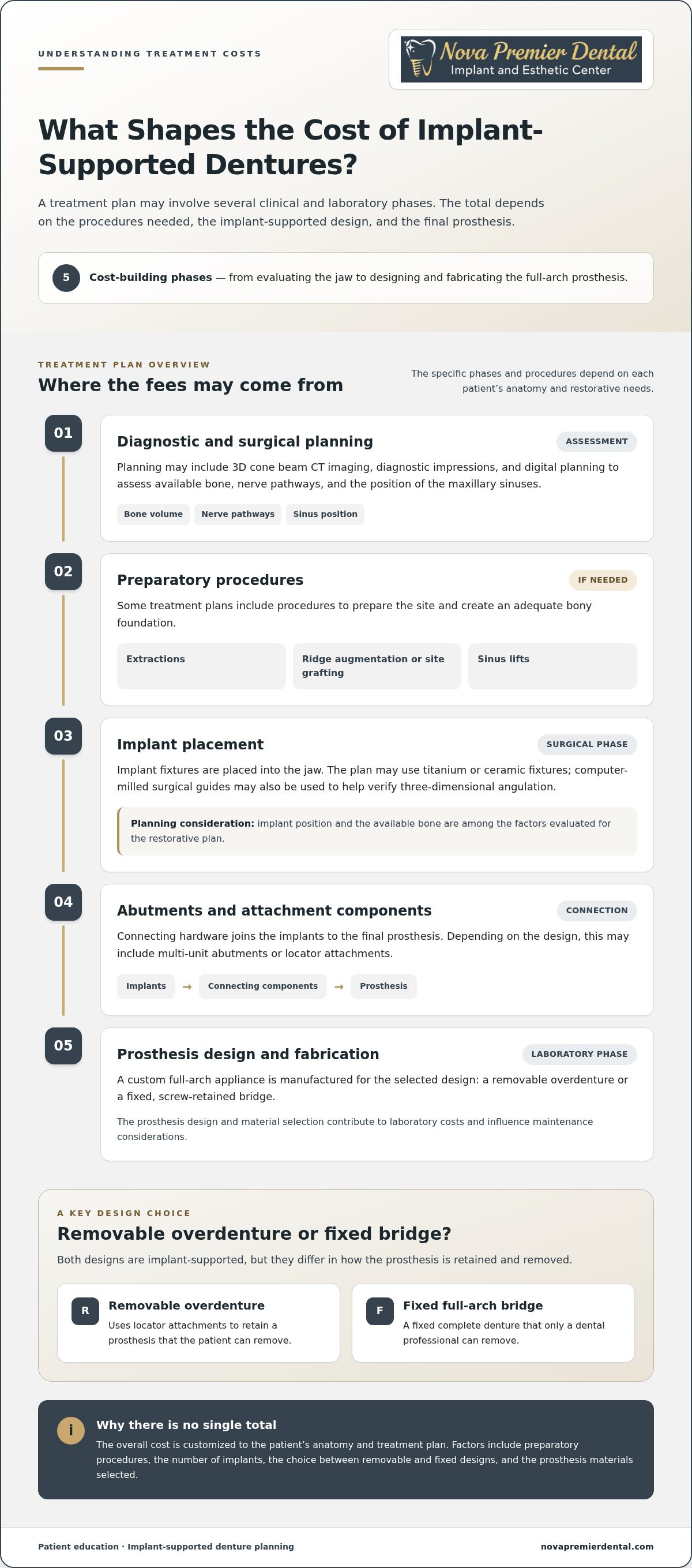
The total investment for implant-supported restorations in Northern Virginia cannot be summarized by a single figure, as treatment plans must be customized to each patient's anatomical presentation and aesthetic goals. In areas such as Falls Church, Arlington, and McLean, restorative fees typically reflect several interrelated phases:
- Diagnostic and Surgical Planning: High-resolution 3D Cone Beam Computed Tomography (CBCT) scans, diagnostic impressions, and digital planning to evaluate available bone volume, nerve pathways, and maxillary sinus position.
- Preparatory Procedures: Any necessary extractions, ridge augmentations, site grafting, or sinus lifts required to create an adequate bony foundation.
- Surgical Implant Placement: The surgical insertion of titanium or ceramic implant fixtures into the jaw, which may involve computer-milled surgical guides to verify precise three-dimensional angulation.
- Abutment and Attachment Components: Connective hardware—such as multi-unit abutments or locator attachments—that joins the submerged implants to the final prosthesis.
- Prosthetic Design and Fabrication: The custom laboratory manufacturing of the full-arch appliance, whether an overdenture or a fixed screw-retained bridge.
Material Comparison: PMMA Acrylic vs. High-Strength Zirconia
The materials chosen for your prosthesis play a significant role in determining laboratory costs, aesthetic translucency, structural weight, and maintenance expectations over the life of the restoration.
| Prosthetic Material | Initial Relative Cost | Expected Clinical Maintenance | Key Advantages | Primary Limitations |
|---|---|---|---|---|
| Acrylic (PMMA) with Titanium Bar | Moderate | Periodic prosthetic tooth replacement, relining, or replacement of nylon locator inserts every 1–3 years. | Lighter in weight, easily repaired or modified chairside if a tooth chips, more economical initial laboratory fee. | Porous surface susceptible to staining; acrylic denture teeth wear down faster against natural teeth or opposing ceramics. |
| Monolithic or Layered Zirconia | Higher | Occasional component checks, regular professional debridement, low material wear. | Extremely wear-resistant, biocompatible, non-porous (resists odors and staining), highly lifelike translucency. | Heavier restoration; requires adequate restorative space; repairs if fractured are more complex and costly. |
Patients considering comprehensive oral reconstruction must balance these material properties against available interocclusal space. If there is insufficient vertical clearance between the upper and lower arches, a bulkier acrylic prosthesis may be prone to fracture, making a high-strength monolithic material a more reliable clinical recommendation.
Preparatory Interventions and Anatomical Considerations
The condition of the patient's existing jawbone directly impacts the surgical complexity and overall fee. In cases of chronic edentulism or long-standing periodontal disease, substantial bone loss may have occurred. Common preparatory steps include:
- Tooth Extractions: Removing non-restorable or periodontally compromised teeth before implant therapy begins.
- Bone Grafting: Introducing bone graft materials to augment ridge width or height to securely house standard-diameter implants.
- Sinus Augmentation (Sinus Lift): Elevating the sinus membrane in the posterior maxilla and placing bone graft material to create adequate vertical bone height.
- Surgical Guides: Fabricating custom stents using digital scan data to guide accurate drill depth and trajectory during surgery.
The Role of Prosthodontic Specialty Care in Complex Restorations
Many general dentists provide exceptional preventive, diagnostic, and restorative care, including single-tooth restorations and conventional dentures. However, full-arch tooth replacement involves complex occlusal dynamics, vertical dimension calculations, and biomechanical load distribution.
A prosthodontist is a dental specialist who has completed a dental degree followed by three years of rigorous advanced specialty training in an accredited residency program. This additional education focuses intensively on diagnosis, treatment planning, rehabilitation of complex dental conditions, and the restoration of missing teeth. At Nova Premier Dental, Dr. Peterson Huang is a dentist and dual board-certified prosthodontist, possessing board certification in prosthodontics in both the United States and Canada. His advanced training equips him to manage complex full-mouth cases, manage compromised restorative space, and evaluate subtle bite discrepancies.
Occlusal Harmony and Load Distribution
When multiple implants support a complete arch of teeth, improper bite alignment or uneven force distribution can lead to mechanical or biological complications. These may include:
- Prosthetic screw loosening or fracture
- Chipping of ceramic or wear of acrylic teeth
- Unfavorable stress transfer to the crestal bone
- Peri-implant tissue inflammation
A prosthodontist evaluates the relationship between your temporomandibular joints (TMJ), masticatory muscles, and prosthetic tooth positions to ensure that biting forces are distributed evenly across all supporting fixtures. While specialty treatment does not guarantee an outcome free of maintenance, meticulous pre-surgical planning helps manage risk and establishes a stable occlusal scheme designed for durability.
Implant Survival vs. Prosthetic Longevity
It is important to differentiate between implant fixture survival and prosthesis longevity. Peer-reviewed literature generally documents favorable survival rates for endosseous titanium implants over ten- to twenty-year observation periods in healthy patients. However, the prosthetic restoration attached to those implants experiences constant mechanical stress.
Attachments on removable overdentures inevitably wear out and require replacement. Acrylic denture teeth wear down over time and may need refurbishment, and fixed bridges may occasionally require screw retorquing, repair of minor porcelain fractures, or professional deep cleaning. Understanding this distinction prevents unrealistic expectations: while the implants beneath the gum tissue are intended to serve as long-term anchors, the visible denture or bridge requires ongoing clinical maintenance.
Navigating Insurance, In-House Options, and Pre-Tax Health Accounts
Managing the financial aspect of implant-supported restorations requires clear coordination between the clinical team and the patient. While full-arch implant therapy represents a notable out-of-pocket healthcare expense, several avenues can help organize and offset costs.
Dental Insurance Limitations
Most dental insurance policies carry an annual maximum benefit, typically capped between $1,000 and $2,000 per calendar year—limits that have changed little over several decades. Patients should also consider common policy conditions:
- Missing Tooth Clauses: Some insurance policies exclude coverage for replacing teeth that were extracted prior to the effective date of coverage.
- Coverage Categorization: Insurers may cover a standard percentage of the removable denture base or tooth extraction, but classify surgical implant placement or custom abutments as elective or major services with limited reimbursement.
- Pre-Determination of Benefits: Our administrative team regularly submits pre-treatment estimates to insurance carriers so patients receive an objective, formal projection of covered benefits before treatment starts.
Phased Treatment Sequencing and Pre-Tax Accounts
When clinically appropriate, treatment can sometimes be phased across benefit periods. For instance, diagnostic planning, extractions, and implant placement may occur late in one calendar year, with final prosthetic loading and delivery scheduled in the following calendar year, allowing patients to utilize two consecutive annual benefit maximums.
Additionally, Health Savings Accounts (HSA) and Flexible Spending Accounts (FSA) allow patients to allocate pre-tax income toward eligible medical and dental procedures. Because implant-supported restorations resolve edentulism and re-establish oral function, they generally qualify as deductible medical/dental expenses under IRS regulations, providing a valuable tax-advantaged method to reduce net expenditures.
Nova Premier Dental offers in-house payment plans for qualifying patients, allowing treatment costs to be paid over several months while patients enjoy their new smile.
What to Expect During Your Restorative Consultation
The path to restorative treatment begins with a thorough clinical examination to evaluate whether you are an appropriate candidate for dental implants. During an initial visit at our Falls Church office, you can expect a methodical diagnostic review:
- Comprehensive Health History: We review existing systemic conditions—such as controlled diabetes, autoimmune disorders, or history of bisphosphonate therapy—that may influence bone healing and osseointegration.
- 3D Radiographic Diagnostics: We capture CBCT imaging to assess alveolar bone ridge height, density, and spatial relationships to anatomical landmarks.
- Occlusal and Soft Tissue Evaluation: We evaluate jaw mobility, tongue posture, keratinized gingival tissue volume, and restorative vertical dimension.
- Collaborative Discussion: Dr. Huang presents suitable restorative options—outlining the distinct advantages, maintenance expectations, and fees of removable overdentures versus fixed prostheses.
A detailed written treatment plan is provided following the diagnostic assessment, ensuring complete clarity regarding clinical timelines, preparatory surgical requirements, and fee schedules.
Frequently Asked Questions
What is the typical cost range for implant-supported dentures in Virginia?
Because every case is unique, treatment costs vary widely. A two-implant removable overdenture involves lower surgical and restorative complexity than a fixed, screw-retained full-arch zirconia bridge requiring four to six implants and preparatory bone augmentation. In Northern Virginia, total fees depend on the number of implants, preparatory grafting, and whether an acrylic or zirconia prosthesis is selected. A thorough clinical and radiographic evaluation is required to provide an individualized estimate.
Does Virginia dental insurance cover the cost of implant dentures?
Dental plans vary, but most insurance policies do not cover the complete cost of implant-supported restorations. While insurers may partially cover standard components—such as extractions, temporary dentures, or preliminary imaging—the surgical implant placement and high-grade restorative materials often exceed standard annual benefit maximums (typically $1,000–$2,000). We assist patients by submitting pre-determinations to verify available benefits.
How does a fixed implant denture differ from a removable overdenture?
A removable overdenture snaps onto two or more dental implants using locator attachments; the patient removes the prosthesis daily for hygiene and sleep. A fixed implant prosthesis (often referred to as a hybrid bridge or All-on-4 design) is firmly screwed into four or more implants and cannot be removed by the patient. Fixed options provide greater retention and feel more like natural teeth, but they require higher surgical complexity, precise cleaning beneath the prosthesis, and higher initial investment.
How long do implant-supported dentures last?
The titanium implant fixtures integrate with the jawbone and are designed to function for decades when supported by good oral hygiene and routine maintenance. However, the external prosthesis is subject to daily chewing wear. Removable overdenture attachments typically need periodic replacement every few years, and acrylic teeth may require relines or replacement after 7 to 10 years. Zirconia restorations demonstrate exceptional wear resistance but still require professional monitoring to ensure screws remain tight and tissue remains healthy.
What if I have experienced significant bone loss in my jaw?
Substantial bone resorption is common among individuals who have been missing teeth for an extended period. In many situations, bone grafting, ridge expansion, or sinus lifts can reconstruct adequate volume for standard implants. In other cases, specialized implant techniques—such as tilting posterior implants to maximize available native bone—can avoid the need for extensive grafting. A 3D CBCT scan is essential to assess whether bone augmentation is necessary.
Why choose a prosthodontist for implant-supported dentures?
While many general dentists perform restorative procedures, prosthodontists complete three additional years of post-doctoral residency training focused exclusively on complex tooth replacement, occlusion, and full-mouth rehabilitation. Choosing a board-certified prosthodontist in Northern Virginia provides patients with an advanced level of diagnostic evaluation for complex bite forces, aesthetic challenges, and anatomical variations.
Schedule an Educational Consultation in Falls Church
Navigating the options, clinical requirements, and associated costs of full-arch tooth replacement is a significant health decision. Whether you are currently experiencing the limitations of conventional removable prosthetics or are planning for the extraction of failing teeth, an objective, diagnostic-driven assessment will help clarify the best course of action for your anatomy and lifestyle.
If you have questions about complex restorative care or wish to discuss the cost of implant supported dentures in Virginia, Nova Premier Dental provides specialized prosthodontic evaluation and treatment planning. We welcome you to contact our Falls Church office to schedule a comprehensive restorative consultation.
Disclaimer
The information provided on this website and blog is intended for general educational and informational purposes only and should not be considered dental or medical advice, diagnosis, or treatment. Reading content on this website does not establish a doctor-patient relationship with Nova Premier Dental or Dr. Peterson Huang. Dental conditions and treatment needs vary from patient to patient. Individuals should consult directly with a qualified dental professional for personalized evaluation, diagnosis, and treatment recommendations. Do not delay seeking professional dental care based on information found on this website. While we strive to provide accurate and up-to-date information, no guarantee is made regarding the completeness, accuracy, or applicability of the content. Treatment outcomes may vary depending on individual circumstances. If you are experiencing a dental emergency or urgent oral health concern, please contact a licensed dental professional immediately or call 911 in the event of a medical emergency.


