

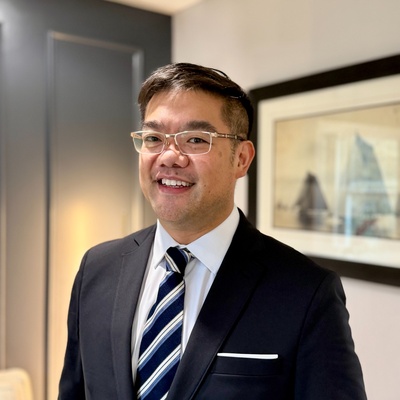
Article by
Peterson Huang DMD, MS, FACP, FRCDC
Dr. Peterson Huang is a dual board-certified prosthodontist serving Falls Church and Northern Virginia. He has been recognized as a Top Prosthodontist by Northern Virginia Magazine and Arlington Magazine and is affiliated with the Inova Fairfax Hospital Tumor Board. Dr. Huang focuses on dental implants, full mouth reconstruction, and complex restorative dentistry for patients who need advanced, comprehensive care.
What Does "Board Certified Prosthodontist" Mean?
A board-certified prosthodontist is a dentist who completed an accredited specialty residency in Prosthodontics and then passed the examinations of a specialty certifying board, such as the American Board of Prosthodontics. Prosthodontics is the dental specialty focused on restoring and replacing teeth and managing complex restorative problems. Board certification is voluntary and goes beyond the state license and the specialty training itself.
Prosthodontists complete additional specialty training focused on restoring and replacing teeth and managing complex restorative problems. Accredited programs in the United States are typically three years after dental school. Their work often includes dental implant restoration, full-arch tooth replacement, complex dentures, crowns and bridges, restoration of worn or damaged dentition, and rehabilitation after cancer treatment or trauma.
The credential tells you about training and examination. It does not guarantee a particular result, and it does not mean every patient needs a specialist. Many restorative procedures are appropriately performed by general dentists.
How Board Certification Works
The American Board of Prosthodontics is the certifying body recognized for the specialty in the United States. Candidates generally complete specialty education, then pass written and clinical examinations, including a review of treatment of actual patients. Certification is maintained through ongoing requirements rather than held indefinitely. Exact requirements are set by the board and can change, so the best source for current details is the board itself.
You can verify any prosthodontist's status directly on the American Board of Prosthodontics website, which lists certified diplomates, and through the Virginia Department of Health Professions license lookup.
Dual Board Certification in the United States and Canada
Dr. Peterson Huang completed specialty training in prosthodontics and holds board certification through the American Board of Prosthodontics and the Royal College of Dentists of Canada. His credentials are DMD, MS, FACP, FRCDC, and both certifications are in prosthodontics. Details of his training and background are on the Meet Dr. Huang page. Holding two certifications in the same specialty reflects completion of two sets of examinations; it is a verifiable fact about credentials, not a predictor of any individual treatment result.
Prosthodontist or General Dentist: How to Decide
General dentists provide preventive care and a wide range of restorative treatment, and many patients need nothing beyond that. A prosthodontist may be a helpful additional opinion when treatment is complex, involves several teeth or implants, or has previously not worked as expected.
| Situation | General dentist | Prosthodontist |
|---|---|---|
| Cleanings, exams, fillings, single crowns | Typically appropriate | Not usually necessary |
| Single implant crown in a straightforward site | Often appropriate | Option if space or bite is complicated |
| Replacing all teeth in an arch | Varies with training and experience | Core area of specialty training |
| Severe tooth wear or a changed bite | May refer for evaluation | Evaluates occlusion and plans sequencing |
| Repeated restoration or implant failures | May refer | Helpful for a second opinion |
| Rehabilitation after oral cancer or trauma | Part of a team | Often leads the prosthetic portion, with surgeons and oncology teams |
A fuller comparison is available in our article on prosthodontist vs. general dentist.
When a Second Opinion May Help
A second opinion is reasonable when treatment plans differ widely, when many teeth are involved, or when you are unsure why a material or approach was recommended. Questions that may be worth raising include:
- Is there enough bone, and enough space between the jaws, for the planned implants and restorations?
- Has the bite (occlusion) been evaluated, including signs of bruxism, the clenching or grinding of teeth?
- Are there alternatives, such as keeping a compromised tooth, a removable prosthesis, or a bridge?
- What are the maintenance needs and likely repairs over time?
A prosthodontic consultation can also be a collaboration. Prosthodontists commonly work with general dentists, oral surgeons, periodontists, and dental laboratories, and the general dentist often continues to provide routine care afterward.
Complex Restorative Treatment: What the Planning Involves
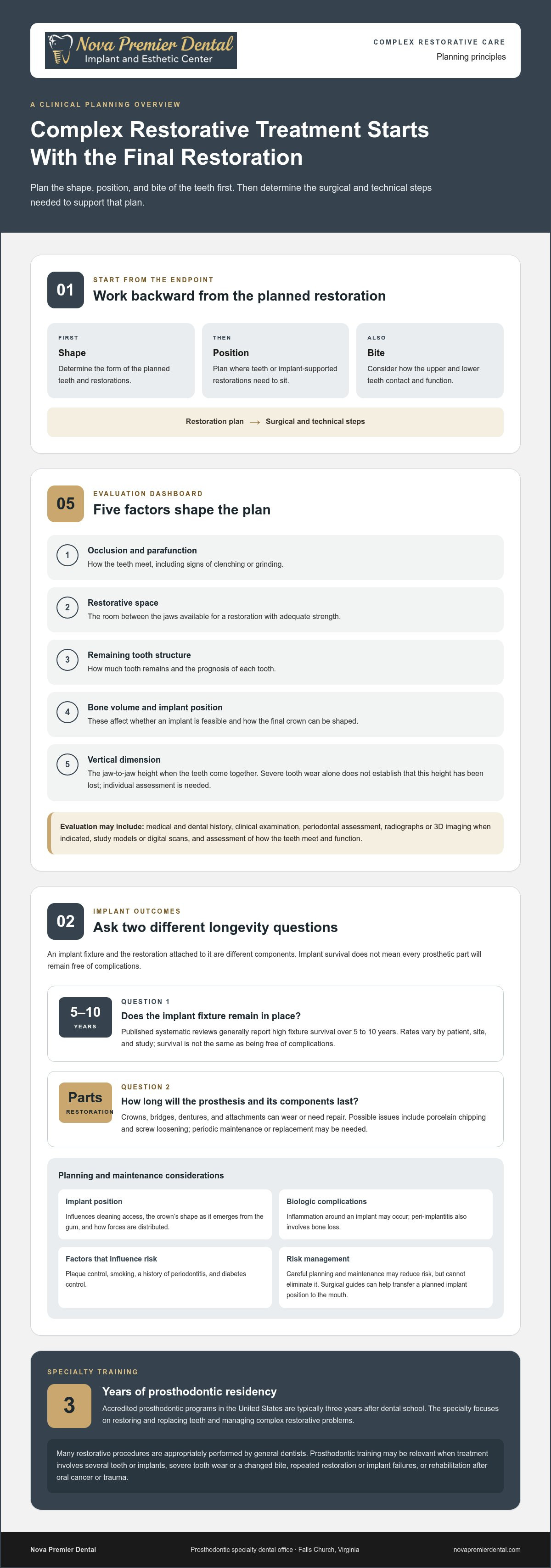
Complex restorative treatment is planned from the final restoration backward: the shape, position, and bite of the teeth are determined first, and the surgical and technical steps follow from that plan.
Diagnosis and Evaluation
Evaluation typically includes a medical and dental history, clinical examination, periodontal assessment, radiographs or 3D imaging when indicated, study models or digital scans, and an assessment of how the teeth meet and function. Factors reviewed often include:
- Occlusion (how the upper and lower teeth contact) and any parafunction such as grinding.
- Restorative space, meaning the room available between the jaws for a restoration of adequate strength.
- Remaining tooth structure and the prognosis of each tooth.
- Bone volume and implant position, which affect both feasibility and how the final crown can be shaped.
- Vertical dimension, the jaw-to-jaw height at closure. Severe tooth wear does not by itself mean vertical dimension has been lost, since teeth can erupt and adapt as they wear. This needs individual assessment.
Dental Implants: Survival Versus Prosthesis Longevity
Implant outcomes involve two separate questions. The first is whether the implant fixture, the part anchored in bone, remains in place. Published systematic reviews generally report high survival for implant fixtures over 5 to 10 years, but rates vary with the patient, site, and study, and survival is not the same as freedom from complications. The second is how long the crown, bridge, denture, or attachments last. These parts are subject to wear, porcelain chipping, screw loosening, and the need for replacement, and they typically require periodic maintenance or repair.
Biologic complications such as peri-implant mucositis and peri-implantitis (inflammation, and in the latter case bone loss, around an implant) occur in a meaningful share of patients, and risk is influenced by plaque control, smoking, history of periodontitis, and diabetes control. Careful planning and maintenance may reduce risk but cannot eliminate it. For more detail, see our pages on dental implants and common causes of implant restoration failure.
Implant position matters because it influences access for cleaning, the shape of the crown where it emerges from the gum (emergence profile), and how forces are distributed. Surgical guides are one tool that can help transfer a planned position to the mouth.
Full-Mouth Rehabilitation
Full-mouth rehabilitation is treatment that restores most or all teeth, usually because of extensive wear, fracture, decay, missing teeth, or prior restorations that are failing. It is typically staged: disease control first, then provisional restorations to test the bite and appearance, then definitive work. Material choices, such as zirconia, lithium disilicate, porcelain-fused-to-metal, or gold, involve tradeoffs among strength, wear against opposing teeth, appearance, and repairability. Duration depends on the case, and a timeline is best given after evaluation.
Relationships between bite changes and symptoms such as jaw pain or headaches are not simple. Temporomandibular disorders have multiple contributing factors, and bite correction is not an established cure for them. Conservative approaches are generally tried first.
Rehabilitation After Cancer or Trauma
Maxillofacial prosthetics is the branch of prosthodontics concerned with replacing parts of the mouth, jaws, and face lost to surgery, trauma, or congenital conditions. Treatment after head and neck cancer is coordinated with surgeons and oncology teams, and radiation can affect healing, saliva, and implant planning, so decisions are individualized. See information on oral cancer rehabilitation.
How to Evaluate a Prosthodontic Specialist
- Verify credentials. Check the American Board of Prosthodontics directory and the Virginia license lookup. Ask which board certifications the clinician holds.
- Review comparable cases. Before-and-after photographs are most useful when the starting condition resembles yours; remember they show selected cases.
- Ask about experience with your condition, including cases that needed revision and how complications were handled.
- Ask for the reasoning. A good plan explains why materials, implant numbers, and sequencing were chosen, and what the alternatives are.
- Understand maintenance. Ask about expected follow-up, night guard use if you grind, and the likely cost of repairs.
- Look at independent recognition cautiously. Peer-voted lists and community awards, such as those described on our awards page, are one data point, not a measure of clinical outcomes.
About Nova Premier Dental
Nova Premier Dental is a private prosthodontic specialty dental office in Falls Church, Virginia, serving patients throughout Northern Virginia. Dr. Huang provides prosthodontic care including dental implant restoration, crowns and bridges, dentures, and full-mouth rehabilitation. Our Northern Virginia prosthodontist page describes the specialty and services in more detail.
Nova Premier Dental offers in-house payment plans for qualifying patients, allowing treatment costs to be paid over several months.
Frequently Asked Questions
Is a board-certified prosthodontist more expensive?
Fees depend on the complexity of the treatment, materials, laboratory costs, and number of visits rather than on certification alone. Comparing written treatment plans, including what is and is not included, is more informative than comparing hourly or per-tooth figures.
Do I need a referral?
Referrals are not generally required to schedule a consultation, though some dental insurance plans have their own rules. Check your plan's specialist requirements.
Can a prosthodontist place implants?
Prosthodontic training emphasizes planning and restoring implants, and some prosthodontists place them as well, depending on their training and credentials. In other cases, a surgeon or periodontist places the implants and the prosthodontist designs and delivers the restoration. Ask who will perform each phase.
How long does full-mouth reconstruction take?
It varies from several months to a year or more, depending on whether extractions, bone grafting, implant healing, or staged provisional restorations are needed.
Why does certification matter for implants?
Certification verifies specialty education and examination in prosthodontics, which includes implant restoration. It does not by itself predict the outcome of any case, and implants placed or restored by other qualified clinicians can also succeed.
If you have questions about a complex restorative or prosthodontic concern, Nova Premier Dental in Falls Church provides prosthodontic specialty care for patients throughout Northern Virginia, and you can contact the office to arrange a consultation.
Disclaimer
The information provided on this website and blog is intended for general educational and informational purposes only and should not be considered dental or medical advice, diagnosis, or treatment. Reading content on this website does not establish a doctor-patient relationship with Nova Premier Dental or Dr. Peterson Huang. Dental conditions and treatment needs vary from patient to patient. Individuals should consult directly with a qualified dental professional for personalized evaluation, diagnosis, and treatment recommendations. Do not delay seeking professional dental care based on information found on this website. While we strive to provide accurate and up-to-date information, no guarantee is made regarding the completeness, accuracy, or applicability of the content. Treatment outcomes may vary depending on individual circumstances. If you are experiencing a dental emergency or urgent oral health concern, please contact a licensed dental professional immediately or call 911 in the event of a medical emergency.


