


Article by
Peterson Huang DMD, MS, FACP, FRCDC
Dr. Peterson Huang is a dual board-certified prosthodontist serving Falls Church and Northern Virginia. He has been recognized as a Top Prosthodontist by Northern Virginia Magazine and Arlington Magazine and is affiliated with the Inova Fairfax Hospital Tumor Board. Dr. Huang focuses on dental implants, full mouth reconstruction, and complex restorative dentistry for patients who need advanced, comprehensive care.
Porcelain veneers are a common option for changing the color, shape, or surface of front teeth, but candidacy depends on enamel availability, gum health, and bite function. Patients researching porcelain veneers in Virginia often want to know how much natural tooth structure is removed, how long the restorations last, and how to compare treatment plans and costs across Northern Virginia.
This guide explains how veneers work, when crowns are a better choice, how treatment is planned, and what maintenance and complications to expect. Nova Premier Dental is a private prosthodontic specialty dental office in Falls Church serving Northern Virginia. Prosthodontists complete additional specialty training focused on restoring and replacing teeth and managing complex restorative problems. Dr. Peterson Huang completed specialty training in prosthodontics and holds board certification through the American Board of Prosthodontics and the Royal College of Dentists of Canada.
Key Takeaways
- Veneers are thin ceramic restorations bonded mainly to enamel; candidacy depends on enamel, gum health, and bite.
- Veneers cover the facial surface of a tooth, while crowns cover the whole tooth and are used when more structure is lost.
- A diagnostic wax-up and provisional restorations let patients preview proposed shape and contour before final restorations are made.
- Longevity varies with material, bonding, bite forces, bruxism, and oral hygiene, and veneers may eventually need repair or replacement.
- Patients with complex bite or restorative needs may consider evaluation by a prosthodontist.
What Are Porcelain Veneers?
Porcelain veneers are thin, custom-made ceramic laminates bonded to the front surface of teeth in the esthetic zone. Patients often ask what are dental veneers? in relation to staining, but they may also be used for intrinsic discoloration, minor chips or fractures, and minor tooth misalignment that does not require orthodontic treatment. Because veneers function under chewing forces, planning should consider occlusion as well as appearance.
Ceramics such as lithium disilicate have good translucency and are widely used for anterior restorations. At Nova Premier Dental, Dr. Peterson Huang evaluates the color of the teeth along with how veneers relate to the bite, the gum line, and the lips and face. A prosthodontist treats a veneer as a functional restoration that must tolerate chewing forces as well as meet esthetic goals.
Veneer Thickness and Bonding
Veneer thickness varies with the case. Conventional veneers often require some enamel reduction, while minimal-preparation designs remove less tooth structure, though they are not suitable for every situation. Bonding to enamel is central to retention, and a well-bonded margin helps limit leakage, though it does not eliminate the risk of debonding, chipping, or decay at the margin. The esthetic zone refers to the teeth visible when smiling, commonly the upper front teeth; the number involved varies by patient.
Porcelain Veneers vs. Composite Bonding
Composite resin bonding is a common alternative to porcelain. Composite is usually less costly and can often be done with little or no tooth reduction and repaired more easily, but it tends to stain and wear more readily than ceramic. Porcelain is more resistant to staining and can closely match the optical properties of enamel, but it generally requires more tooth preparation and is harder to reverse. Longevity for either material depends on bite forces, habits such as bruxism, hygiene, and technique, so patients should discuss expected maintenance with their clinician.
When to Consider a Prosthodontist for Veneers
Many general dentists place veneers successfully. Prosthodontists complete additional specialty training focused on restoring and replacing teeth and managing complex restorative problems. Referral or consultation with a prosthodontist may be useful when veneers are part of a larger treatment plan, such as cases involving significant tooth wear, bite changes, or multiple missing teeth. Dr. Peterson Huang completed specialty training in prosthodontics and holds board certification through the American Board of Prosthodontics and the Royal College of Dentists of Canada.
Occlusion, or how the teeth meet, affects veneer success. Unfavorable bite forces, including those associated with bruxism, may contribute to chipping, cracking, or debonding of ceramic restorations. Evaluation of the bite before treatment helps identify these risks. General dentists in Northern Virginia may also refer patients with complex restorative needs to Nova Premier Dental in Falls Church.
The gum line also affects the result. Veneer margins and emergence profile (how the restoration exits the gum) should allow the patient to clean the area and should support healthy gingival tissue. Overcontoured restorations can make plaque control harder and may irritate the gums. The patient information on the porcelain veneer process gives additional background.
Board Certification
Board certification is a voluntary process that includes examination. Peterson Huang, DMD, MS, FACP, FRCDC, holds dual board certification in prosthodontics in the United States and Canada. Certification does not remove the risks of veneers, which include debonding, chipping, sensitivity, and the need for eventual replacement. You can learn more about Dr. Huang's background.
Digital Smile Design and Treatment Planning
Planning may include photographs, 3D imaging, and Digital Smile Design to preview proposed changes before teeth are prepared. The evaluation considers the lip line, facial midline, tooth proportions, and speech. A preview is a planning aid, and the final result may differ somewhat from the digital simulation.
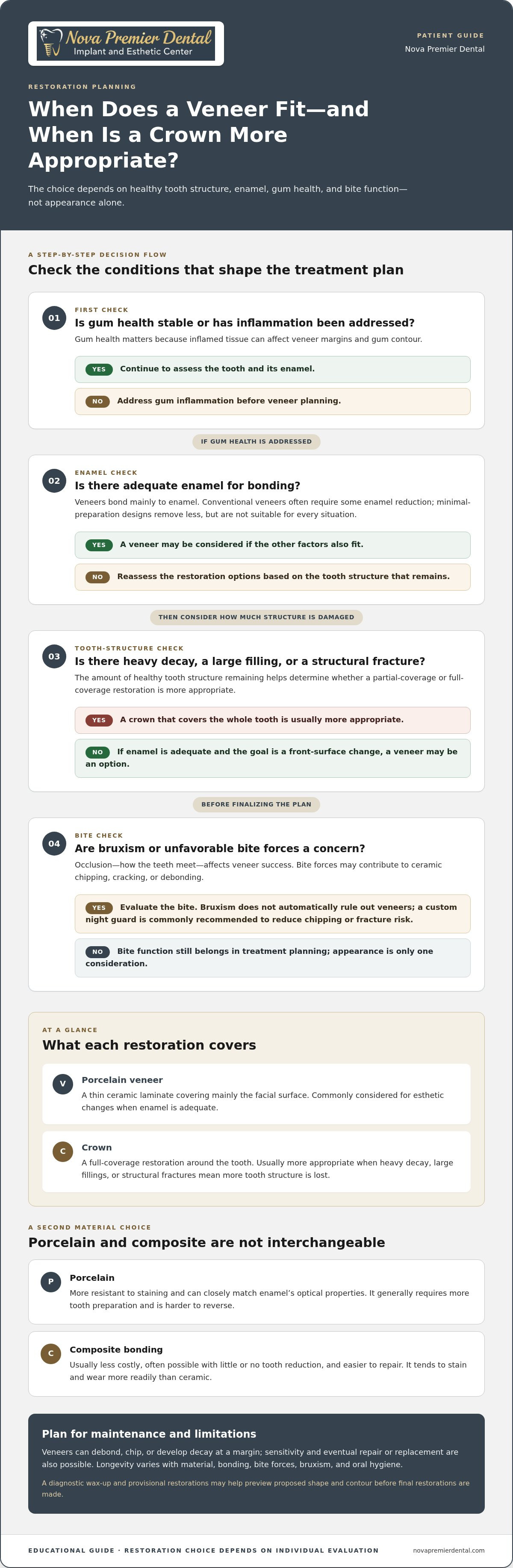
Porcelain Veneers vs. Crowns: Which Restoration is Right for You?
The choice depends on how much healthy tooth structure remains. A veneer is a thin ceramic laminate that covers mainly the facial surface of the tooth, and it is commonly used for esthetic changes when enamel is adequate. If a tooth has heavy decay, large fillings, or structural fractures, a crown that covers the whole tooth is usually more appropriate. The American Dental Association's Porcelain Veneers vs. Crowns information provides more background. At Nova Premier Dental, preserving natural tooth structure is a planning priority.
In more complex cases, veneers on visible teeth may be combined with dental crowns on posterior teeth as part of a broader oral reconstruction. Crowns can provide strength and posterior support where chewing forces are greater, while veneers conserve more tooth structure in the front.
The Veneer Candidate Checklist
Veneers bond best to enamel, so adequate enamel is needed. Gum health should be addressed first, because inflamed tissue can affect margins and gum contour. Bruxism does not automatically rule out veneers, but a custom night guard is commonly recommended to reduce the risk of chipping or fracture.
Material Science: E-max vs. Zirconia
Lithium disilicate (e-max) is widely used for anterior restorations because of its translucency. Zirconia is generally more fracture resistant and is often used for full-coverage restorations on molars or in patients with heavy bite forces, though it is typically less translucent. Material selection depends on tooth location, bite forces, available space, and esthetic goals.
The Porcelain Veneer Process in Falls Church: What to Expect
Veneer treatment is usually done in several phases. It begins with an examination, imaging, and often a diagnostic wax-up, a model that lets the patient and Dr. Peterson Huang review proposed proportions and contour before treatment. The number of visits varies with the complexity of the case, and Nova Premier Dental in Falls Church schedules them accordingly.
The second phase is tooth preparation, which removes only the enamel needed to create space for the ceramic. Provisional restorations are then placed. These can be used to evaluate speech, bite, and appearance before final restorations are made. Final veneers are bonded after adjustments, and the occlusion is checked and refined.
Does Getting Veneers Hurt?
Tooth preparation is usually done with local anesthesia, so it is generally tolerated well. Some sensitivity can occur afterward and usually resolves, but persistent or severe sensitivity should be evaluated. Enamel removed during preparation does not regenerate, so veneers should be considered a largely irreversible treatment.
Cost Factors for Veneers in Northern Virginia
The cost of porcelain veneers varies across Northern Virginia. Factors that influence the fee include:
- The number of teeth treated and the complexity of the case.
- The ceramic material and the dental laboratory involved.
- The clinician's training and the planning, provisional, and follow-up care included.
Nova Premier Dental offers in-house payment plans for qualifying patients, allowing treatment costs to be paid over several months. You can schedule a consultation to discuss your options.
Veneer Care at Nova Premier Dental
Nova Premier Dental is a private prosthodontic specialty dental office in Falls Church serving Northern Virginia. Dr. Peterson Huang is a prosthodontist who also provides oral reconstruction for patients with more complex restorative needs. Veneer treatment is planned around the health of the remaining tooth structure and the stability of the bite.
Treatment planning is individualized. Tooth shape, color, and proportions are chosen based on dental history, facial features, and the patient's preferences, with attention to long-term health of the underlying tooth structure and bite stability.
Digital Records and Technology
The office uses intraoral scanners and 3D printing to create digital records of the teeth, which can reduce the need for traditional impression material in some cases. Dr. Huang is the treating clinician throughout the process. Our Falls Church location serves patients from Arlington, Fairfax, and surrounding communities.
Next Steps: Your Specialist Consultation
For a first visit, bring photos of smiles you like and a list of functional concerns, such as teeth grinding or previous jaw joint discomfort. Patients who have received a treatment plan elsewhere are welcome to seek a second opinion, particularly for extensive work. To begin, contact the office to schedule a consultation.
Summary: Planning Porcelain Veneers
Porcelain veneers can be an appropriate option when enamel is adequate, the gums are healthy, and the bite has been evaluated. Material selection, occlusion, and maintenance all influence how long the restorations last. Patients with complex restorative needs may benefit from evaluation by a prosthodontist such as Dr. Peterson Huang at Nova Premier Dental.
Schedule a veneer consultation
Frequently Asked Questions
How long do porcelain veneers last on average?
Longevity varies. Veneers can last many years with proper maintenance, but lifespan depends on bonding, material, bite forces, bruxism, and hygiene, and published survival rates differ between studies. Routine exams and cleanings help detect problems early, and veneers may eventually need repair or replacement.
Will my porcelain veneers look fake or too white?
Veneers look natural when translucency, shade, and shape are matched to the surrounding teeth and face. Shade and contour are usually reviewed with the patient in advance, such as with a wax-up or provisional restorations. A prosthodontist can help match the restorations to natural enamel and facial features.
Can veneers be whitened if they stain over time?
Porcelain does not respond to whitening treatments once bonded. Because natural teeth can still change color, whitening is often completed before veneer shade selection so the veneers can be matched to the final tooth color.
What is the difference between a general dentist and a prosthodontist for veneers?
Prosthodontists complete additional specialty training focused on restoring and replacing teeth and managing complex restorative problems. Both general dentists and prosthodontists may provide veneers; referral is often considered for complex cases. Dr. Peterson Huang holds board certification in prosthodontics in the United States and Canada.
How many veneers do I need for a full smile makeover?
The number of veneers varies with the width of the smile, tooth position, and goals. Some patients need only a few, while others treat most of the visible upper teeth. At Nova Premier Dental, 3D imaging and a diagnostic wax-up help determine the number of restorations.
Can I get porcelain veneers if I grind my teeth at night?
Veneers may still be possible with bruxism, but a custom night guard is generally recommended to reduce the risk of chipping or debonding. Wear patterns and bite forces are evaluated during the diagnostic phase to guide material selection and design.
Are there any food or drink restrictions with porcelain veneers?
Strict dietary restrictions are generally not required, but avoid biting hard objects such as ice, hard candy, or non-food items. Porcelain is a brittle, glass-based ceramic that can fracture under concentrated force.
Does insurance cover the cost of porcelain veneers in Virginia?
Dental insurance often does not cover veneers when they are done for cosmetic reasons, though coverage varies by plan, so check your benefits. Nova Premier Dental offers in-house payment plans for qualifying patients, allowing treatment costs to be paid over several months.
Disclaimer
The information provided on this website and blog is intended for general educational and informational purposes only and should not be considered dental or medical advice, diagnosis, or treatment. Reading content on this website does not establish a doctor-patient relationship with Nova Premier Dental or Dr. Peterson Huang. Dental conditions and treatment needs vary from patient to patient. Individuals should consult directly with a qualified dental professional for personalized evaluation, diagnosis, and treatment recommendations. Do not delay seeking professional dental care based on information found on this website. While we strive to provide accurate and up-to-date information, no guarantee is made regarding the completeness, accuracy, or applicability of the content. Treatment outcomes may vary depending on individual circumstances. If you are experiencing a dental emergency or urgent oral health concern, please contact a licensed dental professional immediately or call 911 in the event of a medical emergency.


