

Article by
Peterson Huang DMD, MS, FACP, FRCDC
Dr. Peterson Huang is a dual board-certified prosthodontist serving Falls Church and Northern Virginia. He has been recognized as a Top Prosthodontist by Northern Virginia Magazine and Arlington Magazine and is affiliated with the Inova Fairfax Hospital Tumor Board. Dr. Huang focuses on dental implants, full mouth reconstruction, and complex restorative dentistry for patients who need advanced, comprehensive care.
When evaluating full-arch tooth replacement options, patients are generally choosing between two primary approaches: conventional complete dentures and implant-supported restorations. While both approaches can replace an entire dental arch, they function through completely different biomechanical mechanisms. Choosing between them involves evaluating anatomical considerations, oral function, bone remodeling patterns, maintenance requirements, and overall treatment goals.
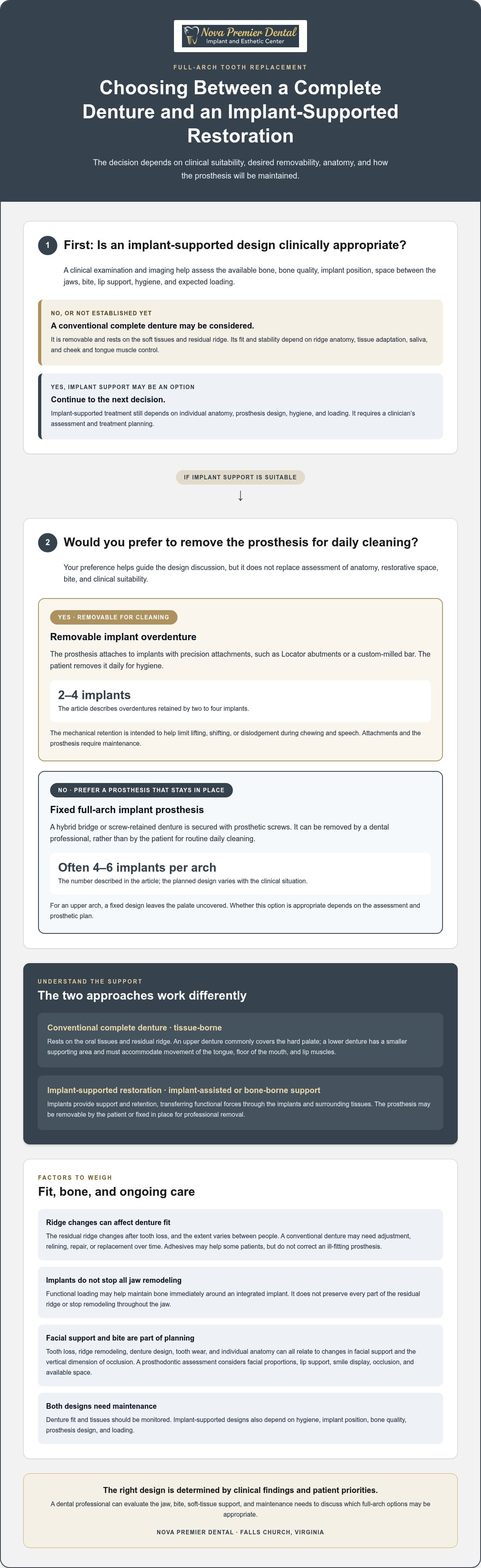
A conventional denture is a removable prosthesis that rests entirely on the soft oral mucosa and the underlying residual alveolar ridge (tissue-borne support). In contrast, an implant-supported denture relies on titanium fixtures placed into the jawbone to anchor the prosthesis, transferring biting forces directly to the bone (bone-borne or implant-assisted support). Understanding these differences helps patients make informed decisions about their oral health and daily comfort.
Understanding the Fundamentals: Traditional vs. Implant-Supported Dentures
Traditional dentures and implant-supported dentures serve the same basic goal of restoring dental function and aesthetics following full-arch tooth loss. However, their structural engineering and connection to the jaw differ fundamentally.
How Traditional Dentures Function
Traditional complete dentures are removable appliances crafted from polymethyl methacrylate (acrylic resin), sometimes reinforced with a cast metal framework. They rely on intimate tissue adaptation, saliva surface tension, and muscle control from the cheeks and tongue to remain seated.
- Maxillary (Upper) Dentures: An upper denture commonly covers the hard palate and may gain retention from border adaptation and saliva. Palatal coverage can affect taste, temperature perception, and speech during the adjustment period.
- Mandibular (Lower) Dentures: A lower denture rests on a smaller supporting area and must accommodate movement of the tongue, floor of the mouth, and lip muscles. Its stability varies with ridge anatomy, neuromuscular control, and denture fit.
- Maintenance of Fit: The residual ridge changes after tooth loss, so a conventional denture may require adjustment, relining, repair, or replacement over time. Adhesives may help some patients but do not correct an ill-fitting prosthesis.
The Mechanism of Implant-Supported Solutions
Dental implants change how forces are distributed across the oral structures. Biocompatible titanium or zirconia posts are placed surgically into the maxilla or mandible, where they fuse directly to the living bone through a biological process known as osseointegration.
Prosthodontists generally categorize implant-supported options into two primary designs:
- Removable Implant Overdentures: These prostheses snap onto precision attachments (such as Locator abutments or custom milled bars) affixed to two to four implants. The patient removes the prosthesis daily for hygiene, but the mechanical retention prevents the prosthesis from lifting, shifting, or dislodging during mastication and speech.
- Fixed Implant Prostheses (Hybrid Bridges or Screw-Retained Dentures): These restorations, often supported by four to six implants per arch, are secured in place with prosthetic screws and can only be removed by a dental professional. They leave the upper palate uncovered, restoring chewing capabilities that closely mimic the feel of natural dentition.
Planning these restorations requires meticulous evaluation of available bone volume, interarch space, and cosmetic lip support. Evaluating these factors is a core component of complete and partial denture prosthodontics.
Biomechanics and Bone Health: The Specialist’s Perspective
The biological impact on underlying skeletal bone is one of the most significant clinical distinctions when comparing implant-supported dentures to traditional dentures. Bone is dynamic living tissue that requires mechanical stimulation to maintain its cellular density and volume.
The Physiology of Alveolar Bone Resorption
Natural teeth are suspended within the jawbone by the periodontal ligament (PDL). When you chew, microscopic forces transmit through the PDL to stimulate the surrounding alveolar bone, triggering bone remodeling cells (osteoblasts) to preserve bone mass. When teeth are extracted, this functional mechanical stimulation ceases.
In the absence of functional load, the body begins a catabolic process of bone remodeling known as residual ridge resorption:
- Early remodeling: Changes in the residual ridge are often most active after tooth extraction, although the rate varies substantially among individuals and locations.
- Ongoing change: Ridge remodeling can continue over time. The extent depends on factors such as anatomy, loading, systemic health, and the duration of tooth loss.
- Denture fit: A poorly fitting or unstable denture can contribute to mucosal irritation and altered loading. Regular examinations help determine whether adjustment or replacement is appropriate.
Over decades of severe bone atrophy, the lower jaw can resorb down to the basal bone, bringing the inferior alveolar nerve closer to the surface. This can result in chronic pain, nerve paresthesia, and extreme difficulty stabilizing any conventional removable appliance.
Implants as a Physiological Stimulator
Dental implants can provide support and retention for an implant prosthesis. When an implant successfully integrates with bone, functional loading is transferred through the implant and surrounding tissues. This may help maintain bone immediately around the implant, but it does not stop remodeling throughout the jaw.
Implants do not preserve every part of the residual ridge, and their benefits depend on implant position, bone quality, prosthesis design, hygiene, and loading. Clinical examination and imaging are needed to assess whether an implant-supported design is appropriate.
Facial Support and Soft Tissue Architecture
The lower third of the face relies heavily on the underlying teeth and alveolar ridges for structural support. When substantial bone resorption occurs:
- The vertical dimension of occlusion may change, although tooth loss, tooth wear, denture design, and individual anatomy all influence this relationship.
- The lips may receive less support from missing teeth and resorbed ridges, but the degree of visible change varies.
- Changes in the lower face can occur with tooth loss and ridge remodeling, but they should not be attributed to a single mechanism without clinical evaluation.
During treatment planning, a prosthodontist evaluates facial proportions, lip support, smile display, occlusion, and the available prosthetic space. A conventional denture can replace tooth structure and add controlled soft-tissue support with its acrylic base. Implant-supported designs may improve retention and can help maintain bone around the fixtures, but neither approach prevents all age-related or post-extraction changes.
Comparison Summary: Traditional vs. Implant-Supported Dentures
| Clinical Factor | Traditional Complete Dentures | Removable Implant Overdentures | Fixed Full-Arch Implant Prostheses |
|---|---|---|---|
| Support mechanism | Primarily mucosa and residual ridge | Implant retention with tissue support | Implant-supported, with design-dependent tissue contact |
| Retention | Denture fit, border seal, muscle control, and sometimes adhesive | Attachments or bars retain a removable prosthesis | Prosthetic screws or other clinician-accessible connections |
| Palatal coverage | Commonly covers the palate in the upper arch | May allow reduced palatal coverage, depending on design and anatomy | Typically does not cover the palate |
| Bone remodeling | Residual ridge remodeling continues after tooth loss | May help maintain bone immediately around implants | May help maintain bone immediately around implants |
| Maintenance | Periodic examinations, adjustments, relines, repairs, or replacement may be needed | Requires hygiene care and maintenance of attachments and the removable prosthesis | Requires home care and professional maintenance of the prosthesis, implants, and connections |
| Surgical requirement | None for the denture itself | Requires implant surgery | Requires implant surgery and may require additional procedures |
Lifestyle and Functionality: Comfort, Speech, and Nutrition
Tooth loss impacts daily quality of life in subtle and profound ways. Daily activities like speaking, chewing, and laughing are dependent on the stability of the oral reconstruction.
Masticatory Efficiency and Diet
Studies evaluating masticatory performance show that individuals wearing conventional complete dentures typically exhibit a significant reduction in maximum bite force compared to individuals with natural teeth. Because biting down with force can cause mucosal discomfort or dislodge a traditional lower denture, wearers often adjust their dietary habits:
- Some patients avoid hard, fibrous, or tough foods because of reduced stability or mucosal tenderness.
- Food choices may change during adaptation or when the denture is loose, although dietary effects vary among individuals.
- Persistent difficulty chewing or unintentional dietary restriction warrants evaluation by a dentist or prosthodontist.
Implant-supported prostheses can improve retention for appropriately selected patients, particularly when a conventional denture is unstable. Many patients can manage a broader range of foods, but comfort and chewing ability depend on the prosthesis, anatomy, adaptation, bite forces, and maintenance.
Phonetics and Clear Speech
Clear speech depends on precise interactions between the tongue, teeth, alveolar ridge, and palate. The production of sibilant sounds (“s”, “z”) and fricatives (“f”, “v”) requires accurate airflow control:
- Denture bulk: Conventional upper dentures cover part of the palate and may alter oral sensation or speech during adaptation.
- Stability: Movement of a denture during speech can affect clarity and confidence, particularly when fit or neuromuscular control is limited.
- Palatal design: Some implant prostheses reduce or eliminate palatal coverage, but speech outcomes still depend on prosthesis contours, implant position, bite, and patient adaptation.
Treatment Planning and Longevity Considerations
A successful full-arch restoration requires evaluating both initial surgical requirements and long-term prosthetic maintenance.
Understanding Prosthetic vs. Implant Longevity
It is important to distinguish between the survival of the titanium implant fixture and the lifespan of the attached dental prosthesis:
- Implant fixtures: Integrated fixtures can provide long-term support, but they remain susceptible to biological complications, mechanical problems, and failure. Regular hygiene and professional monitoring are important.
- Removable overdenture components: Attachments and retentive inserts can wear and may need adjustment or replacement. Acrylic teeth and bases also experience wear and may eventually require repair or replacement.
- Traditional dentures: Changes in the residual ridge can lead to loss of fit, so examinations may identify a need for adjustment, relining, repair, or replacement.
- Fixed implant prostheses: These prostheses are exposed to functional and parafunctional forces and require professional assessment of hygiene, occlusion, connections, and restorative materials.
Managing complications, such as screw loosening, framework wear, or prosthetic fracture, requires an advanced understanding of bite forces and restorative materials. Patients experiencing mechanical issues can learn more about prosthetic assessment and emergency denture repair to understand repair protocols.
Candidacy, Anatomical Limits, and General Health
Not every patient is an immediate candidate for full-arch dental implants. A thorough evaluation involves multiple diagnostic checks:
- Bone Volume: If a patient has been missing teeth for many years, severe resorption may leave insufficient bone height or width for standard implant fixtures. Advanced procedures like bone grafting, sinus augmentations, or specialized angled implants may be required.
- Systemic Medical Factors: Uncontrolled diabetes, active cancer treatments, heavy smoking, or a history of antiresorptive medications (such as intravenous bisphosphonates) can influence bone healing and increase the risk of peri-implant complications.
- Severe Bruxism: Chronic clenching and grinding place heavy lateral forces on both traditional prostheses and implant components, demanding tailored occlusal night guards and heavy-duty restorative materials.
Financial Considerations and Long-Term Value
Financial considerations often play an important role when choosing a restorative option. Conventional complete dentures require a lower initial financial investment, making them accessible to patients who need an immediate tooth replacement solution without surgical procedures.
However, patients should also account for long-term maintenance costs over 10 to 20 years:
- Adhesive pastes, powders, and specialized soaking cleansers.
- Periodic hard and soft relines performed by a dental laboratory.
- Prosthetic remakes every several years to compensate for progressive bone atrophy.
Implant-supported solutions generally have higher upfront costs because they involve surgery, diagnostic evaluation, implant components, and custom prosthetic fabrication. They may reduce movement and improve retention, but they still require ongoing hygiene, professional maintenance, and eventual repair or replacement of prosthetic components.
Nova Premier Dental offers in-house payment plans for qualifying patients, allowing treatment costs to be paid over several months.
The Specialist’s Role in Full-Arch Rehabilitation
General dentists provide foundational preventative, restorative, and maintenance care for patients of all ages, and many competently manage straightforward denture cases. However, full-arch reconstruction—especially when complicated by severe bone loss, collapsed bites, or anatomical limitations—often benefits from specialist evaluation.
Prosthodontists complete additional specialty training focused on restoring and replacing teeth and managing complex restorative problems.
Dr. Peterson Huang is a dentist and dual board-certified prosthodontist (Peterson Huang, DMD, MS, FACP, FRCDC). Dr. Peterson Huang completed specialty training in prosthodontics and holds board certification through the American Board of Prosthodontics and the Royal College of Dentists of Canada.
Whether you require a carefully adapted traditional prosthesis or are exploring bone-anchored restorations, seeking care from a board-certified prosthodontist in Northern Virginia provides a comprehensive diagnostic foundation for your oral health decisions.
Frequently Asked Questions
Are implant-supported dentures more comfortable than traditional dentures?
Implant-supported dentures may feel more stable than conventional dentures for some patients, particularly when a lower denture is difficult to retain. They can still cause pressure, soreness, or maintenance concerns, and comfort depends on anatomy, prosthesis design, hygiene, and adaptation. Some upper implant prostheses allow reduced palatal coverage, but this is not appropriate for every patient.
How long do implant-supported dentures typically last?
Implant fixtures and prosthetic components have different expected service requirements. An integrated implant may provide long-term support, but it can develop biological or mechanical complications. The removable or fixed prosthesis, attachments, screws, acrylic teeth, and other components can wear and may require maintenance, repair, or replacement at different intervals based on design, hygiene, bite forces, and use.
Can I switch from traditional dentures to implant-supported dentures later?
Many patients can transition from conventional dentures to implant-supported treatment later. However, the residual ridge may change after tooth loss, and available bone, anatomy, medical history, and prosthetic space must be reassessed. Some patients may need additional procedures before implant placement, while others may remain suitable for a less invasive option.
How many implants are required to support a full denture?
The number and position of implants depend on the planned removable or fixed prosthesis, jaw anatomy, bone volume and quality, restorative space, hygiene access, and medical factors. Some removable overdentures use fewer implants than fixed full-arch prostheses, but there is no single number appropriate for every patient. A clinical examination and imaging are required for treatment planning.
How do I clean and maintain my implant-supported dentures?
Removable implant overdentures must be taken out twice daily, brushed with a soft denture brush and non-abrasive cleanser, and soaked overnight, while the exposed abutments in the mouth are brushed and gently wiped. Fixed screw-retained prostheses are cleaned in place like natural teeth, using a soft-bristled toothbrush, specialized tufted floss, or a water flosser to clean beneath the bridge where it meets the gums. Regular professional cleanings and examinations are essential for both designs to prevent peri-implant disease.
If you are experiencing loose dentures, progressive bone loss, or are planning for full-arch tooth replacement, an advanced clinical assessment can help clarify your options. Nova Premier Dental provides comprehensive prosthodontic specialty care for patients in Falls Church and throughout Northern Virginia.
Disclaimer
The information provided on this website and blog is intended for general educational and informational purposes only and should not be considered dental or medical advice, diagnosis, or treatment. Reading content on this website does not establish a doctor-patient relationship with Nova Premier Dental or Dr. Peterson Huang. Dental conditions and treatment needs vary from patient to patient. Individuals should consult directly with a qualified dental professional for personalized evaluation, diagnosis, and treatment recommendations. Do not delay seeking professional dental care based on information found on this website. While we strive to provide accurate and up-to-date information, no guarantee is made regarding the completeness, accuracy, or applicability of the content. Treatment outcomes may vary depending on individual circumstances. If you are experiencing a dental emergency or urgent oral health concern, please contact a licensed dental professional immediately or call 911 in the event of a medical emergency.


