


Article by
Peterson Huang DMD, MS, FACP, FRCDC
Dr. Peterson Huang is a dual board-certified prosthodontist serving Falls Church and Northern Virginia. He has been recognized as a Top Prosthodontist by Northern Virginia Magazine and Arlington Magazine and is affiliated with the Inova Fairfax Hospital Tumor Board. Dr. Huang focuses on dental implants, full mouth reconstruction, and complex restorative dentistry for patients who need advanced, comprehensive care.
Choosing a crown material involves balancing strength, appearance, and how the crown interacts with the opposing teeth. Patients often have questions about visible metal lines at the gumline and about technical terms such as zirconia and lithium disilicate (often called E-max). This guide explains the main crown materials, their advantages and limitations, and how a prosthodontist in Northern Virginia evaluates which material suits a particular tooth. It is published by Nova Premier Dental, a private prosthodontic specialty dental office in Falls Church serving Northern Virginia.
The guide covers how Peterson Huang, DMD, MS, FACP, FRCDC, who is board certified in prosthodontics in both the United States and Canada, evaluates the bite, the remaining tooth structure, and appearance when recommending a material. It also describes monolithic zirconia and lithium disilicate, digital impressions, and maintenance. Nova Premier Dental offers in-house payment plans for qualifying patients, allowing treatment costs to be paid over several months.
Key Takeaways
- Monolithic zirconia and lithium disilicate are widely used crown materials; each has different strength and translucency characteristics.
- Material choice depends on tooth location, bite forces, remaining tooth structure, and appearance requirements.
- Evaluation by a prosthodontist, a dental specialist in restoring and replacing teeth, may be useful for complex cases, such as multiple crowns or bite problems.
- Digital intraoral scanners can replace traditional putty impressions for many patients, although conventional impressions remain an accepted option.
- Crowns can chip, loosen, or wear and need regular maintenance. Nova Premier Dental offers in-house payment plans for qualifying patients, allowing treatment costs to be paid over several months.
Understanding Dental Crown Materials in Modern Restorative Dentistry
A dental crown is a custom-made restoration that covers a damaged tooth to restore its shape, strength, and function. Crown material is one of several factors in restorative dentistry planning. Metal-free ceramic materials are now commonly used. General information on dental crown materials is available, and the FDA's Quality Management System Regulation, effective February 2, 2026, applies to medical device manufacturers.
Peterson Huang, DMD, MS, FACP, FRCDC, is dual board certified in prosthodontics in the United States and Canada. Evaluation includes the bite (occlusion), the health of the supporting tissues, and appearance goals, which together guide material selection. Older approaches could leave visible metal lines or use more fragile porcelain, and current options address some of these limitations.
Key Factors: Strength, Appearance, and Biocompatibility
Three factors guide crown material selection. Strength matters because the crown must withstand chewing forces, particularly in patients with bruxism (teeth grinding or clenching). Appearance involves translucency and light reflection to blend with neighboring teeth. Biocompatibility refers to how well gum tissue tolerates the material. Balancing these factors helps the crown perform well, though lifespan varies by patient, tooth, and oral hygiene.
When Does a Tooth Require a Crown?
A crown may be recommended in situations such as the following:
- Structural reinforcement: Protecting a tooth weakened by a large cavity or root canal therapy.
- Functional restoration: Repairing a fractured tooth or one worn down by bruxism (grinding).
- Implant restoration: Serving as the visible tooth portion of a dental implant restoration. Implant survival and crown longevity are separate: the crown may need repair or replacement even if the implant remains stable.
Conservative options, such as fillings, are considered first when appropriate. Nova Premier Dental offers in-house payment plans for qualifying patients, allowing treatment costs to be paid over several months.
The Top Dental Crown Materials in 2026: Pros and Cons
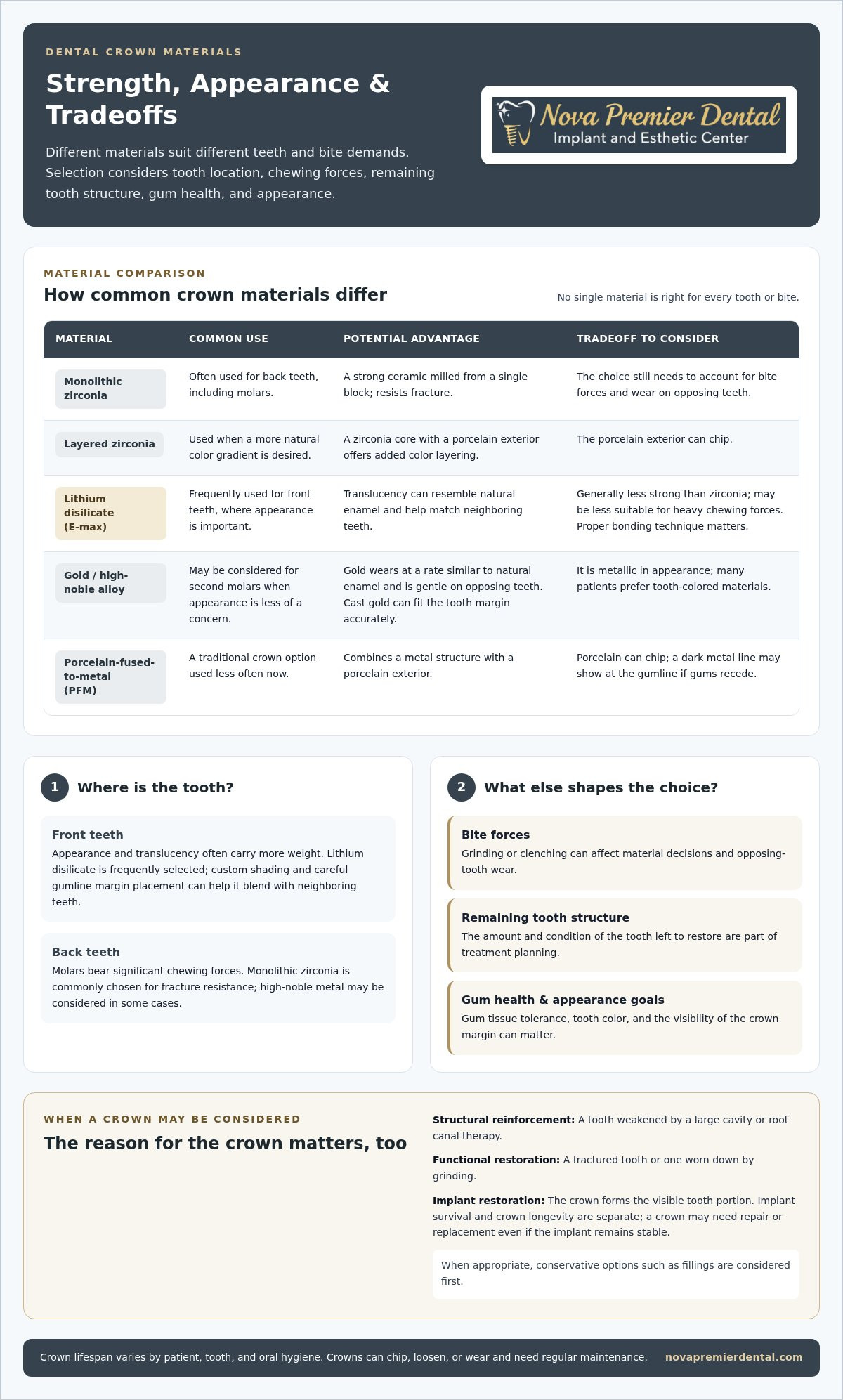
Common types of dental crowns include zirconia, lithium disilicate, gold alloys, and porcelain-fused-to-metal. The choice depends on the forces the tooth bears and on appearance expectations. Each material has tradeoffs.
Zirconia Crowns: Monolithic vs. Layered
Zirconia is a very strong ceramic. Monolithic zirconia, milled from a single solid block, is often used for back teeth because it resists fracture. Layered zirconia uses a zirconia core with a porcelain exterior for a more natural color gradient, but the porcelain layer can chip. Zirconia is often used for bridges as well. Survival rates differ between studies, so a clinician can discuss published evidence relevant to a specific case.
Lithium Disilicate (E-max) for Front Teeth
Lithium disilicate, commonly known by the brand name E-max, is frequently used for front teeth because its translucency resembles natural enamel. It may be used when matching adjacent porcelain veneers. It is generally less strong than zirconia, so it may be less suitable for heavy chewing forces, and proper bonding technique is important.
Gold and High-Noble Alloys
Gold and high-noble alloys remain a option in some cases. Gold wears at a rate similar to natural enamel, so it is gentle on opposing teeth, and cast gold can fit the tooth margin accurately. It may be considered for second molars where appearance is less of a concern, though many patients prefer tooth-colored materials.
Porcelain-fused-to-metal (PFM) crowns are used less often now. A dark metal line can become visible at the gumline if the gum recedes, and the porcelain can chip. To discuss which material may fit your situation, contact our office to schedule a consultation. Nova Premier Dental offers in-house payment plans for qualifying patients, allowing treatment costs to be paid over several months.
Selecting the Right Material Based on Tooth Location and Function
The right crown material depends largely on the tooth's position in the dental arch. Front teeth emphasize appearance, while back teeth must withstand greater chewing forces. At our Falls Church office, Dr. Huang evaluates the bite before recommending a material. This is particularly relevant for patients with TMJ or jaw joint disorders, where the restoration should fit well with jaw movement. The relationship between bite changes and joint symptoms is not fully established, so evaluation is individualized.
Front Teeth: Matching Appearance
Restoring front teeth involves more than matching a shade. Lithium disilicate (E-max) is often selected because it can be more translucent than metal-based options. Custom shading and characterization help the crown resemble neighboring teeth, and careful margin placement at the gumline reduces visibility. Results depend on the patient's tooth color, gum health, and the amount of remaining tooth structure.
Durability for the Posterior Region
Molars bear significant chewing forces. Monolithic zirconia is commonly chosen for these teeth because of its fracture resistance, including in patients with a history of broken crowns. In some cases, high-noble metal crowns are used because they can require less tooth reduction. For patients with severe bruxism, material choice should consider both durability and the wear on opposing teeth.
The premolars are a transition zone: visible when smiling but involved in chewing. As a prosthodontist in Northern Virginia, Dr. Huang may use high-translucency zirconia for these teeth to balance strength and appearance. Nova Premier Dental offers in-house payment plans for qualifying patients, allowing treatment costs to be paid over several months.
The Role of Advanced Technology in Material Success
Crown fit affects performance, since a poorly fitting margin can contribute to recurrent decay. Digital intraoral scanners record the tooth shape without traditional putty impressions, and many offices use them. The data feed a CAD/CAM (computer-aided design and manufacturing) workflow in which a crown is milled from a block of material. Digital and conventional impressions can both produce well-fitting crowns when done carefully.
Milling avoids some distortion that can occur when metal is cast or porcelain is fired, though the final result still depends on the preparation, scan quality, and laboratory work. Dr. Huang works with dental laboratories experienced in prosthodontic requirements.
Precision Fit and Marginal Integrity
Marginal integrity refers to how closely the crown seals against the natural tooth. Gaps can allow bacteria to collect, which may lead to recurrent decay or gum inflammation. Digital planning helps control material thickness while preserving tooth structure. Bite analysis tools such as T-Scan can help identify heavy contacts so the bite can be adjusted, which may reduce stress on the crown, though crown lifespan cannot be guaranteed.
From Temporary to Permanent: The Transition
A temporary crown protects the tooth while the final crown is made, and it lets the dentist and patient assess comfort, bite, and appearance. Adjustments from the temporary can guide the final crown. The temporary step is also part of larger oral reconstruction planning. To discuss your options, contact Nova Premier Dental. Nova Premier Dental offers in-house payment plans for qualifying patients, allowing treatment costs to be paid over several months.
When to Consider Specialist Evaluation for a Dental Crown
Many crowns are placed successfully by general dentists. A prosthodontist is a dental specialist who completes additional years of postgraduate training in restoring and replacing teeth, and may be helpful for complex cases involving several teeth, bite problems, or jaw function concerns. You can learn more on the prosthodontist in Northern Virginia page.
In complex cases such as a full mouth reconstruction, different materials may be chosen for different areas of the mouth to keep the bite stable. A single front crown might use lithium disilicate, while a full-arch restoration may use high-translucency zirconia for strength, particularly when the vertical dimension (the bite height) is being changed.
Planning and Attention to Detail
Peterson Huang, DMD, MS, FACP, FRCDC, is board certified in prosthodontics in the United States and Canada. Treatment planning before tooth preparation, including review of margins and occlusion, applies to every crown and bridge case. Careful planning helps reduce problems from poor fit or an unbalanced bite, but outcomes cannot be guaranteed.
Cost and Payment Options
Crown cost varies with the material, laboratory fees, and complexity of the case. Replacement or repair may be needed if a crown chips, loosens, or decay develops. Nova Premier Dental offers in-house payment plans for qualifying patients, allowing treatment costs to be paid over several months.
Summary: Choosing a Crown Material
No single crown material suits every tooth. Zirconia is often chosen for strength, lithium disilicate for translucency, and gold for gentle wear on opposing teeth. Choice depends on the tooth, bite, and patient priorities, and any crown needs regular care and monitoring.
Nova Premier Dental is a private prosthodontic specialty dental office in Falls Church serving Northern Virginia. Dr. Huang, a prosthodontist, evaluates crowns and more complex restorations. To discuss your situation, you can schedule a consultation or visit the practice homepage.
Frequently Asked Questions
What is the most durable material for a dental crown in 2026?
Monolithic zirconia is generally regarded as one of the most fracture-resistant crown materials, which is why it is commonly used for molars. Even so, any crown can chip, loosen, or wear, and its lifespan varies with bite forces, oral hygiene, and fit.
Which dental crown material looks the most like a natural tooth?
Lithium disilicate (E-max) is commonly chosen for front teeth because its glass-ceramic structure resembles the translucency of natural enamel. Final appearance also depends on shade matching, neighboring teeth, and the dentist's technique.
Is zirconia better than porcelain for back teeth?
Zirconia is often preferred over traditional layered porcelain for back teeth because it has higher fracture resistance. Porcelain can chip under heavy chewing forces, while monolithic zirconia is milled from a solid block. The best choice still depends on the individual tooth and bite.
How long does a dental crown last?
Crown lifespan varies widely. It depends on the material, fit, bite forces, oral hygiene, and whether decay develops at the margin. Regular exams and cleanings help detect problems early. If you want a specialist's opinion, see our prosthodontist in Northern Virginia page.
Can I get a dental crown if I grind my teeth at night?
Yes, but material selection matters for patients with bruxism (teeth grinding or clenching). Monolithic zirconia is often chosen for its resistance to fracture, though it can wear opposing teeth. A custom night guard is often recommended to help protect the crown and natural teeth. A night guard reduces forces but does not eliminate the risk of damage.
When might a prosthodontist be helpful for a crown?
A prosthodontist is a dental specialist with additional postgraduate training in restoring and replacing teeth. Specialist evaluation may be useful for multi-tooth cases, bite or jaw function concerns, or previous restoration failures. General dentists also provide crowns, and the right provider depends on the complexity of the case.
Does the material of the crown affect the total cost of the procedure?
Yes, material choice influences cost, as some ceramics involve different fabrication processes and laboratory fees. Nova Premier Dental offers in-house payment plans for qualifying patients, allowing treatment costs to be paid over several months.
Are there metal-free options for patients with sensitivities?
Yes. Zirconia and lithium disilicate are metal-free ceramics, and they are options for patients concerned about metal sensitivity. They also avoid the dark margin line sometimes seen with porcelain-fused-to-metal crowns. Patients with known allergies should discuss them with their dentist before treatment.
Disclaimer
The information provided on this website and blog is intended for general educational and informational purposes only and should not be considered dental or medical advice, diagnosis, or treatment. Reading content on this website does not establish a doctor-patient relationship with Nova Premier Dental or Dr. Peterson Huang. Dental conditions and treatment needs vary from patient to patient. Individuals should consult directly with a qualified dental professional for personalized evaluation, diagnosis, and treatment recommendations. Do not delay seeking professional dental care based on information found on this website. While we strive to provide accurate and up-to-date information, no guarantee is made regarding the completeness, accuracy, or applicability of the content. Treatment outcomes may vary depending on individual circumstances. If you are experiencing a dental emergency or urgent oral health concern, please contact a licensed dental professional immediately or call 911 in the event of a medical emergency.


