


Article by
Peterson Huang DMD, MS, FACP, FRCDC
Dr. Peterson Huang is a dual board-certified prosthodontist serving Falls Church and Northern Virginia. He has been recognized as a Top Prosthodontist by Northern Virginia Magazine and Arlington Magazine and is affiliated with the Inova Fairfax Hospital Tumor Board. Dr. Huang focuses on dental implants, full mouth reconstruction, and complex restorative dentistry for patients who need advanced, comprehensive care.
How Much Does a Dental Crown Cost in Virginia?
dental crown fees in Virginia vary widely. They depend on the material, the condition of the tooth, the lab used, the complexity of the case, and the office's fee structure. Because fees differ so much between offices, this article does not quote a single price range. Ask any office for a written estimate that itemizes every step. A crown fee usually covers more than the crown itself, and the lowest quoted fee is not always the lowest total cost if the crown needs early replacement.
Fees in Northern Virginia generally reflect regional overhead, including facility costs, staffing, and laboratory fees. Offices in Falls Church and Arlington are subject to the same market pressures. That is one reason national averages can be a poor guide to local fees.
What Determines Dental Crown Cost?
- Material: Zirconia, lithium disilicate (often sold as e.max), porcelain-fused-to-metal, and gold alloy are priced differently.
- Remaining tooth structure: A heavily broken-down tooth may need a core build-up, and sometimes crown lengthening, before a crown can be made.
- Diagnostic records: X-rays, 3D imaging when indicated, and digital or conventional impressions may be billed as part of the visit or separately.
- Laboratory: Labs differ in materials, shade matching, and communication with the dentist. Some offices use local labs, others use larger or overseas labs. Where a crown is made is not, by itself, a reliable measure of quality.
- Case complexity: A single crown on a healthy tooth is a different task from several crowns planned together to change the bite.
Diagnostic and Preparatory Steps
Before a crown is made, the dentist evaluates the tooth with an exam and radiographs. The tooth's prognosis matters: a crown placed on a tooth with unresolved decay, a fracture below the gum line, or an untreated infection may not last. If a tooth has had a root canal, the root canal treatment should be assessed first. Endodontic treatment is performed by a general dentist or an endodontist; Nova Premier Dental does not provide it and coordinates referrals when needed.
A core build-up replaces missing internal tooth structure so the crown has something stable to attach to. Crown lengthening exposes more tooth when the break extends near the gum line. Both add cost, but skipping needed preparation can compromise the crown's retention and the health of the surrounding gum tissue.
Crown Materials Compared
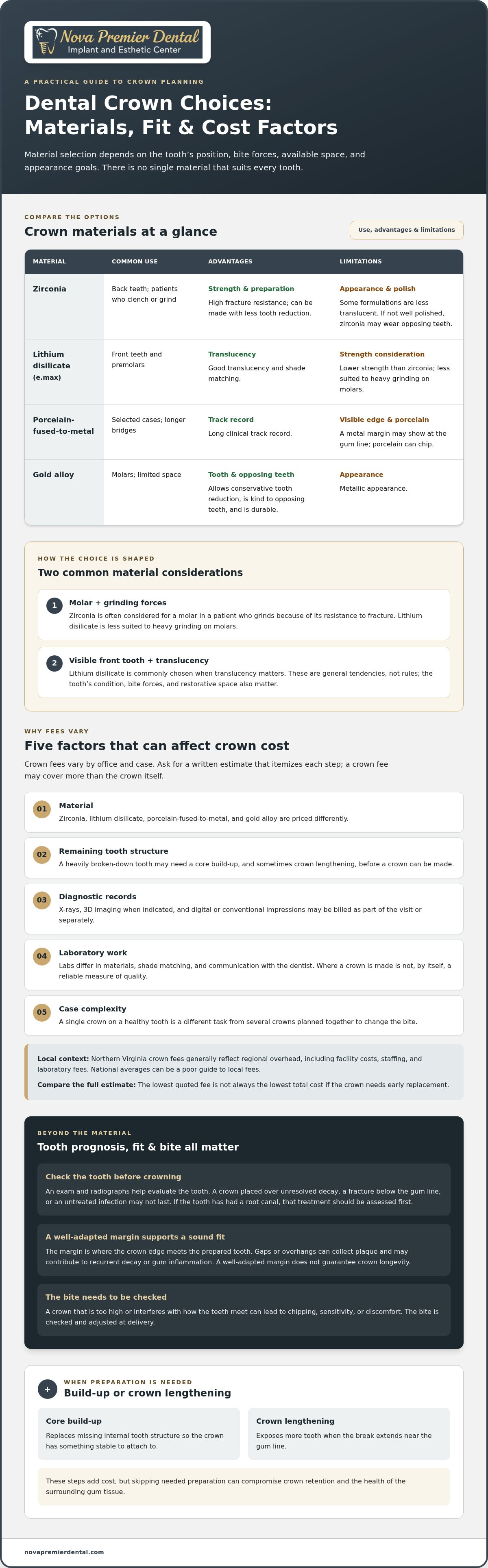
No single material is best for every tooth. The choice depends on the tooth's position, the forces it receives, the available space, and appearance goals.
| Material | Typical use | Advantages | Limitations |
|---|---|---|---|
| Zirconia | Back teeth, patients who clench or grind | High fracture resistance; can be made with less tooth reduction | Can be less translucent in some formulations; may wear opposing teeth if not well polished |
| Lithium disilicate (e.max) | Front teeth and premolars | Good translucency and shade matching | Lower strength than zirconia; less suited to heavy grinding on molars |
| Porcelain-fused-to-metal | Selected cases, longer bridges | Long clinical track record | Metal margin may show at the gum line; porcelain can chip |
| Gold alloy | Molars, limited space | Conservative tooth reduction, kind to opposing teeth, durable | Metallic appearance |
Systematic reviews of single crowns report that survival varies by material, tooth location, and patient factors, and that chipping and loss of retention are common causes of repair or replacement. Because published figures differ by study design and follow-up period, no lifespan should be treated as a promise. Grinding or clenching (bruxism), the bite relationship (occlusion), oral hygiene, and the amount of remaining tooth all influence how long a crown lasts. A custom night guard may be recommended for patients who grind; see our guide to custom night guards for bruxism.
Choosing Between Zirconia and e.max
For a molar in a patient who grinds, zirconia is often considered because of its resistance to fracture. For a visible front tooth where translucency matters, lithium disilicate is commonly chosen. These are general tendencies, not rules. Dr. Peterson Huang, a prosthodontist, selects materials based on bite forces, restorative space, and the tooth's condition, which may be especially relevant when several teeth are being restored together. More on the practice's approach is on the crowns page.
General Dentists and Prosthodontists: Why Fees May Differ
General dentists provide most crowns in the United States and routinely place them well. Many single-crown cases are appropriately handled in a general practice. Prosthodontists complete additional specialty training focused on restoring and replacing teeth and managing complex restorative problems.
A fee difference, where one exists, may reflect longer appointments, more detailed records, laboratory communication, or treatment of cases with greater complexity. Specialist care is not necessary for every crown, and no study supports the claim that a prosthodontist's crown will always outperform one from another qualified dentist. Specialist evaluation may be worth considering when:
- several teeth need restoration and the bite must be coordinated;
- a previous crown or bridge failed repeatedly;
- there is significant tooth wear, limited restorative space, or a jaw joint disorder;
- crowns are part of an implant-supported or full-mouth plan.
Our comparison of a prosthodontist and a general dentist explains this in more detail.
Credentials
Dr. Peterson Huang completed specialty training in prosthodontics and holds board certification through the American Board of Prosthodontics and the Royal College of Dentists of Canada. His credentials are Peterson Huang, DMD, MS, FACP, FRCDC. You can read about his training on the Meet Dr. Huang page, and about the specialty in our overview of prosthodontic care in Northern Virginia.
Why Fit and Margins Matter
Marginal integrity refers to how closely the edge of a crown meets the prepared tooth. Gaps or overhangs at the margin can collect plaque and may contribute to recurrent decay or gum inflammation. A well-adapted margin does not guarantee the crown will last, but a poorly adapted one is a recognized risk factor. Margin quality depends on the preparation, the impression or scan, the lab work, and the final cementation or bonding.
Occlusion is equally important. A crown that is too high or interferes with how the teeth meet can lead to chipping, sensitivity, or discomfort, and is adjusted at delivery.
Insurance and Payment
Most dental plans classify crowns as major restorative services and pay a percentage of the plan's allowed amount, subject to annual maximums, waiting periods, and frequency limits. Several terms are worth understanding:
- Usual, customary, and reasonable (UCR) fees: the amount a plan considers standard for an area. If an office charges more, the patient may owe the difference, depending on the contract.
- Least expensive alternative treatment (LEAT) clause: some plans base payment on a less costly option, such as a filling or a different material, even when a crown is chosen.
- Pre-determination: a request to the insurer before treatment for an estimate of coverage. It is helpful for larger plans and is not a guarantee of payment.
Coverage differs between plans, and whether a specialist is in-network depends on your contract. Review the dental insurance and benefits page and confirm details with your insurer. Nova Premier Dental offers in-house payment plans for qualifying patients, allowing treatment costs to be paid over several months while patients enjoy their new smile.
Frequently Asked Questions
How long do crowns last?
There is no fixed lifespan. Published studies report a wide range depending on material, tooth, and patient factors, and crowns may need repair or replacement at different times. Regular exams and cleanings, good home care, and protection from grinding help.
Can a chipped crown be repaired?
Small chips in porcelain can sometimes be polished or repaired with bonded composite, though repairs may be temporary. Larger fractures or a loose crown usually require replacement, and the underlying tooth should be examined for decay.
Is a crown needed after a root canal?
Often, particularly for back teeth, because a tooth that has had a root canal may have lost significant structure and can be more prone to fracture. A front tooth with minimal loss may sometimes be restored with a filling. The decision depends on how much tooth remains.
Does insurance cover the full cost of a porcelain crown?
Typically not. Plans usually pay a portion and apply deductibles, annual maximums, and sometimes a LEAT clause.
Getting an Accurate Estimate
Ask for a written treatment plan listing the crown, any build-up or crown lengthening, imaging, and anticipated follow-up. Ask which material is proposed and why, and what happens if the crown needs adjustment or replacement. A second opinion is reasonable before major work.
If you have questions about a complex restorative or prosthodontic concern, Nova Premier Dental, a private prosthodontic specialty dental office in Falls Church, provides care for patients throughout Northern Virginia. You can contact the office to arrange an evaluation.
Disclaimer
The information provided on this website and blog is intended for general educational and informational purposes only and should not be considered dental or medical advice, diagnosis, or treatment. Reading content on this website does not establish a doctor-patient relationship with Nova Premier Dental or Dr. Peterson Huang. Dental conditions and treatment needs vary from patient to patient. Individuals should consult directly with a qualified dental professional for personalized evaluation, diagnosis, and treatment recommendations. Do not delay seeking professional dental care based on information found on this website. While we strive to provide accurate and up-to-date information, no guarantee is made regarding the completeness, accuracy, or applicability of the content. Treatment outcomes may vary depending on individual circumstances. If you are experiencing a dental emergency or urgent oral health concern, please contact a licensed dental professional immediately or call 911 in the event of a medical emergency.


