

Article by
Peterson Huang DMD, MS, FACP, FRCDC
Dr. Peterson Huang is a dual board-certified prosthodontist serving Falls Church and Northern Virginia. He has been recognized as a Top Prosthodontist by Northern Virginia Magazine and Arlington Magazine and is affiliated with the Inova Fairfax Hospital Tumor Board. Dr. Huang focuses on dental implants, full mouth reconstruction, and complex restorative dentistry for patients who need advanced, comprehensive care.
What if the quickest way to replace a lost tooth actually compromised the health of the two perfectly healthy teeth next to it? When weighing a dental bridge vs implant for one missing tooth, many patients prioritize speed, yet the biological cost of altering adjacent enamel is often overlooked. At Nova Premier Dental, we understand that losing a tooth is a significant event that requires a meticulous, long-term perspective. It's natural to feel anxious about invasive surgery or confused by the disparity between initial costs and lifetime value.
As a specialist in restorative care, Dr. Huang focuses on solutions that mirror the natural function of your original dentition. You deserve a restoration that feels seamless and protects your remaining healthy teeth for decades, not just years. This guide explores the clinical differences between these two standards of care to help you choose the right path for your oral health. We will examine how a prosthodontist evaluates bone preservation, the 98% success rate of modern implants, and how our in-house payment plans can make elite-level care manageable over several months.
Key Takeaways
- Understand why delaying treatment leads to dental drifting and bite misalignment, which can complicate future restorative efforts and compromise your oral health.
- Evaluate the structural differences of a dental bridge vs implant for one missing tooth, including how implants preserve jawbone while bridges rely on the support of adjacent teeth.
- Discover why implants are considered a lifetime investment with a 98% success rate, compared to the typical 10 to 15 year lifespan of traditional dental bridges.
- Learn the specific clinical criteria, such as jawbone density and the health of neighboring enamel, that determine which restoration is ideal for your unique smile.
- Gain insight into the specialized planning process used by a board-certified prosthodontist to ensure your new tooth integrates seamlessly with your natural facial proportions.
The Clinical Importance of Replacing a Single Missing Tooth
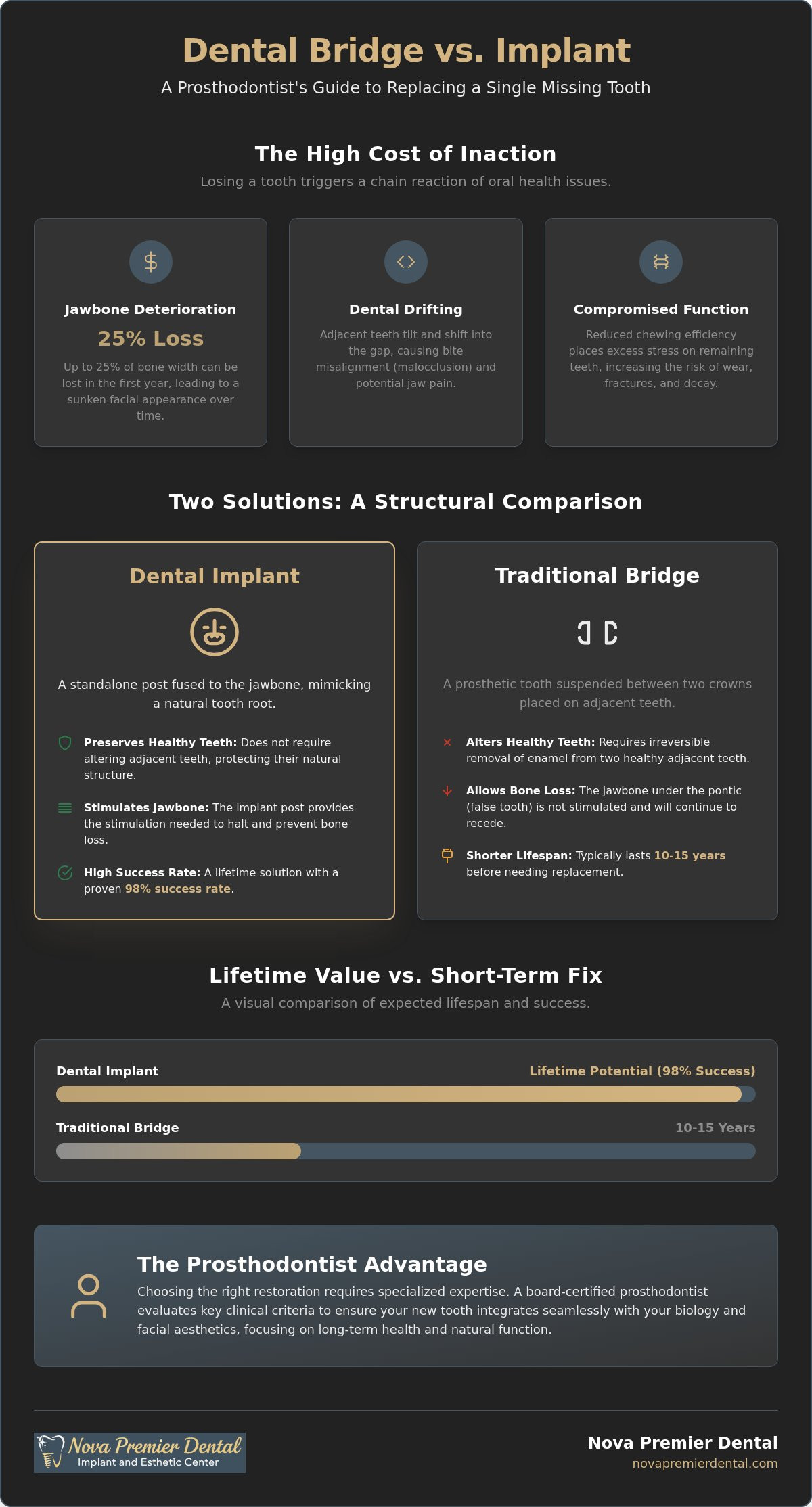
The loss of a single tooth triggers a cascade of physiological changes that extend far beyond the visible gap in a smile. Dr. Peterson Huang, a dual board-certified prosthodontist, emphasizes that the oral cavity exists in a state of dynamic equilibrium. When that balance is disrupted, the surrounding structures immediately begin to compensate. Neighboring teeth often tilt or drift into the vacant space, a phenomenon known as dental drifting. This movement can lead to malocclusion, where the upper and lower teeth no longer align correctly, potentially causing discomfort in the jaw joint and increasing the risk of periodontal disease in hard-to-reach crevices. When evaluating a dental bridge vs implant for one missing tooth, the choice should be made with a full understanding of these biological consequences.
The Biological Impact of Tooth Loss
The most significant concern following tooth loss is the silent deterioration of the jawbone. Research indicates that patients can lose up to 25% of bone width in the first twelve months after an extraction. Without the mechanical stimulation of a natural root, the body begins to reclaim the minerals in the alveolar bone. Bone resorption is the physiological process where the body reabsorbs unused jawbone minerals following the loss of a tooth root. This loss of volume doesn't just compromise the stability of adjacent teeth; it can eventually lead to a sunken facial appearance as the bone that once supported the lips and cheeks diminishes. The choice between a dental bridge vs implant for one missing tooth often hinges on how effectively the restoration can halt this bone loss.
Restoring Function and Aesthetics in Northern Virginia
Functionally, even one missing tooth reduces masticatory efficiency. It forces the remaining teeth to bear a higher load, which can lead to premature wear, enamel fractures, or muscle fatigue. A Dental implant provides a direct replacement for the lost root, while fixed bridges utilize neighboring teeth as structural anchors. Both options address the psychological impact of tooth loss, restoring the confidence needed for social and professional interactions in Northern Virginia. We believe that financial considerations shouldn't prevent patients from receiving elite restorative care. Our practice offers in-house payment plans for qualifying patients, allowing you to manage the cost over several months while you're already enjoying the benefits of your new smile. At Nova Premier Dental, we specialize in high-end problem solving for these complex restorative cases.
Dental Bridges vs. Implants: How Each Restoration Works
The engineering behind a dental bridge vs implant for one missing tooth determines not just how your smile looks, but how it functions under the pressure of daily use. While both options are designed to fill a gap, they interact with your oral anatomy in fundamentally different ways. One uses the strength of neighboring teeth to support a prosthetic; the other utilizes the structural integrity of the jawbone itself to create a standalone replacement.
The Mechanics of a Dental Bridge
A traditional fixed bridge typically utilizes a three-unit structure to bridge the gap. This involves two "abutment" teeth, which act as anchors, and a "pontic," the prosthetic tooth suspended between them. To secure this restoration, a specialist must prepare the adjacent healthy teeth by removing a significant layer of their natural enamel to accommodate the crowns. This process is irreversible. While a bridge offers a shorter clinical timeline, often completed in just two visits, it places the masticatory load of three teeth onto the roots of two. Clinical insights from the Dental Bridge vs Implant comparison by Cleveland Clinic suggest that this added stress can eventually compromise the long-term health of those anchor teeth.
The Engineering of a Dental Implant
A dental implant is a more sophisticated, standalone restoration. It consists of a titanium or zirconia post that serves as a prosthetic root, an abutment, and a custom-milled crown. The core of this technology is osseointegration, a biological process where the jawbone physically fuses with the implant post. This creates a foundation that is often more durable than a natural tooth root. Because it doesn't require shaving down healthy enamel on neighboring teeth, it's widely considered the most conservative and biological approach to tooth replacement.
Material science plays a critical role in the success of these restorations. At Nova Premier Dental, Dr. Huang utilizes advanced materials like high-strength zirconia and biocompatible titanium to ensure seamless integration. While the implant process requires several months for the bone to fully integrate with the post, the result is a tooth that functions independently. We believe that elite care should be accessible, which is why our practice offers in-house payment plans for qualifying patients. These plans allow you to manage the cost of your care over several months while you're already benefiting from a restored, healthy smile. If you're curious about which mechanical approach is best for your specific case, you can request a personalized evaluation to discuss your goals.
Comparing Longevity, Oral Health, and Aesthetics
Choosing between a dental bridge vs implant for one missing tooth requires a careful analysis of how each restoration interacts with your biology over several decades. While a bridge provides an immediate functional result, the long-term success rates reveal a distinct advantage for the implant. Data from 2026 suggests that traditional three-unit bridges maintain an 89 to 90 percent survival rate over ten years. In contrast, dental implants boast a ten-year survival rate of 95 to 97 percent; many are considered a lifetime investment that can last 25 years or more with meticulous care. At Nova Premier Dental, we prioritize restorations that offer the highest predictability for our patients.
Maintenance and Long-Term Success Rates
Hygiene requirements differ significantly between these two options. A dental implant functions like a natural tooth, allowing for standard brushing and flossing. Conversely, a bridge is a single, connected unit that requires specialized tools, such as floss threaders, to clean the space beneath the prosthetic tooth. If hygiene is neglected, food particles can become trapped, leading to recurrent decay on the anchor teeth; this is a primary cause of bridge failure. According to a report on replacing lost teeth by Harvard Health Publishing, implants are often preferred because they cannot develop cavities, though they still require healthy gum tissue to remain stable. For more specialized insights, you may explore our guide on Restorative Dentistry in Falls Church, VA.
Preserving Your Natural Tooth Structure
The most significant "biological cost" of a bridge is the permanent alteration of adjacent teeth. To place a bridge, a dentist must shave down the healthy enamel of the neighboring teeth to serve as anchors. This process is irreversible and can leave those teeth more vulnerable to sensitivity or future structural issues. An implant avoids this sacrifice entirely. It stands alone, protecting the integrity of the entire dental arch without involving the surrounding dentition.
From an aesthetic perspective, Dr. Peterson Huang utilizes his expertise as a prosthodontist to achieve an "emergence profile" that mimics a tooth growing naturally from the gum line. This level of customization ensures that the final restoration is indistinguishable from your natural teeth. We recognize that these advanced procedures represent a commitment to your health. To support our patients, we offer in-house payment plans for qualifying individuals. These plans allow you to distribute the cost over several months, ensuring you can enjoy the benefits of a permanent, natural-looking smile without delay.
Decision Criteria: Which Option is Right for Your Smile?
Selecting a dental bridge vs implant for one missing tooth is a clinical decision that requires a synthesis of your biological candidacy, systemic health, and long-term restorative goals. While the previous sections established the structural and aesthetic advantages of each, the final choice often hinges on specific diagnostic data. A meticulous evaluation ensures that the chosen restoration doesn't just fill a gap but integrates perfectly with your existing dental arch. Factors such as the condition of neighboring enamel, the presence of systemic conditions like controlled diabetes, or a history of smoking can significantly influence the predictability of your outcome.
Clinical Candidacy for Implants
The primary prerequisite for a successful implant is sufficient bone volume to support the titanium post. At Nova Premier Dental, we utilize advanced cone beam computed tomography (CBCT) to create a high-resolution 3D map of your jaw. This allows us to assess bone density with precision before any procedure begins. If the scan reveals inadequate bone, we may recommend a bone grafting procedure to rebuild the site. Conversely, if the teeth adjacent to the gap already have large, failing fillings or require crowns, a bridge might be a highly efficient way to address multiple restorative needs simultaneously. Consulting with a board certified prosthodontist in VA is essential for this level of nuanced planning, as they possess the specialized training to manage complex reconstructions that general practices might overlook.
Investing in Your Oral Health
When evaluating the financial aspect, it's vital to distinguish between the initial price and the total cost of ownership over twenty years. A bridge may appear more accessible at first, yet its 10 to 15 year lifespan often necessitates at least one full replacement. An implant, while requiring a larger upfront commitment, is designed to be a permanent solution. We believe that elite clinical care should be within reach for those who value their long-term health. To facilitate this, Dr. Huang offers in-house payment plans for qualifying patients. These plans are structured to allow you to make payments over several months. This approach ensures you can comfortably manage the investment in your health while you're already enjoying the function and confidence of your restored smile.
If you're ready to determine which restoration is best for your unique anatomy, we invite you to schedule a comprehensive consultation at our Northern Virginia office for a personalized treatment plan.
Specialized Restorative Care at Nova Premier Dental
Achieving a result that is both biologically sound and aesthetically perfect requires more than standard dentistry; it demands the precision of a specialist. When deciding on a dental bridge vs implant for one missing tooth, the technical execution of the procedure is just as vital as the choice of restoration itself. At Nova Premier Dental, we approach every case with a commitment to excellence that is grounded in advanced medical training and a meticulous eye for detail. Our goal is to provide a solution that doesn't just fill a gap but restores the biomechanical stability of your entire smile.
Meet Dr. Peterson Huang
As a dual board-certified specialist, Dr. Huang’s credentials reflect a level of expertise that distinguishes our practice from general dental offices. While a general dentist provides a wide range of basic services, a prosthodontist undergoes years of additional residency training dedicated specifically to the restoration and replacement of teeth. This specialization is critical for complex oral reconstruction, where the objective is to balance the mechanics of your bite with the natural contours of your face. Dr. Huang is a perfectionist. He views every single-tooth replacement as a vital component of your long-term health and functional beauty.
Your Consultation in Falls Church
Your journey toward a restored smile begins with a comprehensive evaluation at our Falls Church practice. We utilize state-of-the-art 3D imaging and computer-guided planning to ensure that every implant is placed with sub-millimeter precision. This technology allows us to visualize your bone structure and nerve pathways before the procedure begins, minimizing surgical trauma and maximizing the longevity of the restoration. During your visit, we will discuss the clinical nuances of a dental bridge vs implant for one missing tooth based on your specific diagnostic data. We prioritize transparency, ensuring you have all the information necessary to make an informed decision for your health.
We recognize that elite clinical care is a significant investment. To support our patients, we offer in-house payment plans for qualifying individuals. These plans are designed to allow you to make payments over several months, ensuring you can manage the cost of care while you are already enjoying the benefits of your new smile. This individualized approach to both treatment and financing reflects our commitment to patient-centric care. If you're ready to explore a permanent, natural-feeling solution for your missing tooth, we invite you to Contact Us to schedule your specialized consultation.
Securing Your Long-Term Oral Health and Confidence
Choosing between a dental bridge vs implant for one missing tooth involves balancing immediate functional needs with the biological preservation of your jawbone and adjacent teeth. While a bridge offers a rapid restoration, a dental implant remains the gold standard for its ability to stop bone resorption and protect natural enamel. At Nova Premier Dental, we focus on providing restorative solutions that stand the test of time, utilizing advanced 3D imaging to ensure meticulous placement and a 98% clinical success rate.
As a dual board-certified prosthodontist and an expert in complex oral reconstruction, Dr. Peterson Huang provides the specialized care necessary for a seamless, natural-looking result. We believe elite medical care should be accessible; therefore, we offer in-house payment plans for qualifying patients. These plans allow you to manage the investment over several months while you already enjoy the benefits of your restored smile. Don't let a single gap compromise the integrity of your dental arch. Schedule Your Specialist Consultation with Dr. Huang today to begin your personalized journey toward functional beauty. We look forward to helping you achieve a permanent solution you can trust.
Frequently Asked Questions
Is a dental implant more painful than getting a bridge?
The implant procedure is typically no more uncomfortable than a routine tooth extraction. We utilize advanced local anesthesia to ensure you don't feel pain during the surgery. Most patients report that any post-operative soreness is mild and easily managed with standard over-the-counter medication for a few days.
How long does the dental implant process take compared to a bridge?
The timeline for a dental bridge vs implant for one missing tooth differs due to the requirement for biological integration. A bridge is usually completed in two appointments over two to three weeks. An implant requires a healing period of three to six months for the post to fuse with the jawbone, though we can often provide a temporary aesthetic restoration during this time.
Can I switch from a bridge to an implant later in life?
It's possible to transition from a bridge to an implant, though it may require additional steps. Because the bone beneath a bridge often resorbs over time, Dr. Huang might need to perform a bone graft to ensure there's enough volume to support the implant post. We recommend an early evaluation to assess your bone density.
Does insurance typically cover implants or bridges for one missing tooth?
Most major dental PPO plans in 2026 categorize both restorations as major procedures and cover approximately 50 percent of the cost after the deductible. Because individual plans vary, our team provides a comprehensive benefit analysis during your visit. For any out-of-pocket costs, we offer in-house payment plans that allow you to distribute payments over several months.
What happens if I don’t replace my missing tooth at all?
Leaving a gap triggers dental drifting, where neighboring teeth tilt into the vacant space and disrupt your bite alignment. This can lead to increased wear on other teeth and potential jaw joint issues. You'll also experience bone volume loss in the jaw, which can eventually alter your facial structure and make future tooth replacement more complex.
How do I clean and maintain a dental bridge vs. an implant?
An implant is maintained exactly like a natural tooth with standard brushing and flossing. A bridge requires a more specialized hygiene routine; you must use floss threaders or interdental brushes to clean the space beneath the prosthetic tooth. Failure to clean under the bridge can lead to gum disease or decay on the supporting anchor teeth.
Are there any age limits for getting a dental implant?
There is no upper age limit for dental implants as long as you have sufficient bone density and are in good systemic health. However, we don't place implants in younger patients whose jawbones are still growing. This usually means waiting until the late teens or early twenties once skeletal development is complete.
What is the success rate for single tooth implants at Nova Premier Dental?
Our practice achieves a success rate of approximately 98 percent for single tooth implants, matching the highest clinical standards of 2026. This level of predictability is achieved through the specialized training of a prosthodontist and the use of precision 3D imaging. At Nova Premier Dental, we focus on meticulous planning to ensure your restoration lasts for decades.
Disclaimer
The information provided on this website and blog is intended for general educational and informational purposes only and should not be considered dental or medical advice, diagnosis, or treatment. Reading content on this website does not establish a doctor-patient relationship with Nova Premier Dental or Dr. Peterson Huang. Dental conditions and treatment needs vary from patient to patient. Individuals should consult directly with a qualified dental professional for personalized evaluation, diagnosis, and treatment recommendations. Do not delay seeking professional dental care based on information found on this website. While we strive to provide accurate and up-to-date information, no guarantee is made regarding the completeness, accuracy, or applicability of the content. Treatment outcomes may vary depending on individual circumstances. If you are experiencing a dental emergency or urgent oral health concern, please contact a licensed dental professional immediately or call 911 in the event of a medical emergency.


