


Article by
Peterson Huang DMD, MS, FACP, FRCDC
Dr. Peterson Huang is a dual board-certified prosthodontist serving Falls Church and Northern Virginia. He has been recognized as a Top Prosthodontist by Northern Virginia Magazine and Arlington Magazine and is affiliated with the Inova Fairfax Hospital Tumor Board. Dr. Huang focuses on dental implants, full mouth reconstruction, and complex restorative dentistry for patients who need advanced, comprehensive care.
The most significant risk in restorative dentistry isn't the procedure itself, but choosing a material that looks like a "fake" tooth or chips under the pressure of a daily bite. It's common to feel a sense of anxiety about dark metal lines at the gumline or confusion over technical terms like zirconia and E-max. At Nova Premier Dental, we believe you shouldn't have to compromise between clinical strength and natural beauty. This 2026 guide identifies the best material for dental crowns by utilizing the specialized expertise of a prosthodontist in Northern Virginia.
You'll learn how Dr. Peterson Huang applies his dual board-certified training to select restorations that harmonize with your unique facial features. We'll preview the latest advancements in monolithic zirconia and lithium disilicate, which now meet the rigorous FDA Quality Management System Regulation standards effective as of February 2026. This overview provides a clear path toward a durable, functional result. We also highlight how our in-house payment plans help qualifying patients comfortably manage the investment in their long-term health while already enjoying the benefits of a restored, confident smile.
Key Takeaways
- Learn why monolithic zirconia and lithium disilicate are the premier choices for restoring both structural integrity and natural translucency in 2026.
- Discover how to select the best material for dental crowns by balancing the mechanical demands of posterior teeth with the aesthetic requirements of your smile line.
- Understand the clinical advantages of a specialist-led approach, where a dual board-certified prosthodontist ensures a seamless fit that avoids the "fake" look of traditional restorations.
- See how advanced CAD/CAM technology and high-definition intraoral scanners replace traditional putty impressions for superior precision and patient comfort.
- Explore how our in-house payment plans allow you to prioritize high-end restorative materials while comfortably managing the investment over several months.
Understanding Dental Crown Materials in Modern Restorative Dentistry
A dental crown is a custom-fabricated restoration that encapsulates a compromised tooth to restore its structural integrity. It's not just a superficial cover; it's a meticulously engineered prosthesis designed to protect the tooth while restoring its original shape and function. Selecting the best material for dental crowns is the foundation of a successful restorative dentistry plan. In 2026, we've seen a definitive shift toward metal-free, highly biocompatible materials. This evolution is supported by the FDA’s Quality Management System Regulation, which became fully effective on February 2, 2026, ensuring that the dental crown materials and CAD/CAM systems used to create your restoration meet the highest global quality standards.
Dr. Peterson Huang approaches each case with the precision of a dual board-certified specialist. He evaluates your unique bite (occlusion), the health of the supporting bone, and your aesthetic goals to determine which materials will perform best in your specific oral environment. This personalized assessment ensures that the restoration doesn't just look natural but also functions seamlessly within your existing dental architecture. We focus on delivering a result that offers long-term value, moving away from outdated techniques that often resulted in visible metal lines or fragile porcelain.
The Restorative Trifecta: Strength, Aesthetics, and Biocompatibility
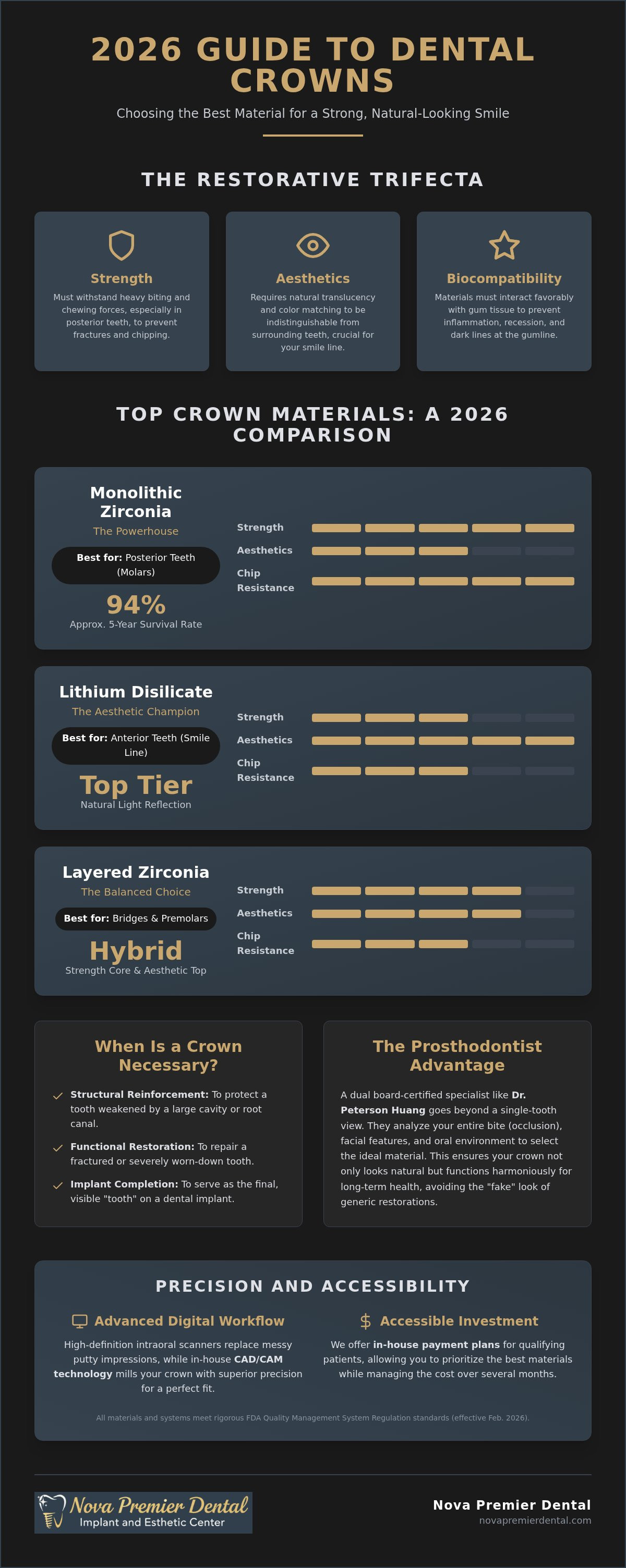
A successful restoration relies on three critical pillars. First, strength is paramount. The crown must withstand heavy occlusal forces, especially for patients with a history of grinding. Second, aesthetics involve more than just "white" teeth. We focus on translucency and light reflection to ensure the crown is indistinguishable from surrounding natural teeth. Finally, biocompatibility is essential. Modern ceramics interact favorably with the gingiva (gum tissue), preventing the inflammation or recession often seen with older metal-based options. Choosing the best material for dental crowns requires a careful balance of these three factors to ensure the crown lasts for a decade or more.
When Does a Tooth Require a Crown?
While we always prioritize conservative treatments, there are specific clinical scenarios where a crown is the most predictable solution for long-term health:
- Structural Reinforcement: Protecting a tooth that's been weakened by a large cavity or root canal therapy.
- Functional Restoration: Repairing a fractured tooth or one severely worn down by bruxism (grinding).
- Implant Completion: Serving as the final aesthetic component of a dental implant restoration.
By using advanced materials, we can address these issues while maintaining a natural appearance. Our practice offers in-house payment plans for qualifying patients, allowing you to prioritize the highest quality materials today while managing the cost comfortably over several months.
The Top Dental Crown Materials in 2026: Pros and Cons
In 2026, the clinical landscape for Types of dental crowns has evolved to prioritize materials that offer a seamless blend of biological compatibility and high-performance durability. Selecting the best material for dental crowns involves a meticulous analysis of the specific stresses a tooth will face, as well as the patient's aesthetic expectations. While traditional options still exist, advanced ceramics have largely redefined the standard of care for restorative procedures.
Zirconia Crowns: Monolithic vs. Layered
Zirconia is the 2026 industry leader due to its nearly indestructible nature. Monolithic zirconia, which is milled from a single solid block, provides maximum strength for posterior teeth. Recent 2026 data indicates a five-year survival rate of approximately 94% for these restorations, particularly in high-stress areas. Layered zirconia offers a more nuanced approach, utilizing a high-strength core with an aesthetic porcelain exterior to mimic the natural color gradients of a tooth. Many prosthodontists in Northern Virginia prefer zirconia for long-span bridges because it resists the chipping and fracturing that often plagued older ceramic systems.
Lithium Disilicate (E-max) for Elite Aesthetics
Lithium disilicate, frequently referred to by the brand name E-max, remains the premier choice for anterior restorations. It possesses a superior translucency that allows light to pass through the restoration much like natural enamel. This makes it the best material for dental crowns when performing smile makeovers or matching adjacent porcelain veneers. Although its survival rate is slightly lower than zirconia at 89%, the precision bonding techniques utilized at Nova Premier Dental significantly enhance the structural integrity of this glass-ceramic material.
The Enduring Value of Gold and High-Noble Alloys
Despite the popularity of "white" restorations, gold and high-noble alloys retain a critical place in specialized restorative dentistry. Gold is exceptionally gentle on opposing teeth because its wear rate closely mirrors that of natural enamel. This prevents the excessive wear of the "antagonist" teeth that can occur with some harder ceramics. Cast gold restorations also provide superior marginal integrity, fitting the tooth with microscopic accuracy. Specialists often recommend gold for second molars where visibility is low but the mechanical demands of chewing are at their peak.
Porcelain-fused-to-metal (PFM) crowns are increasingly rare in 2026. The inherent risk of a dark metal line appearing at the gumline makes them less desirable than modern all-ceramic alternatives. If you're determining which material is right for your unique case, contact our office to schedule a specialized consultation. We also provide in-house payment plans for qualifying patients, ensuring you can choose the highest-quality materials for your long-term health while managing the cost over several months.
Selecting the Right Material Based on Tooth Location and Function
Selecting the best material for dental crowns is a clinical decision that depends heavily on the tooth's position within the dental arch. Front teeth demand optical excellence, while back teeth require mechanical resilience. For patients in Falls Church, Dr. Peterson Huang analyzes the unique functional stresses of your bite before recommending a specific material. This tailored approach is especially critical for individuals suffering from TMJ or jaw joint disorders, where the restoration must harmonize with complex jaw movements to prevent further joint strain or premature wear on opposing teeth.
The Anterior Aesthetic Challenge
Restoring front teeth involves more than matching a shade guide. E-max (lithium disilicate) is often favored because it avoids the "opaque" or chalky appearance found in traditional metal-based options. Dr. Huang uses custom shading and characterization to ensure the crown replicates the subtle imperfections and light-reflective properties of your natural enamel. This meticulous approach ensures the crown margin, where the material meets the gumline, remains invisible even during a wide smile. By prioritizing seamless integration, we achieve a result that is indistinguishable from your natural dentition, avoiding the "fake" look that causes many patients anxiety.
Durability for the Posterior Region
Molars bear the brunt of masticatory forces, often enduring significant pressure during daily chewing. In 2026, monolithic zirconia has become the primary choice for these high-stress areas because it resists fracturing even in patients with a history of broken crowns. In specific clinical scenarios, high-noble metal crowns are still utilized because they require less tooth reduction, preserving more of the natural tooth structure. This is a vital consideration for patients with severe bruxism who need a restoration that is both durable and gentle on the opposing teeth, ensuring the longevity of the entire oral system.
The "transition zone," which includes the premolars, requires a hybrid strategy. These teeth are visible when you smile but still participate in heavy chewing. As a dual board-certified prosthodontist in Northern Virginia, Dr. Huang often utilizes high-translucency zirconia to provide the necessary strength without sacrificing the lifelike appearance required for the smile line. Regardless of the material chosen, our practice offers in-house payment plans for qualifying patients. These plans allow you to receive the highest standard of care now and pay over several months, ensuring your long-term oral health remains a manageable priority while you enjoy your restored smile.
The Role of Advanced Technology in Material Success
The clinical success of a restoration is inextricably linked to the technology utilized during its fabrication. Even the best material for dental crowns can fail if the fit isn't microscopically precise. In 2026, digital dentistry has reached a pivotal milestone, with intraoral scanner penetration exceeding 60% in the United States. This shift has established digital impressions as the definitive standard of care. By replacing traditional, messy putty with high-definition intraoral scans, we capture a level of detail that was previously impossible. This data is then used in a CAD/CAM (computer-aided design and manufacturing) workflow, where the crown is milled from a solid, monolithic block of material rather than being cast in a traditional lab setting.
Milling eliminates the risk of distortions or shrinkage that often occur during the cooling of molten metal or the firing of porcelain. It allows for a level of precision that ensures the restoration integrates perfectly with your existing dentition. Dr. Peterson Huang works exclusively with specialized lab partners who understand the nuances of prosthodontic requirements. This partnership ensures that every crown, whether zirconia or lithium disilicate, meets the highest standards of structural integrity and aesthetic translucency.
Precision Fit and Marginal Integrity
Marginal integrity refers to the seal where the crown meets the natural tooth. A perfect fit is essential to prevent bacteria from infiltrating the space under the crown, which can lead to recurrent decay or gum inflammation. Digital technology allows us to maintain ideal material thickness while preserving as much of your natural tooth structure as possible. We also utilize digital bite analysis, such as T-Scan technology, to ensure the new restoration doesn't interfere with your occlusion. This objective data allows for micro-adjustments that protect the crown from excessive forces, significantly extending its lifespan.
From Temporary to Permanent: The Transition
The transition from a temporary to a permanent crown is a critical phase in any oral reconstruction. We view high-quality temporary crowns as a functional prototype that allows you to "test-drive" your new bite and aesthetics. Once we've achieved the desired comfort and look, the digital files from the successful temporary can be used to replicate those exact dimensions in the final material. This process ensures patient comfort throughout the treatment and provides a predictable, high-end result. If you are ready to experience the precision of modern restorative care, contact Nova Premier Dental today. We offer in-house payment plans for qualifying patients, allowing you to invest in the latest dental technology while managing the cost over several months.
Why a Specialized Approach Matters for Your Dental Crown
The clinical success of a restoration depends on more than just the physical properties of the ceramic block. The distinction between a general practitioner and a board-certified prosthodontist is defined by three additional years of rigorous, specialized training in the restoration and replacement of teeth. While a general office might provide a standard crown, a specialist views each restoration as a critical component of your entire masticatory system. This high-level expertise is vital when determining the best material for dental crowns, as the choice must account for your bite alignment, jaw function, and long-term biological health.
When managing complex cases like a full mouth reconstruction, material selection becomes an engineering challenge. In these scenarios, Dr. Huang may choose different materials for different zones of the mouth to ensure the new bite is stable. A single anterior crown might prioritize the elite aesthetics of lithium disilicate, but a full-arch restoration often requires the structural "backbone" of high-translucency zirconia to maintain a new vertical dimension. This nuanced understanding of material behavior under heavy load is what separates specialist-led care from traditional general dentistry.
The Prosthodontist’s Eye for Detail
Dr. Huang’s dual board certification serves as a primary marker of clinical excellence and a commitment to the highest standards of restorative care. This level of training leads to better long-term outcomes because it prioritizes meticulous planning before the first tooth is even prepared. For every crown and bridge case, we analyze the microscopic details of the margin and the occlusion. This precision ensures that your investment in the best material for dental crowns isn't undermined by a poor fit or an imbalanced bite.
Managing Your Investment in Restorative Health
Investing in high-tier materials and specialist expertise in Northern Virginia is a decision that pays dividends in longevity and comfort. Choosing quality today prevents the frustration of "fake-looking" teeth or the significant expense of emergency repairs caused by material failure. We understand that elite restorative care is a significant commitment. To ensure our services remain accessible, Nova Premier Dental offers in-house payment plans for qualifying patients. These plans allow you to spread the cost of your care over several months, making it easier to prioritize the health and beauty of your smile while you're already enjoying the results of your treatment.
Invest in a Lasting, Natural-Looking Restoration
The evolution of restorative dentistry in 2026 ensures that you don't have to choose between a durable tooth and a beautiful smile. While identifying the best material for dental crowns is a vital step, the success of your restoration ultimately depends on the meticulous planning of a specialist. By combining advanced ceramics like monolithic zirconia with high-definition digital workflows, Dr. Peterson Huang creates results that are biologically compatible and visually seamless.
As a dual board-certified prosthodontist in Northern Virginia, Dr. Huang provides the elite level of care required for even the most complex reconstructions. Our practice in Falls Church serves patients from McLean and Arlington with a focus on functional beauty and long-term health. We offer in-house payment plans for qualifying patients, allowing you to access high-end care while managing the cost comfortably over several months. You deserve a smile that functions perfectly and looks entirely natural. Schedule your specialized consultation with Dr. Peterson Huang today and begin your journey toward a restored, confident smile at Nova Premier Dental.
Frequently Asked Questions
What is the most durable material for a dental crown in 2026?
Monolithic zirconia is widely considered the most durable material for dental crowns in 2026. Its high flexural strength makes it nearly indestructible, which is why it boasts a 94% five-year survival rate in posterior regions according to recent clinical data. This material is specifically engineered to withstand the intense mechanical demands of chewing without the risk of chipping. It's an ideal choice for patients who prioritize long-term structural integrity for their molar restorations.
Which dental crown material looks the most like a natural tooth?
Lithium disilicate, often known as E-max, is the premier choice for achieving a natural appearance. Its unique glass-ceramic structure mimics the translucency and light-reflective properties of natural tooth enamel. When placed by a specialist like Dr. Peterson Huang, these crowns are virtually indistinguishable from surrounding teeth. This makes E-max the best material for dental crowns in the smile zone, where aesthetic integration is the highest priority.
Is zirconia better than porcelain for back teeth?
Yes, zirconia is typically superior to traditional porcelain for back teeth because it offers significantly higher fracture resistance. While porcelain can be prone to shearing under heavy occlusal pressure, monolithic zirconia is milled from a solid block, providing a more robust solution for molars. This durability ensures that the restoration can handle daily grinding and chewing forces for many years without requiring frequent replacements or repairs often seen with layered materials.
How long can I expect a high-quality dental crown to last?
You can generally expect a high-quality crown to last between 10 and 15 years, though many last significantly longer with meticulous oral hygiene. The longevity is heavily influenced by the precision of the fit and the material selected. By choosing a prosthodontist in Northern Virginia, you ensure that advanced technology and expert placement maximize the lifespan of your restoration, protecting your investment in your long-term restorative health.
Can I get a dental crown if I grind my teeth at night?
Absolutely, but material selection is critical for patients who suffer from bruxism. Monolithic zirconia is the preferred choice because of its extreme hardness and resistance to wear. We often recommend pairing these restorations with a custom night guard to protect both the crown and the opposing natural teeth. This combined approach prevents the mechanical failure of the restoration while managing the underlying symptoms of grinding and protecting your overall oral reconstruction.
What are the advantages of choosing a prosthodontist for my crown?
Choosing a prosthodontist ensures your care is managed by a specialist with three additional years of advanced training in oral reconstruction. Unlike general practitioners, a board-certified specialist like Dr. Huang focuses on the complex relationship between aesthetics, bite function, and long-term biological health. This expertise is particularly valuable for multi-tooth cases where the alignment of the jaw and the precision of the fit are paramount for a successful, lasting outcome.
Does the material of the crown affect the total cost of the procedure?
Yes, the material choice does influence the total investment, as advanced ceramics like high-translucency zirconia involve more sophisticated fabrication processes and specialized lab fees. However, the long-term value often outweighs the initial cost by reducing the need for future repairs. At Nova Premier Dental, we offer in-house payment plans for qualifying patients to help manage these costs over several months while you enjoy your new smile.
Are there metal-free options for patients with sensitivities?
There are excellent metal-free options available in 2026 for patients with metal sensitivities or those who prefer a holistic approach. Both zirconia and lithium disilicate are highly biocompatible and contain no metal alloys. These materials integrate seamlessly with the gum tissue, preventing the dark lines or irritation sometimes associated with older porcelain-fused-to-metal crowns. They provide a safe, aesthetic, and durable alternative for any patient seeking the best material for dental crowns.
Disclaimer
The information provided on this website and blog is intended for general educational and informational purposes only and should not be considered dental or medical advice, diagnosis, or treatment. Reading content on this website does not establish a doctor-patient relationship with Nova Premier Dental or Dr. Peterson Huang. Dental conditions and treatment needs vary from patient to patient. Individuals should consult directly with a qualified dental professional for personalized evaluation, diagnosis, and treatment recommendations. Do not delay seeking professional dental care based on information found on this website. While we strive to provide accurate and up-to-date information, no guarantee is made regarding the completeness, accuracy, or applicability of the content. Treatment outcomes may vary depending on individual circumstances. If you are experiencing a dental emergency or urgent oral health concern, please contact a licensed dental professional immediately or call 911 in the event of a medical emergency.


