
Article by
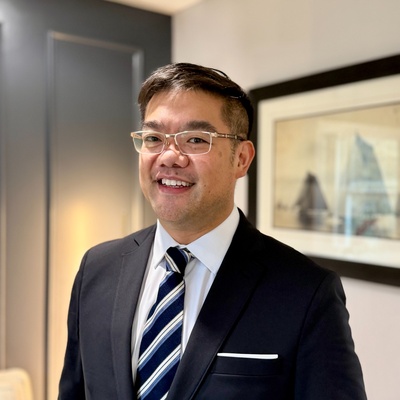
Peterson Huang DMD, MS, FACP, FRCDC
Dr. Peterson Huang is a dual board-certified prosthodontist serving Falls Church and Northern Virginia. He has been recognized as a Top Prosthodontist by Northern Virginia Magazine and Arlington Magazine and is affiliated with the Inova Fairfax Hospital Tumor Board. Dr. Huang focuses on dental implants, full mouth reconstruction, and complex restorative dentistry for patients who need advanced, comprehensive care.
When facing severe tooth wear, multiple missing teeth, failing restorations, or ongoing bite instability, patients often discover that conventional dental treatments may not fully resolve the underlying issues. Navigating advanced restorative dental needs requires a clear understanding of when standard procedures are sufficient and when the specialized training of a prosthodontist becomes necessary. For residents seeking a prosthodontist near Annandale VA, specialty prosthodontic care is located just minutes away in nearby Falls Church, offering dedicated solutions for complex functional and aesthetic oral rehabilitation.
Understanding the difference between primary dental care and prosthodontic specialty treatment helps patients make informed decisions regarding their oral health. Rather than providing quick, localized fixes for individual teeth, prosthodontic care focuses on comprehensive diagnosis, biomechanics, force distribution, and the long-term biological harmony of the entire masticatory system.
What is a Prosthodontist and Why is Specialization Critical?
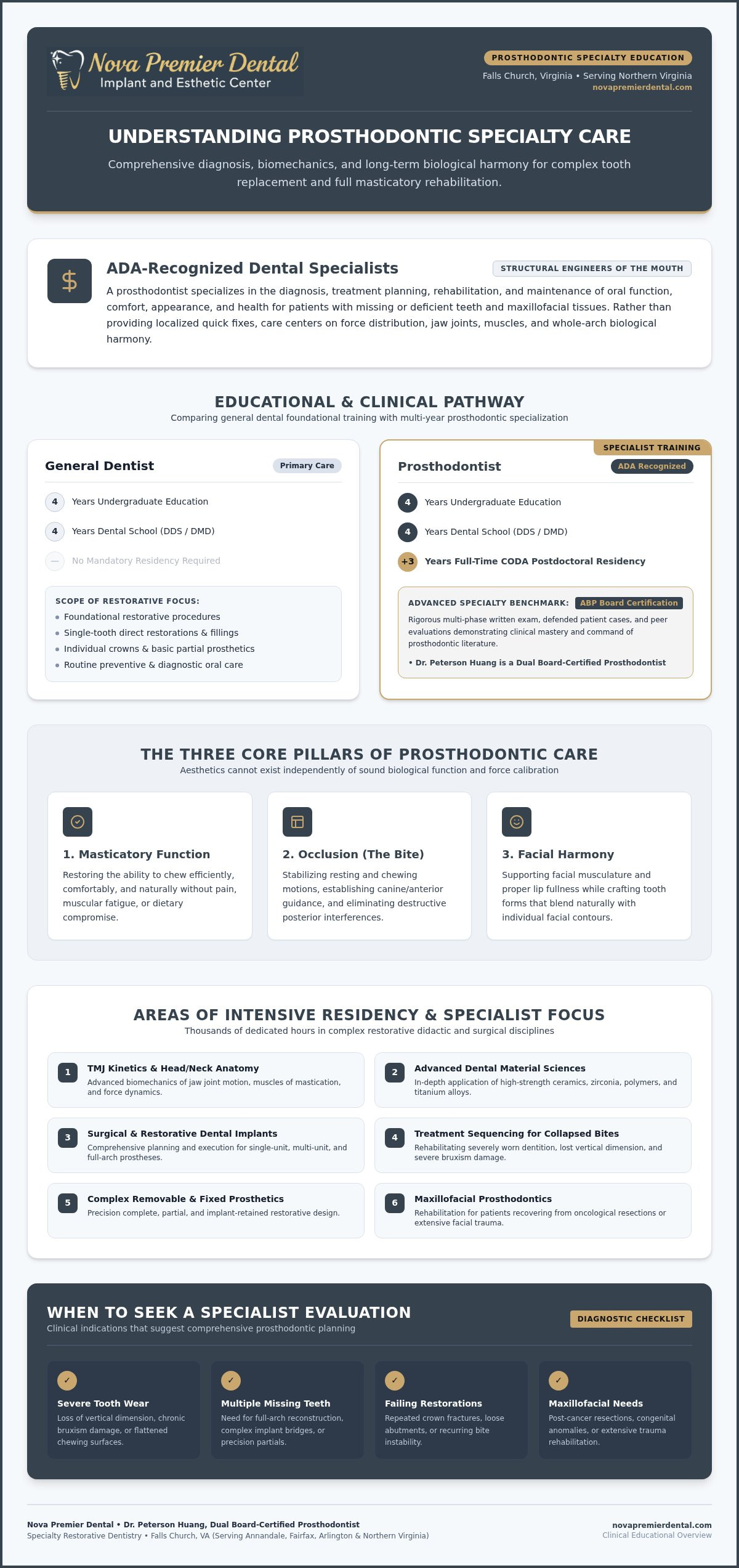
A prosthodontist is a dental specialist recognized by the American Dental Association (ADA) who focuses on the diagnosis, treatment planning, rehabilitation, and maintenance of oral function, comfort, appearance, and health for patients with clinical conditions associated with missing or deficient teeth and maxillofacial tissues. While general dentists receive foundational training in restorative procedures such as single crowns and basic partials, prosthodontists complete three additional years of intensive, full-time residency training dedicated entirely to complex restorations and tooth replacement.
In complex restorative cases, a prosthodontist acts much like a structural engineer for the mouth. When dental structures break down from trauma, decay, genetic disorders, or years of severe grinding (bruxism), simply placing a new crown or filling can result in premature failure if the surrounding bite forces are not properly calibrated. Prosthodontists evaluate the relationship between the jaw joints, muscles, bone support, and dental arches to design restorations that withstand daily chewing forces over the long term.
The Core Focus: Function, Comfort, and Aesthetics
Prosthodontic treatment is grounded in the principle that aesthetics cannot exist independently of sound biological function. When restorative care fails to account for proper jaw movement, patients may experience cracked restorations, loose dental implants, muscle soreness, or accelerated tooth wear. Prosthodontic care prioritizes three interrelated clinical outcomes:
- Restoring Masticatory Function: Ensuring patients can chew efficiently and comfortably without pain or dietary restrictions.
- Stabilizing Occlusion (The Bite): Evaluating how the upper and lower teeth meet during rest and dynamic chewing motions. This involves assessing canine guidance, anterior guidance, and eliminating destructive interferences on posterior teeth.
- Biological and Facial Harmony: Crafting tooth replacements that support facial musculature, maintain proper lip support, and blend naturally with the patient's individual facial contours and skin tones.
Prosthodontic Expertise Serving Annandale and Northern Virginia
Patients residing in Annandale, Virginia, often face a common dilemma when dealing with advanced dental breakdown: their primary dentist may advise that their condition requires advanced planning beyond standard clinical routines. Because Annandale is situated in close proximity to major Northern Virginia transportation corridors, specialized care is readily accessible in adjacent communities.
Accessing dedicated prosthodontic care in Northern Virginia at Nova Premier Dental in Falls Church allows patients from Annandale, Fairfax, and Arlington to undergo comprehensive evaluations without traveling long distances. Complex rehabilitations frequently require sequenced appointments, precise laboratory communication, and meticulous follow-up visits. Having a regional specialty clinic nearby ensures continuity of care throughout each phase of treatment.
Advanced Training: The Difference Between a Dentist and a Specialist
To appreciate why specialized prosthodontic evaluation is recommended for severe dental breakdown, it helps to look at the educational pathway required for this specialty. All dentists complete four years of undergraduate study followed by four years of dental school to earn either a Doctor of Dental Surgery (DDS) or Doctor of Medicine in Dentistry (DMD). Upon graduation, a general dentist is licensed to practice general dentistry.
A prosthodontist, however, must be accepted into an accredited multi-year postdoctoral residency program approved by the Commission on Dental Accreditation (CODA). This rigorous three-year residency provides thousands of hours of advanced clinical and didactic training in:
- Advanced head and neck anatomy and temporomandibular joint kinetics
- Dental material sciences, including ceramics, zirconia, polymers, and titanium alloys
- Surgical and restorative phases of dental implants
- Treatment sequencing for severely worn dentition and collapsed bites
- Removable complete, partial, and implant-retained prosthetics
- Maxillofacial prosthodontics for patients recovering from cancer resections or facial trauma
Board Certification: A Rigorous Benchmark of Clinical Care
Beyond completing a three-year specialty residency, some prosthodontists choose to pursue board certification through the American Board of Prosthodontics (ABP). Achieving board certification represents an exhaustive, multi-phase examination process that demonstrates clinical mastery, ethical standards, and command of prosthodontic literature.
Candidates must present documented patient cases that undergo rigorous peer evaluation, defend their diagnostic and treatment methodologies before an expert examination committee, and complete detailed written examinations. Dr. Peterson Huang is a dual board-certified prosthodontist, holding certifications that reflect an exceptional commitment to ongoing clinical excellence and evidence-based restorative care.
Digital Innovation and Biomechanical Precision in Modern Prosthodontics
Modern prosthodontic care relies heavily on advanced diagnostic and manufacturing technologies that interface directly with clinical biomechanics. The integration of high-resolution intraoral scanning, 3D cone-beam computed tomography (CBCT), and computer-aided design and computer-aided manufacturing (CAD/CAM) allows for precise visualization of anatomical structures before any clinical procedures begin.
Digital workflows eliminate the dimensional instability and patient discomfort associated with traditional tray impressions. More importantly, these technologies allow prosthodontists to simulate restorative outcomes digitally, verifying that dental implants are planned in optimal bone positions relative to the planned prosthetic teeth, thereby reducing surgical risks and enhancing restorative longevity.
Prosthodontist vs. General Dentist: When to Seek Specialized Care
A general dentist serves as the cornerstone of preventive and routine dental health, providing essential services such as cleanings, periodontal screenings, basic fillings, single crowns, and preliminary diagnoses. However, when oral conditions deteriorate past a certain threshold of structural loss or functional instability, the specialized expertise of a prosthodontist becomes invaluable.
| Clinical Category | General Dentist | Prosthodontist |
|---|---|---|
| Primary Focus | Preventive care, diagnosis, routine maintenance, localized restorations | Complex tooth replacement, full mouth reconstruction, systemic bite correction |
| Postdoctoral Training | DDS or DMD (Optional 1-year General Practice Residency) | DDS/DMD plus 3 years of accredited full-time prosthodontic residency |
| Bite & Occlusion | Maintains existing bite during single-tooth restorations | Re-engineers or re-establishes vertical dimension and occlusal relationships |
| Complex Implants | Standard single implants or basic tooth replacements | Full-arch restorations, bone-deficient sites, salvage of failing restorations |
Complex Cases That Warrant Specialist Evaluation
Patients are often unsure whether their specific dental concerns require a specialist. While every case is unique, several distinct clinical presentations generally benefit from prosthodontic evaluation:
- Loss of Vertical Dimension of Occlusion (VDO): Years of chronic grinding, acid reflux (GERD), or missing posterior support can wear teeth down to flat nubs, causing the lower face to collapse and muscles to over-close. Re-establishing proper jaw height requires careful management of vertical dimension and joint position.
- Multiple Failing Restorations: When old bridges, large fillings, and crowns begin failing simultaneously, treating them tooth-by-tooth can create an uneven bite and repetitive structural failures.
- Severe Bone Resorption Under Dentures: Patients who have worn traditional dentures for decades often experience jawbone atrophy, making traditional prosthetics unretentive and painful without specialized implant stabilization.
- Limited Restorative Space: In cases where remaining teeth have drifted or super-erupted, careful interdisciplinary planning is necessary to create adequate physical space for durable restorative materials.
- Congenital Anomalies: Conditions like ectodermal dysplasia, amelogenesis imperfecta, or congenitally missing lateral incisors require complex reconstructive sequencing.
The Collaborative Approach Between General Dentists and Specialists
Seeking care from a prosthodontist does not mean severing ties with your family dentist. In fact, high-level prosthodontic care is inherently collaborative. A prosthodontist frequently partners with general dentists, periodontists, oral surgeons, and endodontists to provide comprehensive care.
In many instances, your general dentist may refer you to a prosthodontist for the complex reconstructive phase—such as oral reconstruction or multi-unit implant design. Once the bite is stabilized and definitive restorations are placed, you can return to your general dentist for ongoing hygiene cleanings, routine checkups, and preventive maintenance.
Specialized Treatments Available Near Annandale
Prosthodontic treatment involves an array of advanced restorative techniques engineered to address both functional deficiencies and cosmetic concerns. For patients traveling from Annandale to Falls Church, a wide spectrum of care is available:
Advanced Dental Implants and Fixed Bridges
Dental implants represent the modern benchmark for replacing missing teeth because they integrate directly with native alveolar bone through osseointegration. Prosthodontists specialize in the biomechanics of implant dentistry, evaluating bone volume, load-bearing capacities, and prosthetic contours to prevent peri-implant complications or mechanical component fatigue.
Depending on clinical needs, options range from individual implant crowns to multi-unit fixed bridges and full-arch implant-supported prostheses. By utilizing precise surgical guides and biocompatible materials such as monolithic zirconia and medical-grade titanium, these restorations replicate the stability and chewing efficiency of natural teeth.
Custom Dentures and Removable Prosthetics
For patients who are missing multiple teeth or entire dental arches, removable prosthetics remain a viable and cost-effective treatment modality. However, poorly designed dentures can cause painful sore spots, speech impediments, and accelerated jawbone shrinkage. Prosthodontists employ specialized border molding techniques and anatomical impression methods to capture accurate soft tissue contours.
Modern dentures and partial dentures can be custom-contoured for retention, balanced occlusion, and lifelike aesthetics. In cases where the jaw ridge offers minimal anatomical retention, dental implants can be incorporated to create implant-retained overdentures that snap securely into place.
Full Mouth Reconstruction and Smile Design
Full mouth reconstruction involves restoring or replacing every tooth in the upper and lower arches to correct systemic breakdown. This comprehensive process requires systematic diagnostic phasing:
- Diagnostic Records: Gathering detailed records, including digital surface scans, 3D CBCT imaging, facial photographs, and facebow-mounted diagnostic casts.
- Diagnostic Wax-Up: Physically or digitally planning the ideal shape, length, and position of each tooth to confirm proper phonetics and bite mechanics.
- Provisionalization: Placing temporary acrylic restorations that allow the patient to test the proposed bite, jaw position, and aesthetics for several weeks before final fabrication.
- Definitive Restoration: Fabricating long-term ceramic crowns, bridges, or porcelain veneers. Patients can review documented clinical outcomes across various scenarios by exploring clinical before and after results.
Emergency Prosthetic Care and Repairs
When a denture fractures, a tooth breaks off a prosthetic base, or an implant abutment loosens, the impact on daily life is immediate. Beyond aesthetic embarrassment, attempting to wear a broken or improperly repaired appliance can inflict mechanical trauma on delicate mucosal tissues and underlying bone.
Access to emergency denture repair ensures that structural damage is addressed using commercial-grade laboratory polymers rather than toxic home adhesives. Professional laboratory relines and repairs re-establish uniform tissue contact and restore prosthetic integrity safely.
Management of TMJ and Bite-Related Disorders
The temporomandibular joints (TMJ) and masticatory muscles work in close coordination with your dental occlusion. When teeth are malpositioned, missing, or worn down, the jaw joints may be forced into an unnatural, compressed position during chewing, contributing to joint clicking, muscle spasm, facial fatigue, and headaches. Prosthodontists are uniquely qualified to assess and manage TMJ and jaw joint disorders through custom occlusal splints, bite adjustments (equilibration), and restorative realignment.
Nova Premier Dental: Prosthodontic Specialty Care Serving Annandale
Centrally located in Falls Church, Nova Premier Dental provides advanced restorative and prosthodontic specialty care for patients throughout Northern Virginia, including Annandale, McLean, Arlington, and Fairfax. Led by dual board-certified prosthodontist Dr. Peterson Huang, our practice is dedicated to solving complex dental dilemmas through meticulous diagnostic assessment and customized treatment sequencing.
For Annandale residents, the short drive north via Route 236 (Little River Turnpike) or I-495 to Falls Church provides immediate access to a practice designed around patient comfort, clinical precision, and advanced prosthodontic protocols.
The Specialized Consultation Experience
Entering a specialty prosthodontic office involves a thorough, unhurried diagnostic experience. During your initial consultation, we focus on understanding your personal oral health history, previous dental experiences, and personal goals for treatment. Your evaluation typically includes:
- A detailed clinical examination of intraoral soft tissues, remaining dentition, and periodontium
- Palpation and dynamic assessment of the temporomandibular joints and masticatory muscles
- Evaluation of your current bite relationship, jaw range of motion, and dynamic chewing patterns
- High-definition digital photography and 3D radiographic imaging when clinically indicated
- A transparent discussion regarding alternative treatment pathways, anticipated timelines, material options, and biological limitations
Financial Planning and In-House Payment Solutions
Reconstructive dental treatment involves extensive chair time, meticulous planning, and specialized laboratory fabrication with high-grade biocompatible materials. Consequently, comprehensive care represents an important financial investment in your overall health and quality of life.
Our administrative team works directly with patients to clarify insurance benefits, providing detailed estimates and assisting with insurance claims submission to optimize eligible benefits. To assist with out-of-pocket costs, Nova Premier Dental offers in-house payment plans for qualifying patients, allowing treatment costs to be paid over several months while patients enjoy their new smile. We are committed to financial transparency, ensuring that all fees and payment schedules are thoroughly explained before treatment commences.
Frequently Asked Questions About Prosthodontic Care Near Annandale
Is a prosthodontist different from a cosmetic dentist?
Yes. The American Dental Association does not recognize "cosmetic dentistry" as a formal specialty. Any licensed general dentist can advertise themselves as a cosmetic dentist regardless of postgraduate training. In contrast, a prosthodontist has completed an additional three years of accredited full-time residency training specifically dedicated to the biomechanics, function, and aesthetics of tooth replacement and restoration.
Do I need a referral to see a prosthodontist near Annandale?
No formal referral is required. While many patients are referred to Nova Premier Dental by their general dentists or other medical specialists for specific complex needs, individuals experiencing chronic dental breakdown, failing dental work, or ill-fitting dentures may schedule an evaluation directly.
How long does a full mouth reconstruction typically take?
Treatment duration varies significantly based on clinical complexity, the need for preliminary periodontal or surgical therapies, and tissue healing times. A standard reconstruction may range from a few months to over a year, particularly when bone grafting or implant osseointegration is required. A detailed timeline is established during your diagnostic consultation.
Can a prosthodontist help with chronically loose or painful dentures?
Yes. Prosthodontists specialize in denture biomechanics and tissue management. After evaluating the amount of remaining jawbone and mucosal tissue, a prosthodontist can determine whether a laboratory reline, a re-engineered custom denture base, or implant stabilization (such as an overdenture) is the most appropriate solution to restore stability and chewing comfort.
What should I bring to my initial consultation?
To ensure a comprehensive evaluation, bring any recent dental records or radiographs (if available from your general dentist), a complete list of current medications and medical conditions, any removable dental appliances or nightguards you currently use, and your dental insurance information.
Schedule a Prosthodontic Consultation
Living with chronic dental discomfort, compromised chewing ability, or failing restorations can take a heavy toll on your health and daily well-being. If you have questions about a complex restorative or prosthodontic concern, Nova Premier Dental in Falls Church provides prosthodontic specialty care for patients throughout Northern Virginia. Contact our office today to arrange your comprehensive clinical evaluation.
Disclaimer
The information provided on this website and blog is intended for general educational and informational purposes only and should not be considered dental or medical advice, diagnosis, or treatment. Reading content on this website does not establish a doctor-patient relationship with Nova Premier Dental or Dr. Peterson Huang. Dental conditions and treatment needs vary from patient to patient. Individuals should consult directly with a qualified dental professional for personalized evaluation, diagnosis, and treatment recommendations. Do not delay seeking professional dental care based on information found on this website. While we strive to provide accurate and up-to-date information, no guarantee is made regarding the completeness, accuracy, or applicability of the content. Treatment outcomes may vary depending on individual circumstances. If you are experiencing a dental emergency or urgent oral health concern, please contact a licensed dental professional immediately or call 911 in the event of a medical emergency.


