

Article by
Peterson Huang DMD, MS, FACP, FRCDC
Dr. Peterson Huang is a dual board-certified prosthodontist serving Falls Church and Northern Virginia. He has been recognized as a Top Prosthodontist by Northern Virginia Magazine and Arlington Magazine and is affiliated with the Inova Fairfax Hospital Tumor Board. Dr. Huang focuses on dental implants, full mouth reconstruction, and complex restorative dentistry for patients who need advanced, comprehensive care.
What if that subtle clicking sound or minor gum sensitivity isn't just a temporary nuisance, but a signal that your entire dental restoration is at risk? For many patients, recognizing the early signs of a failing dental bridge is the difference between a simple adjustment and the loss of additional supporting teeth. At Nova Premier Dental, we understand the anxiety that comes with a loose or uncomfortable restoration. It's frustrating to struggle with chewing or feel embarrassed by a smile that no longer feels secure, especially when you've already invested significant time and resources into your oral health.
This specialist's guide will empower you to identify these critical warning signals and understand the advanced clinical options available for restoration. As a board-certified prosthodontist in Northern Virginia, Dr. Huang specializes in the meticulous mechanics of reconstructive dentistry. You'll learn how to distinguish between minor wear and structural failure. We'll also explain how our practice utilizes in-house payment plans for qualifying patients, allowing you to manage the cost of care over several months. We'll preview the diagnostic process and the long-term solutions that ensure your smile remains functional and beautiful for years to come.
Key Takeaways
- Learn to identify subtle physical indicators, such as clicking, shifting, or localized temperature sensitivity, that suggest your restoration may be compromised.
- Understand the primary signs of a failing dental bridge and how underlying issues like recurrent decay can jeopardize the health of your supporting abutment teeth.
- Discover the advanced diagnostic methods used by specialists to determine if a bridge requires a minor margin adjustment or a comprehensive prosthetic replacement.
- Gain insight into why the expertise of a board-certified prosthodontist is critical for achieving a durable, functional, and aesthetically precise reconstructive outcome.
- Explore manageable pathways to restorative care, including in-house payment plans designed to support your long-term oral health goals without delaying necessary treatment.
Understanding Dental Bridge Longevity and the Risks of Failure
A dental bridge is a sophisticated prosthetic assembly designed to restore the function and aesthetics of a missing tooth. To understand what is a dental bridge, one must view it as a tripartite system consisting of two "abutment" teeth on either side of the gap and a "pontic," or artificial tooth, suspended between them. While a high-quality fixed bridge typically offers a lifespan of 10 to 15 years, its longevity isn't guaranteed solely by the materials used. Instead, the success of the restoration depends heavily on the biological foundation of the supporting natural teeth.
Many patients believe that because the porcelain is durable, the underlying structure is invulnerable. However, we often encounter "silent failure." This occurs when the cement seal at the margin of the crown begins to degrade, allowing microscopic bacteria to seep beneath the restoration. Because the tooth is encased in porcelain, decay can advance significantly without causing immediate pain or visible signs of a failing dental bridge. By the time a patient notices a problem, the structural integrity of the anchor tooth may already be compromised.
The Role of Abutment Teeth in Bridge Stability
The anchor teeth, or abutments, act as the pillars for the entire prosthetic arch. If these teeth suffer from underlying root canal issues or structural fractures, the fate of the entire bridge is sealed. A prosthodontist must meticulously evaluate the bone support and periodontal health of these anchors before placement. Biological width, which refers to the specific distance required between the base of a dental restoration and the underlying bone to prevent inflammation, is a critical measurement in professional bridge design. If this dimension is ignored, the body will naturally react with chronic gum recession or bone loss.
Why Bridge Failure is a Progressive Issue
Failure rarely happens overnight; it's a cascading process. A minor leak at the margin of a crown might seem inconsequential, but it serves as a gateway for recurrent caries. If this isn't caught early, the decay can destroy the natural tooth structure, leading to the need for extensive oral reconstruction or even the loss of the anchor teeth themselves.
Identifying the early signs of a failing dental bridge is essential for preservation. Catching a loose margin or a small fracture early allows for conservative repairs. If the bridge is left to deteriorate, the resulting bone loss often necessitates more complex and costly replacements. To help patients address these issues promptly, we offer in-house payment plans for qualifying patients, allowing you to manage the cost of restorative care over several months while protecting your natural teeth.
5 Red Flags: How to Identify the Signs of a Failing Dental Bridge
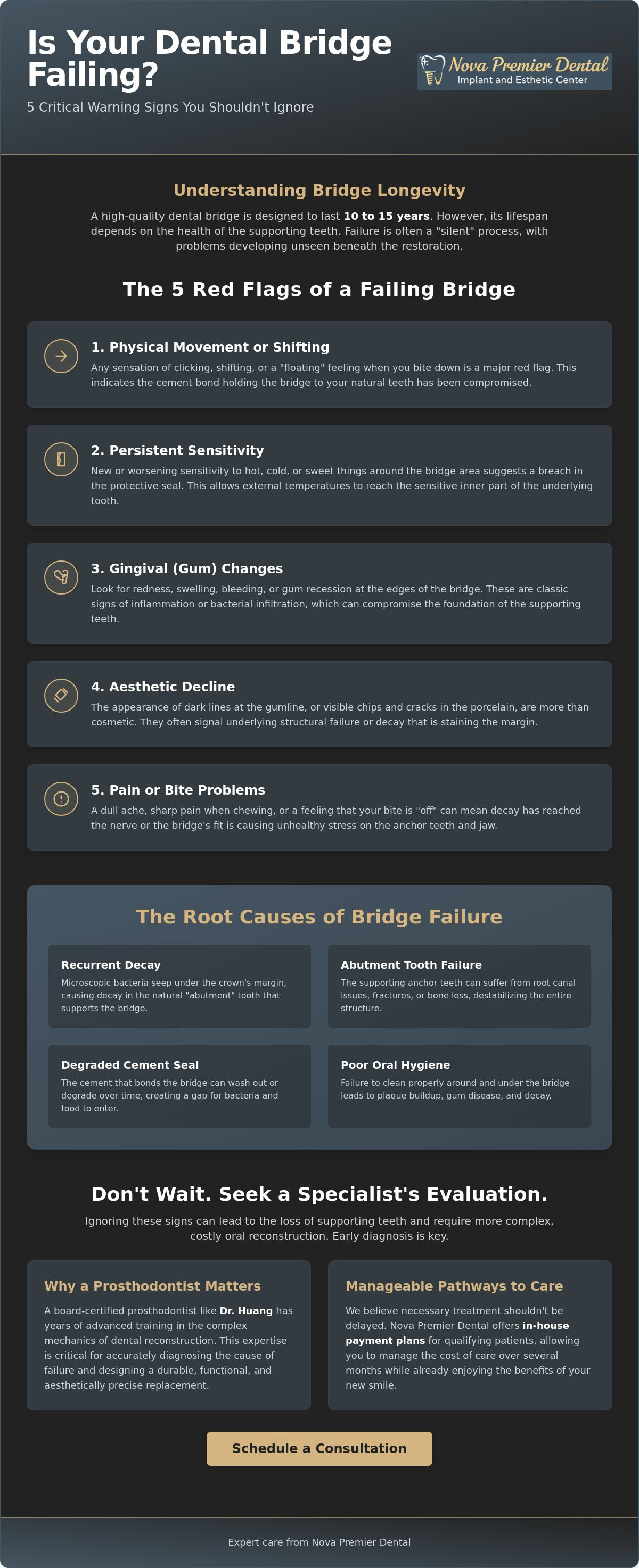
Recognizing the early signs of a failing dental bridge requires a keen awareness of subtle shifts in your oral environment. While these restorations are engineered for durability, they're not immune to the stresses of daily function or biological changes. Early detection is paramount to preserving the integrity of your remaining natural teeth. Identifying these five red flags can help you determine when it's time to seek a specialist's evaluation:
- Physical Movement: Any sensation of clicking, shifting, or "floating" when you bite down indicates a compromised bond.
- Persistent Sensitivity: New or worsening reactions to hot and cold temperatures around the bridge site often signal a breach in the protective seal.
- Gingival Changes: Redness, bleeding, or localized gum recession at the bridge margins suggests inflammation or bacterial infiltration.
- Aesthetic Decline: The appearance of dark lines at the gumline or visible chips in the porcelain framework are more than just cosmetic concerns; they often indicate structural wear.
- Bite Realignment: If your teeth no longer seem to fit together naturally, you may be experiencing occlusal disharmony caused by a shifting restoration.
Understanding the Causes of Dental Bridge Failure is the first step in determining if your discomfort is a minor inconvenience or a clinical emergency.
Detecting Instability and Looseness
You can perform a gentle check for instability by using a clean finger or your tongue to apply light pressure to the pontic; any perceptible wiggle is a significant warning. It's important to understand that "cement failure" is rarely an isolated event. Often, it's a symptom of a deeper structural problem, such as a change in the shape of the abutment tooth due to decay. A specialist must distinguish whether the bridge itself has become unseated or if the supporting tooth is losing its stability within the bone. If you suspect your restoration is compromised, scheduling an evaluation at Nova Premier Dental is the most effective way to prevent further tooth loss.
Pain and Sensitivity: What Your Nerves Are Telling You
Pain provides a direct map of the restoration's internal health. We categorize this into pressure-based pain, which suggests a bite misalignment, and thermal pain, which usually indicates decay. We also look for "rebound pain," which is a sharp discomfort felt specifically when you release your bite. Pain experienced under a bridge often indicates advanced decay of an abutment tooth, as the nerve becomes inflamed due to prolonged bacterial exposure. If you're experiencing these symptoms, consulting a prosthodontist in Northern Virginia like Dr. Huang can provide the clinical clarity you need to restore your health.
The Root Causes: Why Dental Bridges Fail Over Time
While the previous sections explored how to recognize the physical signs of a failing dental bridge, we must address the clinical etiology behind these failures. A bridge is a complex mechanical system operating within a dynamic biological environment. Its failure is typically a slow progression driven by specific stressors rather than a sudden, isolated event. Understanding these root causes allows for more effective preventive care and informed decisions regarding restoration.
The primary drivers of prosthetic failure include:
- Recurrent Decay: Bacteria seeping under the margins of the supporting crowns.
- Periodontal Disease: Inflammation and bone loss around the abutment teeth.
- Mechanical Overload: Excessive force from bruxism or an uneven bite.
- Structural Design Flaws: Bridges that lack the necessary support for the length of the gap.
The Hidden Danger of Recurrent Decay
The space beneath the pontic, or the artificial tooth, represents a significant hygiene challenge. Plaque naturally accumulates in this area, and because traditional flossing cannot reach beneath the bridge, bacteria can colonize the margins where the porcelain meets your natural tooth. Once the cement seal is compromised, decay progresses rapidly in the anaerobic environment beneath the crown. Standard hygiene routines often fall short. Patients require specialized tools, such as interproximal brushes, to maintain the biological seal. Without these interventions, the foundation of the bridge will eventually erode, often without the patient feeling any immediate pain.
Occlusal Trauma and Mechanical Failure
A common oversight in general dentistry is the impact of occlusion, or how your teeth meet during function. An improperly balanced bridge creates a "lever effect" on the anchor teeth. Every time you chew, excessive force is concentrated on the abutments rather than being distributed across the dental arch. This mechanical stress can lead to porcelain fractures and is a frequent contributor to TMJ disorders or chronic jaw pain.
If a bridge is designed without precise consideration for your bite's unique mechanics, the resulting trauma can loosen the anchor teeth or cause the metal framework to fatigue. This is why many signs of a failing dental bridge are actually symptoms of mechanical disharmony. As a board-certified prosthodontist in Northern Virginia, Dr. Huang prioritizes these structural nuances at Nova Premier Dental to ensure that every restoration is both biologically compatible and mechanically sound.
Evaluation and Solutions: Should You Repair or Replace Your Bridge?
Once you've identified the signs of a failing dental bridge, the next step is a comprehensive clinical evaluation. We don't rely on visual inspection alone. At Nova Premier Dental, our diagnostic phase utilizes advanced digital imaging and CBCT scans to see through the porcelain and evaluate the health of the abutment teeth. This precision allows us to determine if the internal structure is still sound or if the biological foundation has been compromised by decay or bone loss.
In some instances, if the issue is caught early and the supporting teeth are healthy, a simple repair like recementation or a minor margin adjustment may be possible. However, if the bridge has physically shifted or the anchor teeth are decayed, a "patch-up" often only delays the inevitable. Transitioning to Dental Implants is frequently the gold standard for long-term health. Unlike traditional bridges, implants don't rely on neighboring teeth for support, which prevents the "domino effect" of tooth loss. This transition often involves a meticulous workflow, including site preparation and bone grafting to ensure a stable foundation for your new restoration.
The Prosthodontic Assessment Process
Seeking a second opinion from a specialist like Dr. Peterson Huang provides you with a deeper level of diagnostic insight. As a board-certified prosthodontist in Northern Virginia, Dr. Huang evaluates the long-term prognosis of your remaining teeth with a focus on structural engineering. We look beyond the immediate discomfort to design a solution that won't fail again. We believe in providing permanent solutions rather than temporary fixes, ensuring your investment in your smile is protected.
Modern Replacement Options
Modern dentistry offers sophisticated alternatives for those with failing restorations. Implant-supported bridges allow us to replace multiple missing teeth without grinding down healthy adjacent teeth. For patients facing the failure of multiple restorations or significant tooth loss, full-arch solutions like All-on-4 provide a stable, fixed alternative that looks and functions like natural teeth. We prioritize aesthetic precision, matching the shade and contour of your new prosthetic to your existing teeth for a seamless result. To make this level of specialized care accessible, we offer in-house payment plans for qualifying patients, allowing you to manage the cost of your reconstruction over several months. If you're ready to move past the anxiety of a loose restoration, we invite you to schedule a consultation to explore your options.
Specialized Restorative Care at Nova Premier Dental
Confirming the signs of a failing dental bridge is only the initial step toward reclaiming your oral health. The success of your recovery depends on the diagnostic precision and clinical expertise of the specialist you choose. At Nova Premier Dental, we provide a sophisticated environment where advanced technology meets compassionate, individualized care. We understand that facing the failure of a major restoration can be daunting. Our objective is to reduce patient anxiety through transparent education and meticulous clinical execution, ensuring that your next restoration is your last.
Our practice isn't a high volume general office. We're a specialized center dedicated to complex reconstruction. We utilize state of the art digital workflows to map your oral anatomy with microscopic accuracy. This level of detail allows us to design prosthetics that don't just fill a gap but integrate seamlessly with your biological structures. By prioritizing the structural integrity of the entire dental arch, we prevent the mechanical stresses that lead to premature prosthetic failure.
Why Northern Virginia Chooses Dr. Huang
The precision required for successful restorative dentistry and oral rehabilitation is immense. Patients throughout the region seek out Dr. Peterson Huang because of his rare status as a dual board-certified prosthodontist in Northern Virginia. This elite certification reflects a mastery of the mechanics of the bite and the aesthetics of the smile. When you visit our practice, you're benefiting from a practitioner who is a recognized expert in the field of dental reconstruction. Dr. Huang’s meticulous approach ensures that even the most difficult cases are resolved with functional beauty and long-term stability.
Managing the Cost of Your New Smile
We believe that financial considerations shouldn't be a barrier to receiving elite level care, especially when you're dealing with the signs of a failing dental bridge that could lead to further tooth loss. To make our specialized services accessible, Nova Premier Dental offers in-house payment plans for qualifying patients. These plans are designed to be manageable and straightforward. They allow you to distribute the cost of your treatment over several months, providing financial flexibility while you're already enjoying the functional benefits of your restored smile. Our team is committed to helping you find a pathway to health that fits your lifestyle, ensuring you don't have to compromise on the quality of your dental reconstruction.
Restoring Your Confidence and Oral Health
Identifying the signs of a failing dental bridge is the first step in preventing the cascade of tooth loss that often follows a compromised restoration. Whether you're experiencing a minor "floating" sensation or persistent sensitivity, these signals warrant a meticulous evaluation by a specialist who understands the complex mechanics of oral rehabilitation. At Nova Premier Dental, we prioritize long-term functional beauty over temporary fixes. Dr. Peterson Huang is a dual board-certified prosthodontist in Northern Virginia who has been serving the Falls Church community for over a decade.
His expertise ensures that your restorative plan is engineered for durability and aesthetic precision. We also believe that financial logistics shouldn't delay your care. Our practice offers in-house payment plans for qualifying patients, allowing you to manage the cost of reconstruction over several months while you enjoy the benefits of your new smile. Don't wait for a minor issue to become a clinical emergency. Schedule your specialized consultation with Dr. Huang today to secure the future of your smile. We look forward to helping you achieve a healthy, lasting result.
Frequently Asked Questions
Can a loose dental bridge be glued back on?
You should never attempt to glue a bridge back on using over the counter adhesives; this can permanently damage the supporting natural teeth and prevent a professional repair. A clinical assessment is required to determine why the bridge became dislodged. If the abutment teeth are structurally sound and the bridge itself is intact, a prosthodontist can professionally recement the restoration to ensure a precise, bacteria-resistant seal.
Is it normal for a dental bridge to hurt after 10 years?
Persistent pain after a decade of use isn't normal and typically indicates that the restoration has reached the end of its functional lifespan. This discomfort often signals that the cement seal has been breached, allowing decay to develop beneath the crowns. Since traditional bridges generally last 10 to 15 years, new pain is a significant clinical marker that requires an immediate evaluation to save the anchor teeth.
What happens if I ignore a failing dental bridge?
Ignoring the signs of a failing dental bridge can lead to the catastrophic loss of the supporting natural teeth and the surrounding jawbone. When a bridge fails, bacteria colonize the anaerobic environment beneath the crowns, causing rapid decay. Delaying treatment often transforms a relatively straightforward prosthetic replacement into a complex case requiring extractions and extensive oral reconstruction.
How much does it cost to replace a dental bridge with an implant in Virginia?
The total investment for an implant replacement depends on the number of implants required and whether bone grafting is necessary to create a stable foundation. While costs vary based on individual clinical needs, Nova Premier Dental provides in-house payment plans for qualifying patients. These plans allow you to distribute the cost of your care over several months while you're already enjoying the benefits of your restored smile.
Can a dentist fix a bridge that has a chip in the porcelain?
Minor aesthetic chips can sometimes be smoothed or repaired with dental bonding, but significant porcelain fractures usually necessitate a full replacement. The porcelain layer provides essential structural support and protection for the bridge framework. Once it's compromised, the restoration becomes susceptible to further breakage and bacterial accumulation. A specialist will determine if the chip is a superficial flaw or a sign of mechanical fatigue.
How do I know if the tooth under my bridge is decaying?
Decay under a bridge often manifests as localized gum inflammation, a persistent bad taste, or heightened sensitivity to temperature. Because the decay is shielded by the prosthetic, it's often invisible to the naked eye. These symptoms are primary signs of a failing dental bridge and should be evaluated by Dr. Huang using digital imaging to prevent the decay from reaching the tooth's nerve.
What is the best way to clean under a dental bridge to prevent failure?
The most effective way to clean under a bridge is to use specialized tools such as floss threaders, interproximal brushes, or a water flosser to remove plaque from the pontic area. Traditional flossing cannot access the space between the artificial tooth and the gumline. Meticulous daily maintenance of these margins is the most important factor in preventing recurrent decay and ensuring the longevity of your restoration.
How long does the process of replacing a failing bridge take?
The timeline for replacement depends on the complexity of your case and the restorative method chosen. A traditional bridge replacement typically requires two appointments over two to three weeks. If you're transitioning to an implant-supported solution, the process can take several months to allow for proper bone integration and healing. A prosthodontist in Northern Virginia will provide a detailed treatment schedule during your initial consultation.
Disclaimer
The information provided on this website and blog is intended for general educational and informational purposes only and should not be considered dental or medical advice, diagnosis, or treatment. Reading content on this website does not establish a doctor-patient relationship with Nova Premier Dental or Dr. Peterson Huang. Dental conditions and treatment needs vary from patient to patient. Individuals should consult directly with a qualified dental professional for personalized evaluation, diagnosis, and treatment recommendations. Do not delay seeking professional dental care based on information found on this website. While we strive to provide accurate and up-to-date information, no guarantee is made regarding the completeness, accuracy, or applicability of the content. Treatment outcomes may vary depending on individual circumstances. If you are experiencing a dental emergency or urgent oral health concern, please contact a licensed dental professional immediately or call 911 in the event of a medical emergency.


