


Article by
Peterson Huang DMD, MS, FACP, FRCDC
Dr. Peterson Huang is a dual board-certified prosthodontist serving Falls Church and Northern Virginia. He has been recognized as a Top Prosthodontist by Northern Virginia Magazine and Arlington Magazine and is affiliated with the Inova Fairfax Hospital Tumor Board. Dr. Huang focuses on dental implants, full mouth reconstruction, and complex restorative dentistry for patients who need advanced, comprehensive care.
Undergoing comprehensive restorative care across an entire dental arch is a significant clinical and personal commitment. For individuals exploring the full mouth reconstruction cost virginia dental offices present, understanding the underlying factors that influence treatment estimates is essential for making informed decisions. Full mouth reconstruction is not an off-the-shelf product or a standardized procedure; rather, it is a highly customized diagnostic and restorative plan designed to re-establish oral function, structural integrity, and aesthetic harmony.
Located in Falls Church, Nova Premier Dental is a private prosthodontic specialty dental office serving Northern Virginia. The practice is led by Peterson Huang, DMD, MS, FACP, FRCDC, a dentist and dual board-certified prosthodontist who holds prosthodontic board certifications in both the United States and Canada. This guide provides an objective, educational breakdown of what a comprehensive rehabilitation entails, the clinical variables that dictate total treatment costs, the difference between general restorative treatment and prosthodontic care, and how patients can systematically plan their care.
Key Takeaways
- Full mouth reconstruction is an individualized, multi-phase treatment plan designed to restore the function, anatomy, and health of severely compromised dentition across both dental arches.
- The primary factors dictating the full mouth reconstruction cost virginia patients encounter include the number of compromised teeth, the need for surgical bone or gum grafting, the diagnostic phase, the chosen restorative materials, and laboratory fabrication costs.
- Prosthodontists undergo three years of rigorous, full-time specialty residency training beyond dental school focusing specifically on complex occlusion, tooth replacement, and multi-disciplinary treatment planning.
- A stable long-term result depends on careful management of the bite (occlusion), restorative space, and vertical dimension, rather than simply placing isolated restorations.
- Nova Premier Dental offers in-house payment plans for qualifying patients, allowing treatment costs to be paid over several months while patients enjoy their new smile.
What is Full Mouth Reconstruction and Why Does the Cost Vary?
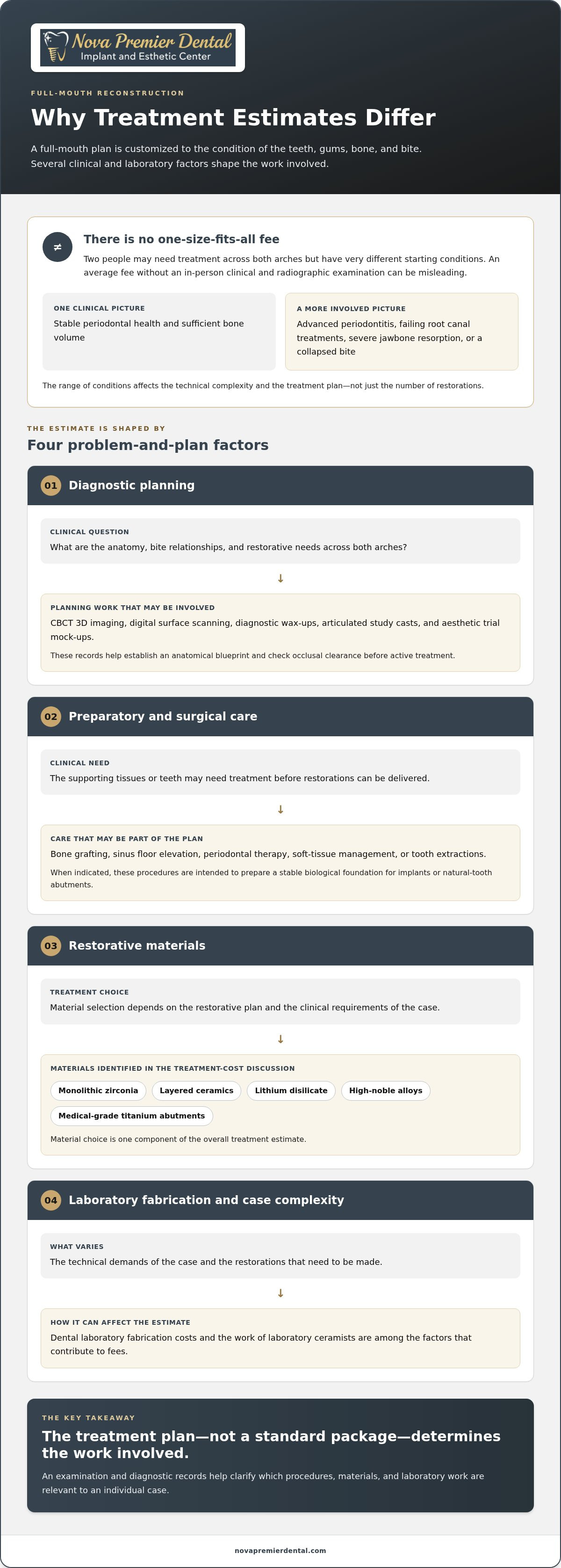
Unlike a routine restorative procedure that focuses on an individual tooth, a full mouth rehabilitation involves the systematic diagnostic planning and simultaneous or staged restoration of all teeth in both the upper and lower jaws. The variation in treatment pricing reflects the wide spectrum of dental conditions patients present with. Two individuals may require full-mouth treatment, but one may possess stable periodontal health and sufficient bone volume, while another may present with advanced periodontitis, multiple failing endodontic treatments, severe jawbone resorption, and a collapsed bite.
Because every clinical presentation is unique, calculating an average fee without an in-person clinical and radiographic examination can be misleading. In Northern Virginia, fees reflect the technical complexity of the case, the quality of dental laboratory ceramists involved, the diagnostic technology utilized (such as high-resolution cone-beam computed tomography and articulated digital impressions), and whether surgical therapies are required before restorations can be delivered.
The Clinical Scope of Total Oral Restoration
Full mouth reconstruction is generally indicated for patients who face widespread oral breakdown. Common clinical indicators include:
- Severe generalized tooth wear caused by chronic nocturnal bruxism, gastroesophageal reflux disease (GERD), or environmental acid exposure.
- Multiple missing teeth accompanied by migration, tilting, or over-eruption of adjacent and opposing teeth.
- Extensive, untreated dental caries compromising the clinical crown structure of multiple teeth throughout both arches.
- Advanced periodontal disease that has led to significant clinical attachment loss and mobility.
- Trauma or developmental defects (such as amelogenesis imperfecta or ectodermal dysplasia) affecting the enamel and dentin architecture.
- A history of multiple fragmented dental treatments performed over decades that have resulted in an unstable or uncomfortable bite.
Addressing these conditions requires comprehensive diagnostic gathering before any tooth preparation begins. This diagnostic phase typically includes extraoral and intraoral photographic series, digital impressions, accurate records of jaw relations (centric relation bite registrations), and specialized radiographic imaging to assess remaining bone quality and the position of vital anatomical structures like the inferior alveolar nerve and maxillary sinuses.
The Difference Between Rehabilitation and Cosmetic Dentistry
Patients often ask about the distinction between a cosmetic smile makeover and full mouth reconstruction. A cosmetic treatment plan primarily targets the aesthetic zone (the teeth visible when speaking and smiling) using elective modalities such as porcelain veneers, composite bonding, or tooth whitening. While aesthetics are an integral component of any full mouth reconstruction, the primary objective of reconstruction is biological and biomechanical: re-establishing chewing efficiency, stabilizing the temporomandibular joints, protecting airway space, and ensuring an even distribution of occlusal forces.
Rebuilding the bite often involves assessing the patient's Vertical Dimension of Occlusion (VDO)—the distance between two chosen points on the face when the teeth are in maximum contact. Severe tooth wear does not automatically mean that a patient has lost vertical dimension, because the alveolar bone and gum tissue often supraerupt alongside the wearing tooth structure (dentoalveolar compensation). Determining whether the VDO has truly collapsed or if compensatory eruption has occurred is a critical diagnostic step that guides restorative space allocation and prevents unnecessary surgical or restorative complications.
Primary Factors Influencing Full Mouth Reconstruction Cost in Virginia
When reviewing treatment proposals for full arch or bi-maxillary restoration, the overall full mouth reconstruction cost virginia patients evaluate is shaped by several distinct components. Understanding these variables helps clarify where clinical resources are directed throughout treatment.
| Cost Driver | Clinical Factors Involved | Impact on Overall Treatment |
|---|---|---|
| Diagnostic & Planning Phase | CBCT 3D imaging, digital surface scanning, diagnostic wax-ups, articulated study casts, aesthetic trial mock-ups. | Establishes the anatomical blueprint, verifies occlusal clearance, and reduces restorative revisions during active care. |
| Preparatory & Surgical Care | Bone grafting, sinus floor elevation, periodontal therapy, soft tissue management, tooth extractions. | Creates a stable, infection-free biological foundation to support implants and natural abutments. |
| Material Selection | Monolithic zirconia, layered ceramics, lithium disilicate, high-noble alloys, medical-grade titanium abutments. | Influences flexural strength, wear rates on opposing enamel, translucency, and long-term fracture resistance. |
| Laboratory Collaboration | Custom master-technician hand-layering, CAD/CAM milling precision, individualized shading, custom ceramic characterization. | Determines the marginal fit, contour, emergence profile, and anatomical naturalism of the final prosthetics. |
| Provisional Phase | High-density acrylic or milled PMMA temporary bridges and crowns worn during tissue maturation. | Allows clinical testing of speech, bite comfort, joint adaptation, and muscle repose before final fabrication. |
Restorative Materials and Laboratory Fees
The materials selected for full mouth restorations significantly impact both clinical performance and laboratory overhead. Historically, porcelain-fused-to-metal (PFM) restorations served as the standard in restorative dentistry. While PFM remains clinically valid, advanced ceramics like monolithic high-strength zirconia (3Y-TZP) and more translucent formulations (4Y and 5Y zirconia) provide elevated fracture resistance without an underlying dark metallic substructure. For anterior aesthetic areas requiring optical translucency, lithium disilicate (such as IPS e.max) is frequently considered when occlusal clearance allows.
Fabricating 28 individual units or cross-arch bridges requires extensive collaboration with experienced dental technicians. High-tier laboratory ceramists meticulously calibrate contacts, marginal fit to the micron level, and occlusal morphology to ensure proper clearance during lateral chewing movements. These technical laboratory fees represent a substantial portion of the total fee presented to the patient.
Preparatory Surgery and Bone Health
Restorations can only be as durable as the biological structures that support them. If a patient presents with chronic periodontal disease or significant alveolar ridge resorption, active preparatory phases are necessary prior to definitive restoration:
- Periodontal Therapy: Scaling and root planing or periodontal flap surgery to arrest active bacterial infection and establish stable pocket depths.
- Hard Tissue Grafting: Autogenous, allograft, or xenograft bone placement to rebuild vertical and horizontal ridge dimensions where teeth have been long missing.
- Sinus Augmentation: Elevating the sinus membrane in the posterior maxilla to provide sufficient bone height for dental implants.
- Crown Lengthening: Minor periodontal recontouring to expose sound tooth structure when severe decay or fracture has extended beneath the gum line, ensuring adequate ferrule effect for crowns and bridges.
While these preparatory interventions increase the treatment timeline and initial investment, proceeding without them introduces elevated risks of biological failure, implant peri-implantitis, or recurrent subgingival caries.
The Specialist Advantage: Understanding Prosthodontic Training
General dentists provide foundational preventative, diagnostic, and restorative care, and many routine dental procedures—including single crowns, direct composite fillings, and simple bridges—are routinely and successfully performed in general dental settings. However, when an entire oral environment requires complete reconstruction, the clinical parameters change dramatically.
A prosthodontist is a dental specialist recognized by the American Dental Association who has completed three additional years of rigorous, full-time residency training beyond dental school in an accredited advanced specialty education program. This residency is dedicated exclusively to complex tooth replacement, occlusion, temporomandibular joint dynamics, maxillofacial prosthetics, and complete oral rehabilitation.
Board Certification and Clinical Decision-Making
Achieving board certification represents an additional tier of professional validation. To become certified by the American Board of Prosthodontics, a specialist must pass multi-part written, scenario-based, and patient-presentation examinations demonstrating advanced diagnostic judgment and technical mastery. As a practitioner with dual prosthodontic board certifications in the United States and Canada, Dr. Peterson Huang applies these standardized principles to evaluate complex restorative conditions.
In full-arch rehabilitation, clinical judgment is critical to avoiding common prosthetic complications, such as:
- Interference in excursive chewing movements that can lead to ceramic chipping or muscular fatigue.
- Incorrect restorative space allocation, leaving insufficient clearance for high-strength restorative materials.
- Improper positioning or angulation of dental implants, which complicates hygiene access and increases screw-loosening risks.
- Over-contouring of crown margins, which can impede home hygiene and predispose soft tissues to chronic inflammation.
Multidisciplinary Coordination
Complex full mouth reconstructions frequently require a multidisciplinary approach. A prosthodontist in Northern Virginia often serves as the lead restorative coordinator, formulating the master treatment sequence before collaborating with periodontists, oral and maxillofacial surgeons, endodontists, and orthodontists. By establishing the definitive occlusal and aesthetic endpoint first (a concept known as prosthetically driven treatment planning), the specialist ensures that surgical graft positions, implant trajectories, and orthodontic tooth movements directly serve the final prosthetic blueprint.
Evaluating Long-Term Value vs. Initial Procedure Cost
When considering the financial commitment of full mouth reconstruction, it is beneficial to view the expenditure through the lens of long-term stability and maintenance requirements. While lower initial estimates from generalized approaches may seem appealing, fragmented or patchwork restorations placed without comprehensive occlusal management can suffer from premature mechanical failure, recurrent decay around margins, or prosthetic breakage.
Distinguishing Implant Survival from Prosthetic Longevity
It is clinically important to distinguish between dental implant survival and the longevity of the prostheses attached to them. Medical literature demonstrates that root-form dental implants have high survival rates (often exceeding 95% over 10 to 15 years in healthy bone). However, the crowns, bridges, hybrid frameworks, or acrylic dentures attached to those implants are mechanical components subject to wear, tear, and maintenance.
Over a 10-to-20-year span, prosthetic components may require routine interventions, including:
- Replacement of resilient plastic retention inserts (nylon locators) in overdentures every 12 to 24 months.
- Screw tightening or prosthetic screw replacement to prevent fatigue fracture.
- Repair of minor ceramic chips or resin composite wear facets.
- Relining of conventional or implant-retained removable prostheses as basal bone slowly remodels over time.
- Definitive replacement of fixed bridges or single crowns if biological complications (like gum recession) or structural wear occur.
Clear diagnostic planning and accurate occlusal engineering reduce unnecessary mechanical stress, which helps maximize the functional lifespan of these restorations.
Functional and Systemic Health Considerations
Restoring a stable, functional dentition extends beyond cosmetic appearances. Adequate chewing capability (masticatory efficiency) plays a direct role in systemic nutrition. Patients suffering from widespread tooth loss or acute dental pain frequently alter their diets toward softer, highly processed carbohydrates, restricting nutrient-dense fibrous foods, fresh fruits, vegetables, and lean proteins.
Additionally, while dental implants do not stop all bone remodeling throughout the human skeleton, they transfer occlusal loads directly into the alveolar process, which helps preserve localized bone volume compared to standard removable dentures that rest solely on soft tissue. Resolving chronic, low-grade periodontal and endodontic infections also reduces the systemic inflammatory burden on the body, which has documented correlations with cardiovascular health and metabolic glycemic control.
Treatment Planning and Managing the Cost at Nova Premier Dental
Because full mouth reconstruction involves multi-step phases, financial planning can often be staged alongside clinical progress. At Nova Premier Dental, transparency in treatment sequencing ensures that patients understand both the clinical rationale and the corresponding costs of each phase.
Phased Treatment Sequences
A full reconstruction is rarely completed in a single series of consecutive visits. Instead, care is systematically divided into predictable clinical milestones:
- Phase 1: Disease Control and Stabilization: Elimination of active dental decay, endodontic therapy for infected pulpal tissues, periodontal debridement, and removal of non-restorable teeth.
- Phase 2: Surgical Site Preparation: Execution of guided bone regeneration, sinus lifts, or placement of dental implants.
- Phase 3: Provisionalization: Insertion of durable, fixed provisional restorations that stabilize the bite, evaluate the vertical dimension, and allow surrounding tissues to heal cleanly over several months.
- Phase 4: Definitive Restoration: Delivery of final zirconia, ceramic, or composite restorations, precisely articulated to ensure balanced occlusal contacts.
- Phase 5: Maintenance and Occlusal Protection: Fabrication of a custom occlusal night guard to protect restorations from nocturnal parafunction, paired with a specialized hygiene recall schedule.
Nova Premier Dental offers in-house payment plans for qualifying patients, allowing treatment costs to be paid over several months while patients enjoy their new smile.
Your Diagnostic Consultation in Falls Church
The first step in determining an accurate full mouth reconstruction cost virginia estimate is a dedicated diagnostic consultation. During this visit at our Falls Church office, Dr. Peterson Huang performs an extensive clinical evaluation, reviews relevant medical history, takes necessary digital radiographs or 3D scans, and discusses your functional goals. Following this assessment, patients receive a clear, itemized proposal detailing the anticipated phases, material choices, and timeline before committing to treatment.
Frequently Asked Questions
How much does a full mouth reconstruction cost on average in Virginia?
Total costs in Virginia vary widely, typically ranging from several thousand dollars for targeted single-arch rehabilitations using tooth-supported crowns to significant five-figure investments for complex, bi-maxillary implant-supported restorations requiring bone grafting and advanced laboratory fabrication. Because each plan is determined by the number of remaining teeth, material choices, and surgical requirements, an in-person clinical examination and 3D radiographic assessment are necessary to provide an accurate estimate.
Is full mouth reconstruction covered by dental insurance?
Dental insurance policies generally provide benefits toward restorative procedures that are medically necessary, such as crowns, extractions, periodontal treatments, and occasionally implant placement. However, coverage is subject to policy limitations, waiting periods, and annual plan maximums—which typically range from $1,000 to $2,500 per year. Insurance can offset minor portions of treatment, but it rarely covers the entire cost of complex reconstruction. Our administrative team assists patients by providing pre-treatment authorizations and verifying benefit breakdowns.
How long does the full mouth reconstruction process take?
Depending on the clinical scope, a full mouth reconstruction can take anywhere from three months to over a year. Cases involving tooth-supported crowns and minimal bite adjustments may proceed relatively quickly. Conversely, cases requiring tooth extractions, substantial bone grafting, implant osseointegration periods (typically three to six months), and a multi-month provisional trial phase to test the bite will require a longer timeline to ensure tissue stability.
Can I undergo full mouth reconstruction if I have significant bone loss?
Yes. Significant bone loss is common in patients seeking full reconstruction due to past tooth loss or advanced periodontal disease. Advanced surgical techniques—such as localized bone grafting, sinus augmentation, or using tilted implant configurations—can often establish the necessary foundation for fixed or removable implant-supported prosthetics. A thorough CBCT scan during your initial examination determines whether grafting is needed.
What is the difference between a smile makeover and a full mouth reconstruction?
A smile makeover is primarily an elective cosmetic treatment focused on improving the visual appearance of the teeth within the aesthetic smile zone using veneers, bonding, or whitening. A full mouth reconstruction is a functional and biological necessity designed to repair widespread mechanical breakdown, manage a collapsed bite, treat missing dentition, and restore stable chewing function across both arches.
Will I be without teeth during the reconstruction process?
No. Patients are not left without functional teeth during active restorative treatment. High-density acrylic or milled composite provisional (temporary) restorations are fabricated and placed immediately following tooth preparation or initial surgery. These provisionals protect prepared teeth, maintain proper aesthetics, support speech, and allow the clinician to evaluate bite comfort before finalizing the permanent restorations.
Why choose a prosthodontist for full mouth reconstruction rather than a general dentist?
While general dentists provide excellent restorative care for standard needs, a prosthodontist has completed three years of intensive, full-time residency training specifically dedicated to complex tooth replacement, occlusion, and multi-tooth rehabilitation. When managing collapsed bites, missing vertical dimension, or complete dental arches, this specialized background ensures that restorative mechanics and biological principles are appropriately integrated for long-term clinical durability.
Educational Summary and Consultation
Undergoing a full mouth reconstruction requires careful diagnostic consideration, appropriate treatment sequencing, and an understanding of the long-term maintenance needs of complex restorative materials. Rather than evaluating care based solely on initial procedure costs, understanding the clinical variables—such as diagnostic accuracy, surgical site preparation, and prosthodontic training—helps ensure your investment provides lasting functional comfort.
If you have questions about a complex restorative concern or wish to explore treatment options, contact Nova Premier Dental in Falls Church to schedule an educational consultation. Our team provides specialized prosthodontic evaluations for patients throughout Northern Virginia seeking clear, reliable restorative care.
Disclaimer
The information provided on this website and blog is intended for general educational and informational purposes only and should not be considered dental or medical advice, diagnosis, or treatment. Reading content on this website does not establish a doctor-patient relationship with Nova Premier Dental or Dr. Peterson Huang. Dental conditions and treatment needs vary from patient to patient. Individuals should consult directly with a qualified dental professional for personalized evaluation, diagnosis, and treatment recommendations. Do not delay seeking professional dental care based on information found on this website. While we strive to provide accurate and up-to-date information, no guarantee is made regarding the completeness, accuracy, or applicability of the content. Treatment outcomes may vary depending on individual circumstances. If you are experiencing a dental emergency or urgent oral health concern, please contact a licensed dental professional immediately or call 911 in the event of a medical emergency.


