

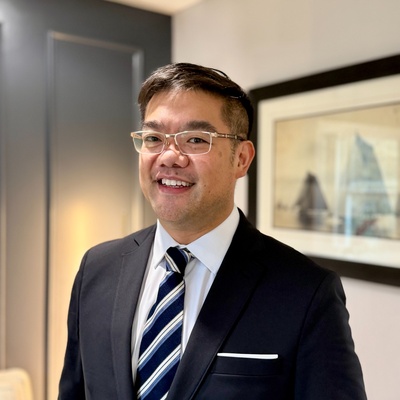
Article by
Peterson Huang DMD, MS, FACP, FRCDC
Dr. Peterson Huang is a dual board-certified prosthodontist serving Falls Church and Northern Virginia. He has been recognized as a Top Prosthodontist by Northern Virginia Magazine and Arlington Magazine and is affiliated with the Inova Fairfax Hospital Tumor Board. Dr. Huang focuses on dental implants, full mouth reconstruction, and complex restorative dentistry for patients who need advanced, comprehensive care.
What is the Difference Between a Prosthodontist and a General Dentist?
When seeking dental care, understanding provider distinctions ensures you receive appropriate care for your clinical needs. The primary comparison in comprehensive oral care is prosthodontist vs general dentist.
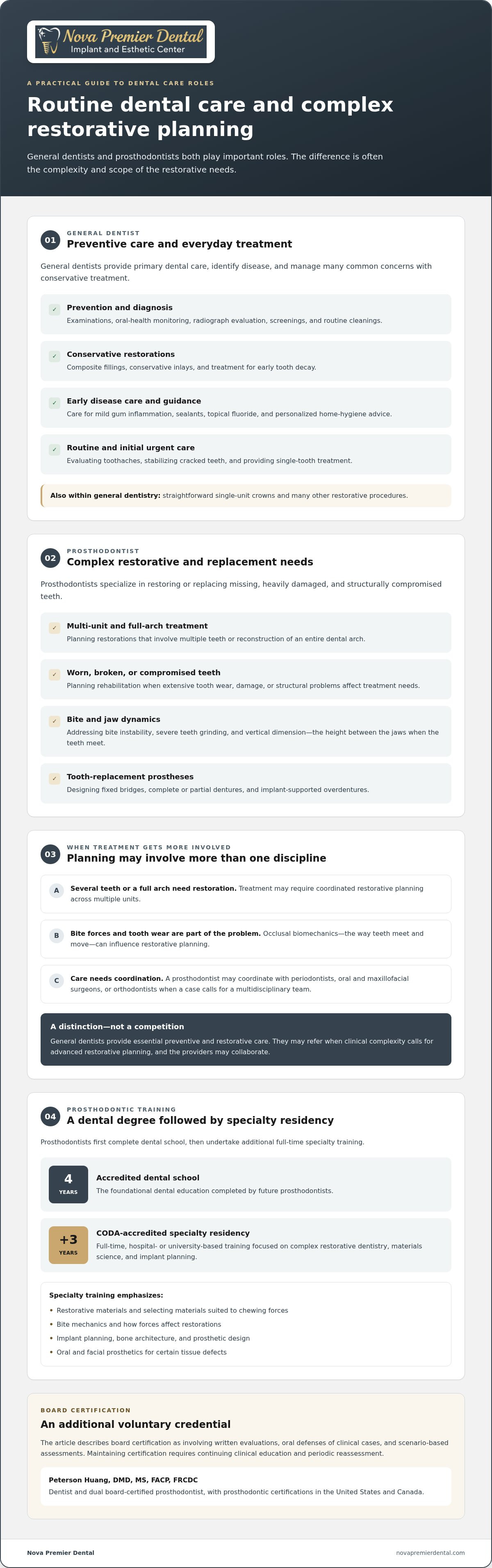
A general dentist serves as a primary dental care provider, focusing on preventive maintenance, diagnostic evaluations, routine restorations (such as composite fillings), and overall oral health monitoring. A prosthodontist is a dental specialist who has completed an additional three years of accredited, post-doctoral surgical and restorative residency training. Recognized by the American Dental Association (ADA) as one of the official dental specialties, Prosthodontics centers on diagnosing, treatment planning, rehabilitating, and maintaining clinical conditions associated with missing teeth, deficient oral tissues, and complex dental biomechanics.
Both practitioners play critical roles within oral healthcare, often collaborating to support patient health. While a general dentist effectively manages routine dental maintenance, a prosthodontist handles extensive restorative reconstructions, rehabilitation of compromised bites, and surgical or prosthetic tooth replacements.
The Role of a General Dentist
General dentists serve as the frontline for oral disease prevention, diagnosis, and conservative therapy. After graduating with either a Doctor of Dental Surgery (DDS) or Doctor of Dental Medicine (DMD) degree, general practitioners manage diverse day-to-day dental needs across all age groups.
- Preventive Care and Diagnostics: Conducting comprehensive clinical examinations, screening for periodontal disease and oral cancer, evaluating radiographs, and providing routine prophylaxis (cleanings).
- Direct Restorations: Placing direct composite resin fillings, conservative inlays, and treating early stages of dental caries (tooth decay).
- Early Disease Intervention: Managing mild gingival inflammation, applying dental sealants, providing topical fluoride treatments, and advising patients on personalized home hygiene.
- Initial Emergency and Routine Care: Evaluating acute toothaches, stabilizing cracked teeth, and performing single-tooth treatments.
General dentists are trained to identify dental diseases early, treat localized oral issues conservatively, and refer patients to dental specialists when clinical complexity warrants advanced intervention.
The Role of a Prosthodontist
A prosthodontist manages advanced dental conditions involving missing, heavily broken down, or structurally compromised teeth. Their training emphasizes restorative dental materials science, occlusal biomechanics (the physics of how teeth come together during chewing and speaking), and multi-disciplinary treatment sequencing.
- Complex Restorative Planning: Designing and executing multi-unit dental restorations, full arch reconstructions, and rehabilitations for severely worn or broken dentition.
- Bite and Jaw Dynamics: Managing vertical dimension of occlusion (the measured height between the upper and lower jaws when teeth meet), severe bruxism (teeth grinding), and occlusal instability.
- Tooth Replacement Prosthetics: Fabricating fixed and removable prostheses, including complete dentures, removable partial dentures, fixed bridges, and implant-supported overdentures.
- Team Coordination: Directing multidisciplinary care teams—including periodontists, oral and maxillofacial surgeons, and orthodontists—for comprehensive oral reconstruction.
The Educational Gap: Three Years of Advanced Specialization
To understand the clinical difference between these two providers, it helps to examine their respective training paths. All prosthodontists begin as general dentists by graduating from an accredited four-year dental school. Following this general doctoral education, future prosthodontists undertake three additional years of rigorous, full-time hospital- or university-based specialty residency training accredited by the Commission on Dental Accreditation (CODA).
Residency and Clinical Rigor
Prosthodontic residency programs provide thousands of clinical and laboratory hours focused exclusively on complex restorative dentistry, materials science, and surgical implant planning. General dentistry programs introduce students to fundamental restorative procedures, but specialty residencies immerse clinicians in advanced, challenging clinical presentations.
- Advanced Materials Science: Deep study of the physical, thermal, and biological properties of restorative ceramics (such as lithium disilicate and monolithic zirconia), metal alloys, and high-performance polymers. This helps the prosthodontist select biomaterials suited to specific masticatory (chewing) forces.
- Occlusal Biomechanics: Specialized education in mandibular movement patterns, joint kinematics, and dynamic bite forces. This training is essential for designing restorations that distribute stress evenly and reduce the likelihood of porcelain fractures, component looseness, or accelerated tooth wear.
- Implant Planning and Restoration: In-depth instruction in the surgical and restorative aspects of dental implants. This includes evaluating remaining bone architecture, soft-tissue contours, emergence profile design, and subgingival prosthetic margins to preserve crestal bone and manage peri-implant tissues.
- Maxillofacial Prosthetics and Tissue Defects: Specialized programs train residents to restore oral and facial defects resulting from trauma, congenital deformities (such as cleft palate), or surgical resections for head and neck cancers.
The Significance of Board Certification
Completion of a residency qualifies a clinician as a specialist in prosthodontics. However, select practitioners choose to pursue voluntary board certification. In the United States, this credential is conferred by the American Board of Prosthodontics (ABP); in Canada, it is administered by the Royal College of Dentists of Canada (RCDC).
Board certification requires passing a multi-part examination process, including rigorous written evaluations, exhaustive oral defenses of clinical cases completed by the practitioner, and scenario-based diagnostic assessments evaluated by senior leaders in the specialty. Maintaining certification requires continuing clinical education and periodic reassessment. At Nova Premier Dental, Dr. Peterson Huang, DMD, MS, FACP, FRCDC, is a dual board-certified prosthodontist certified through both the American Board of Prosthodontics and the Royal College of Dentists of Canada.
When Should You See a Prosthodontist Instead of a Dentist?
Many routine dental procedures—including regular hygiene appointments, basic restorative fillings, and straightforward single-unit crowns—are handled routinely and capably by general dentists. However, specific anatomical, functional, and aesthetic circumstances suggest consulting a specialist.
| Clinical Situation | Primary Provider: General Dentist | Specialist Provider: Prosthodontist |
|---|---|---|
| Preventive Care | Routine cleanings, cavity screenings, dental sealants, periodontal probing. | Ongoing maintenance of complex full-mouth reconstructions and implant bars. |
| Single Tooth Decay | Direct composite fillings, simple single-tooth porcelain crowns. | Teeth with minimal remaining structure requiring complex post-and-core or crown lengthening coordination. |
| Multiple Missing Teeth | Straightforward three-unit bridges or standard removable partial dentures. | Implant-supported bridges, full-arch fixed hybrid prostheses, complex bone resorption situations. |
| Severe Tooth Wear | Conservative composite bonding, fabrication of basic occlusal night guards. | Re-establishing vertical dimension of occlusion, comprehensive diagnostic wax-ups, full-mouth reconstructions. |
| Jaw and Bite Pain | Preliminary evaluation, basic flat-plane occlusal bite splints. | Comprehensive occlusal equilibration, complex management of bite collapse, diagnostic interocclusal records. |
| Previous Restorative Complications | Assessment of recurrent decay beneath restorations or localized crown recementation. | Systematic diagnosis of repeated crown debonding, recurring ceramic fractures, or broken implant screws. |
Complex Restorations and Missing Teeth
When multiple teeth are missing, damaged, or severely broken down, restorative treatment requires careful systemic planning. Simply replacing teeth individually without considering the broader bite often distributes stress unevenly, leading to mechanical complications.
Prosthodontists evaluate how muscle forces, bone architecture, and the opposing dental arch interact. For patients missing most or all of their teeth, prosthodontists determine whether dentures and partial dentures or fixed implant-supported reconstructions provide the best functional and anatomical support. This structured evaluation helps avoid the long-term biological and structural failures seen with unplanned or piecemeal dental work.
When evaluating complicated multi-unit restorative plans, pursuing a second opinion can provide clarity regarding treatment sequencing, material choices, and long-term maintenance requirements.
Specialized Functional and Anatomical Considerations
Certain oral health presentations introduce clinical variables beyond routine restorative protocols:
- Collapsed Vertical Dimension: Decades of severe nocturnal bruxism, untreated erosion from gastroesophageal reflux, or multiple unreplaced back teeth can result in lost posterior support. As posterior teeth wear down or shift, facial height shortens, and anterior teeth absorb excessive force, resulting in cracking and accelerated wear. Rebuilding this height requires careful diagnostic articulation and temporary trial phases to ensure muscles and joints adapt comfortably.
- Temporomandibular Joint and Bite Instability: If bite disharmony contributes to localized muscular fatigue, tension, or occlusal trauma, careful evaluation of how teeth fit together is required. Managing TMJ and jaw joint disorders often involves stabilizing the bite using diagnostic splints before modifying natural tooth enamel.
- Maxillofacial and Cancer Rehabilitation: Patients who have received treatment for head and neck cancers, surgical tumor resections, or congenital conditions require specialized intraoral prostheses. These custom devices, including obturators, seal surgical boundaries, preserve swallowing, and restore speech.
Prosthodontists vs. Cosmetic Dentists
It is important to clarify that the term "cosmetic dentist" is not an officially recognized specialty by the American Dental Association or any recognized dental licensing board. Any licensed general dentist may refer to themselves as a cosmetic dentist, regardless of their continuing education background.
By contrast, prosthodontics is an ADA-recognized dental specialty requiring three years of formal post-doctoral residency. While prosthodontists routinely perform aesthetic restorations—such as cosmetic veneers and lifelike all-ceramic crowns—their approach grounds aesthetic alterations in established biomechanical principles. A restoration must withstand chewing forces and support surrounding periodontal tissues over time, not just look visually appealing.
The Clinical Advantage of Specialized Restorative Planning
Complex dental rehabilitation represents an investment of clinical time, biological healing, and personal financial resources. Choosing a specialist for complex care emphasizes predictable diagnostics, material selection, and long-term restorative durability.
Material Selection and Restorative Longevity
Restorations do not behave identically in every mouth. Masticatory forces vary widely based on muscular anatomy, skeletal patterns, and nocturnal clenching habits. A material suitable for an anterior single tooth in a patient with a normal bite may quickly fracture if placed in a patient with heavy posterior bruxism.
Prosthodontists evaluate physical properties—such as the flexural strength of monolithic zirconia versus the optical translucency and adhesive bond strength of etched lithium disilicate—relative to remaining healthy tooth structure and functional clearance. In complex full-arch cases, planning appropriate restorative space and selecting durable biomaterials helps reduce the risk of structural fractures, component loosening, and repeated remakes.
When considering tooth replacement with implants, it is clinically important to separate implant survival from prosthetic longevity. Clinical studies consistently show high overall survival rates for osseointegrated titanium implant fixtures embedded in bone. However, the prosthetic components attached to them—including ceramic crowns, abutment screws, acrylic teeth, and nylon overdenture attachments—naturally experience mechanical wear, gradual micro-movement, and material degradation over time. Specialized prosthodontic planning designs these prostheses with easily serviceable components, allowing for periodic maintenance, screw tightening, or prosthetic relining without compromising the underlying implant base.
Occlusal Precision and Tissue Integration
Restorative longevity depends heavily on microscopic precision:
- Margin Fit and Seal: The micro-gap between a laboratory-fabricated crown and the prepared natural tooth margin must be minimal and uniform. A precise seal protects the underlying dentin, prevents bacterial infiltration, and supports long-term periodontal health.
- Emergence Profile: When restoring dental implants, the crown must transition smoothly from the circular diameter of the implant platform to the natural anatomy of the tooth at the gumline. A properly contoured emergence profile supports the soft tissue without creating food traps, facilitating routine plaque removal and reducing peri-implant inflammation risks.
- Balanced Occlusal Contacts: Restorations must be adjusted to ensure chewing forces distribute along the long axis of the teeth. Imbalanced contacts can cause localized bone loss around implants, ceramic chipping, muscle pain, or tooth hypermobility.
Specialized Care at Nova Premier Dental in Falls Church
Nova Premier Dental is a private prosthodontic specialty dental office in Falls Church serving Northern Virginia. The practice provides care for patients with missing teeth, broken down dentition, advanced functional challenges, and complex restorative concerns.
The practice is led by Dr. Peterson Huang, DMD, MS, FACP, FRCDC, who completed formal specialty residency training in prosthodontics and earned a Master of Science in Oral Biology. Dr. Huang holds dual board certification in prosthodontics from both the American Board of Prosthodontics and the Royal College of Dentists of Canada. His clinical practice focuses on diagnostic precision, careful restorative planning, and coordinated care alongside regional surgical and general dental colleagues.
Managing extensive restorative therapy often involves financial planning. Nova Premier Dental offers in-house payment plans for qualifying patients, allowing treatment costs to be paid over several months while patients receive the focused restorative care they need.
Whether you require single-tooth restorations, full-mouth reconstructions, or an informed assessment of your bite, pursuing care with a specialist in prosthodontic care in Northern Virginia provides an organized, clinically grounded approach to oral health rehabilitation.
Frequently Asked Questions
Is a prosthodontist more expensive than a general dentist?
Specialty fees may be higher for specific advanced procedures, reflecting the three years of post-doctoral training, the use of specialized materials, and the clinical time required for complex diagnostic planning. However, for complex reconstructions, specialist planning can help reduce overall costs by minimizing restorative failures, frequent remakes, and recurrent complications.
Can a general dentist place dental implants?
Yes. Licensed general dentists are legally permitted to place and restore dental implants, and many do so after pursuing continuing education courses. Prosthodontists, by comparison, complete three years of full-time, accredited residency training dedicated to complex surgical planning, bone evaluation, and implant restoration. For anatomically difficult cases or multi-unit implant restorations, specialist evaluation is often recommended.
Do I need a referral to see a prosthodontist?
No. While many patients are referred directly by their general dentist when a case exceeds routine practice parameters, a formal referral is not strictly required. Patients facing complex dental problems, severe tooth wear, or failed previous restorations may schedule an evaluation directly with a prosthodontic practice.
Will my dental insurance cover a visit to a prosthodontist?
Most dental insurance plans provide benefits based on the specific American Dental Association (ADA) procedure code performed rather than the provider's specialty status. Coverage varies depending on your individual plan design, network status, deductibles, and annual maximums. A detailed pre-treatment estimate can clarify your expected coverage before beginning therapy.
How do I know if my dental case is complex enough for a prosthodontist?
Specialist evaluation is appropriate if you are missing multiple teeth, experience significant jaw joint discomfort alongside extensive tooth wear, have experienced repeated fractures of crowns or bridges, or have been told you require comprehensive full-mouth reconstruction or complex implant therapy.
If you are facing a complex restorative or prosthodontic concern, contact Nova Premier Dental in Falls Church to discuss diagnostic and treatment options with dual board-certified prosthodontist Dr. Peterson Huang.
Disclaimer
The information provided on this website and blog is intended for general educational and informational purposes only and should not be considered dental or medical advice, diagnosis, or treatment. Reading content on this website does not establish a doctor-patient relationship with Nova Premier Dental or Dr. Peterson Huang. Dental conditions and treatment needs vary from patient to patient. Individuals should consult directly with a qualified dental professional for personalized evaluation, diagnosis, and treatment recommendations. Do not delay seeking professional dental care based on information found on this website. While we strive to provide accurate and up-to-date information, no guarantee is made regarding the completeness, accuracy, or applicability of the content. Treatment outcomes may vary depending on individual circumstances. If you are experiencing a dental emergency or urgent oral health concern, please contact a licensed dental professional immediately or call 911 in the event of a medical emergency.


