


Article by
Peterson Huang DMD, MS, FACP, FRCDC
Dr. Peterson Huang is a dual board-certified prosthodontist serving Falls Church and Northern Virginia. He has been recognized as a Top Prosthodontist by Northern Virginia Magazine and Arlington Magazine and is affiliated with the Inova Fairfax Hospital Tumor Board. Dr. Huang focuses on dental implants, full mouth reconstruction, and complex restorative dentistry for patients who need advanced, comprehensive care.
The most advanced dental restoration isn't necessarily the one that replaces your entire tooth, but the one that saves it. Many patients arrive at our office concerned that a large cavity or a fractured cusp means they're destined for a full-coverage crown, yet the debate of inlays vs onlays offers a much more conservative path. If you've felt anxious about losing healthy enamel to a traditional drill, you're not alone. Preserving natural tooth structure is the cornerstone of modern, high-end restorative dentistry.
At Nova Premier Dental, we understand that confusion over clinical terminology can make dental decisions feel overwhelming. This guide clarifies how these precision-crafted restorations bridge the gap between a simple filling and a crown. You'll learn which option fits your specific decay pattern and why the meticulous skill of a prosthodontist in Northern Virginia is essential for a long-lasting result. Dr. Peterson Huang specializes in these complex reconstructions, ensuring a perfect fit to prevent micro-leakage. We'll explore material choices like porcelain and gold, and explain how our in-house payment plans help you prioritize your oral health while comfortably managing the cost of care.
Key Takeaways
- Discover why indirect restorations serve as the ideal conservative alternative to crowns by prioritizing the maximum preservation of your natural tooth structure.
- Identify the structural differences of inlays vs onlays to understand which solution best addresses your specific pattern of tooth decay or damage.
- Evaluate the clinical benefits of porcelain and gold materials and the vital importance of precision fitting to ensure long-term marginal integrity.
- Learn what to expect during the specialized clinical procedure, from advanced diagnostic imaging to the implementation of precision digital impressions.
- Understand why the expertise of a dual board-certified prosthodontist is paramount for achieving the highest standards in complex oral reconstruction.
Defining Inlays and Onlays: The Conservative Alternative to Dental Crowns
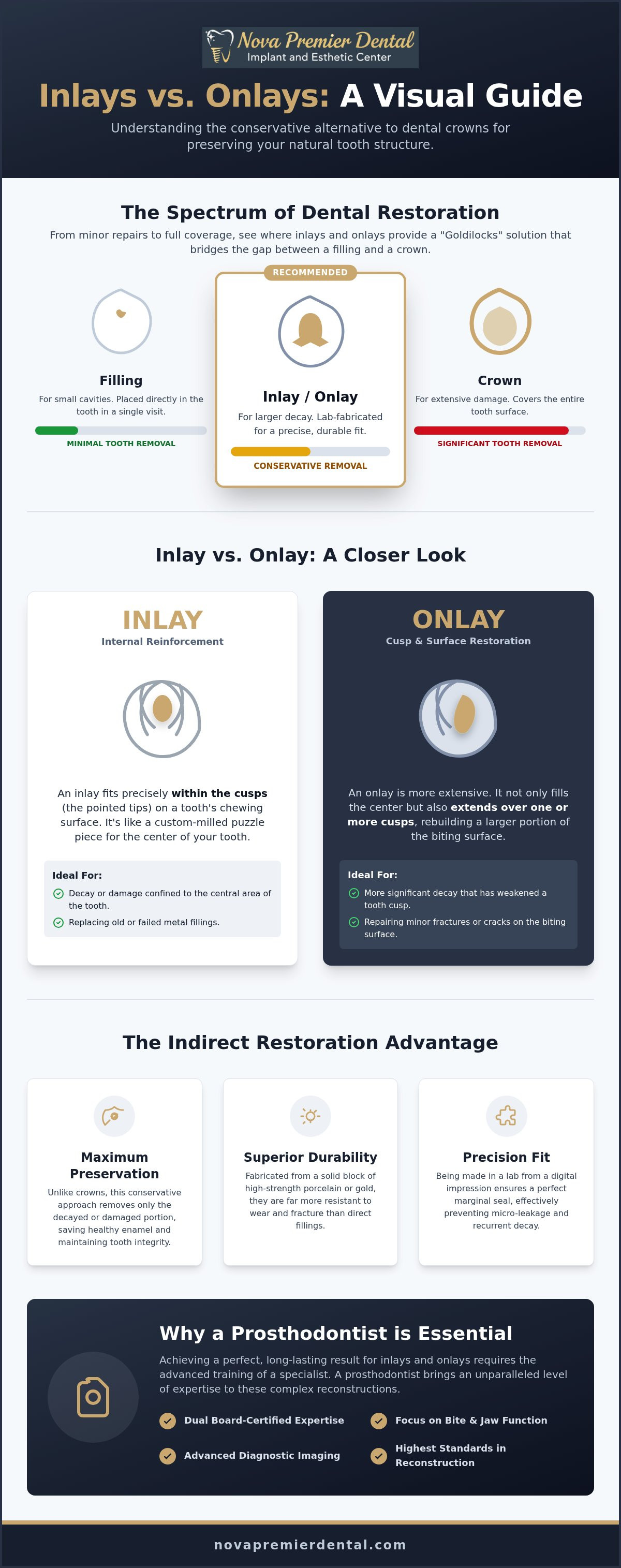
When a cavity becomes too extensive for a standard filling but hasn't yet compromised the entire tooth structure, patients often find themselves in a restorative middle ground. This is where the debate of inlays vs onlays becomes central to a patient's long-term health. These treatments are known as "indirect restorations" because, unlike common fillings, they're custom-fabricated in a specialized laboratory before being bonded to your tooth. This process ensures a level of precision and strength that simply isn't possible with materials hardened directly in the mouth.
These options represent a "Goldilocks" solution in modern dentistry. They're significantly more durable and wear-resistant than a composite filling, yet far less invasive than a full-coverage crown. For patients at Nova Premier Dental, this means we can address structural damage without sacrificing the healthy enamel that remains. It's a specialized approach that requires a meticulous eye for detail to ensure the new piece fits perfectly within the prepared space.
Achieving this balance requires the clinical expertise of a prosthodontist in Northern Virginia. A specialist like Dr. Peterson Huang brings advanced, dual board-certified training to these procedures. His focus is on the long-term functionality of your bite, ensuring that every restoration supports the natural mechanics of your jaw. We also offer in-house payment plans for qualifying patients, allowing you to choose the highest quality restorative care while managing the cost comfortably over several months.
The Philosophy of Conservative Dentistry
Conservative dentistry operates on the biological principle that "less is more." Every millimeter of healthy enamel we preserve contributes to the tooth's overall structural integrity and long-term survival. Avoiding a dental crown when possible is beneficial because crowns require the removal of a significant portion of the tooth's outer layer. Dr. Huang carefully evaluates the remaining tooth integrity to determine if an inlay or onlay can provide the necessary support. This approach maintains the natural bond between the tooth and the bone, reducing the risk of future complications and preserving your biological foundation.
Direct vs. Indirect Restorations
The primary difference between these treatments lies in how they're created. Direct restorations, such as standard composite fillings, are placed and cured directly in your mouth during a single visit. While they're excellent for small repairs, they can sometimes shrink slightly during the curing process, which may lead to microscopic gaps. In contrast, Inlays and onlays are indirect restorations. Because they're milled from high-quality ceramics or cast from gold outside the mouth, they offer a superior marginal fit. This precision is essential for large biting surfaces where the forces of chewing are most intense, providing a seal that effectively prevents micro-leakage and recurrent decay.
Inlays vs. Onlays: Key Differences in Structure and Coverage
Understanding the physical distinction between inlays vs onlays requires a look at the tooth's biting surface anatomy. Every molar has "cusps," which are the raised points or tips used for grinding food. The space between these tips consists of "pits and fissures," the deep grooves where decay frequently begins. The specific location and extent of this damage dictate whether a specialist will recommend an inlay or an onlay to restore the tooth's function.
An inlay is essentially an internal restoration. It's designed to fit snugly within the center of the tooth, restricted entirely to the area between the cusps. It acts as a precise, durable "plug" that reinforces the tooth from the inside out. Conversely, an onlay provides more extensive coverage. It extends over one or more of the tooth's cusps, effectively rebuilding the biting surface. Because an onlay covers a significant portion of the tooth without requiring the total preparation of a full restoration, it's frequently referred to as a "partial crown." This designation signifies that while the repair is substantial, we're still prioritizing the preservation of your natural enamel.
When an Inlay is the Correct Choice
An inlay is the preferred clinical solution when decay has surpassed the limits of a traditional composite filling but the surrounding tooth walls remain robust. If a fracture is localized in the center of the tooth, an inlay provides the structural reinforcement needed to prevent the crack from spreading. By choosing an inlay, Dr. Peterson Huang ensures that the remaining natural walls are supported by a material that matches the thermal expansion of natural teeth, preventing the micro-leakage often seen with smaller, direct restorations. This meticulous approach helps maintain the tooth's integrity for years to come.
When an Onlay Becomes Necessary
Onlays become essential when the structural integrity of the tooth's cusps is compromised. If a cusp is weakened by a large cavity or an old, expanding amalgam filling, it's at high risk of fracturing under the intense pressure of your bite. An onlay "girdles" the tooth, distributing those forces more evenly to prevent a catastrophic break. This restoration bridges the gap when a dental crown is not yet required, allowing you to keep more of your healthy tooth structure while gaining the protection of a full-coverage repair. To ensure these elite treatments are accessible, we offer in-house payment plans for qualifying patients, allowing you to manage the cost over several months while enjoying the benefits of a restored smile.
If you're unsure which restoration is right for your unique case, a consultation with a prosthodontist in Northern Virginia can provide the clinical clarity you need to move forward with confidence.
Materials and Durability: Why Precision Fitting is Paramount
The clinical success of inlays vs onlays hinges on a concept known as "marginal integrity." This term refers to the microscopic seal between the custom restoration and your natural tooth structure. When this seal is perfect, it prevents micro-leakage, a process where bacteria and saliva seep under the restoration to cause secondary decay. While a general dentist might focus on the basic fill, a prosthodontist in Northern Virginia utilizes advanced bonding protocols and digital impressions to achieve a micromillimeter-perfect fit. This level of precision is the primary factor in ensuring your restoration lasts for decades rather than years.
Modern restorative dentistry offers several material paths, each with specific mechanical benefits. Composite resin is sometimes used for smaller repairs, but it lacks the long-term wear resistance and structural strength of laboratory-fabricated materials. For patients at Nova Premier Dental, we prioritize materials that mimic the physical properties of natural enamel while providing the durability required for daily chewing forces. To make this elite level of care accessible, we offer in-house payment plans for qualifying patients, allowing you to invest in superior materials while managing the cost over several months.
Porcelain and Ceramic: The Aesthetic Standard
For teeth that are visible when you smile or speak, porcelain is the premier choice. We often utilize high-strength lithium disilicate, commonly known as E-max, which offers an incredible balance of beauty and resilience. These ceramics are meticulously shade-matched to the unique translucency and color of your natural teeth, ensuring the repair is invisible to the naked eye. Dr. Peterson Huang carefully selects the ceramic ingot that best matches your Northern Virginia smile, providing a restoration that is as functional as it is aesthetic.
The "Gold Standard" for Molar Protection
While ceramic is favored for its appearance, gold remains the unsurpassed "gold standard" for durability on back molars. High-noble gold alloys are exceptionally biocompatible and possess a wear rate almost identical to natural human enamel. This means a gold onlay won't cause excessive wear on the opposing teeth. In many clinical cases, a well-maintained gold restoration can last 30 years or longer. Its malleability allows for a "burnished" edge, creating the most precise marginal seal possible in restorative dentistry. This makes it an ideal choice for patients who prioritize longevity and functional excellence in their oral reconstruction.
Our practice utilizes state-of-the-art digital intraoral scanners rather than traditional putty impressions. This technology captures every nuance of your tooth's preparation, allowing our laboratory partners to mill or cast a restoration that drops into place with absolute accuracy. By combining elite materials with digital precision, we provide a conservative alternative that truly stands the test of time.
The Clinical Procedure: What to Expect During Your Restoration
The clinical journey for inlays vs onlays typically spans two precise appointments, each designed to ensure the biological and mechanical success of the restoration. During the initial visit, our focus is on diagnostic imaging and meticulous tooth preparation. We utilize advanced digital scans rather than traditional putty to capture the unique topography of your tooth. This data allows our laboratory to craft a restoration that accounts for every micromillimeter of space. After preparation, we place a high-quality temporary restoration. This protects the sensitive inner layers of the tooth while your custom piece is being fabricated. The final stage involves the permanent bonding and a meticulous occlusal adjustment to ensure your bite feels natural and balanced.
To ensure that elite restorative care remains accessible, we offer in-house payment plans for qualifying patients at Nova Premier Dental. This allows you to comfortably manage the cost over several months while already benefiting from your restored tooth. Our team is dedicated to providing a seamless experience that prioritizes both your clinical outcome and your personal comfort.
The Specialist’s Approach to Tooth Preparation
Dr. Peterson Huang approaches tooth preparation with a level of precision that defines the prosthodontic specialty. He utilizes high-power magnification to identify and preserve every possible millimeter of healthy enamel. This meticulousness is critical when determining the "path of insertion," which is the specific angle at which the restoration slides into place. A perfectly engineered path of insertion ensures long-term bond stability and prevents unnecessary stress on the remaining tooth structure. We manage patient comfort throughout this phase with advanced local anesthetics, ensuring the preparation process is entirely stress-free.
Recovery and Aftercare
Immediate post-operative expectations are generally mild. You might experience slight temperature sensitivity or minor gum tenderness for a few days after the final bonding. Maintaining the health of your new restoration requires diligent interproximal hygiene. While the ceramic or gold material cannot decay, the margin where it meets your tooth is still vulnerable. We'll show you how to floss effectively around the restoration to protect its longevity. Consistent attendance at routine exams is essential for monitoring the integrity of the bond and ensuring your bite remains correctly aligned over time.
If you're ready to experience the precision of conservative restorative dentistry, we invite you to schedule a consultation with a prosthodontist in Northern Virginia today.
Choosing a Prosthodontist in Falls Church for Your Restorative Care
The technical decision between inlays vs onlays is only one part of the restorative process. The clinical success of these treatments depends heavily on the skill of the practitioner performing the work. While many general practices offer basic restorative services, the precision required for a micromillimeter-perfect fit necessitates the specialized training of a prosthodontist. At Nova Premier Dental, we provide a sophisticated blend of elite technology and individualized care. Our practice is proud to serve the Northern Virginia community, including patients from Falls Church, Arlington, McLean, and Fairfax, who seek a level of excellence that goes beyond standard dentistry.
Choosing a specialist ensures that your restoration is designed with a comprehensive understanding of your entire oral system. We don't just look at a single tooth; we evaluate how that tooth interacts with your bite, your jaw joint, and your overall facial aesthetics. This high-level perspective is what differentiates a standard repair from a true oral reconstruction. By prioritizing the most conservative options first, we help you maintain your natural foundation for a lifetime of functional beauty.
Expertise in Complex Restorations
The technical demands of high-end restorative materials require an intimate understanding of both chemistry and mechanics. As a dual board-certified prosthodontist, Dr. Peterson Huang possesses the advanced credentials necessary to manage the most difficult cases. This expertise is particularly vital when addressing failed previous restorations or complex fracture patterns that require more than a simple fix. Our commitment to why choose us values means we never settle for a "good enough" fit. We meticulously plan every restoration to ensure it integrates seamlessly with your existing anatomy, providing a result that is both functional and aesthetically perfect.
Managing Your Investment in Oral Health
We believe that the highest standard of dental care should be accessible to those who value their long-term health. To support our patients, we offer in-house payment plans for qualifying individuals. These plans are designed to allow you to spread the cost of your care over several months. This approach ensures you don't have to compromise on the quality of your restoration or the durability of the materials used. You can begin enjoying the benefits of your restored, healthy smile immediately while managing your investment through comfortable, predictable payments.
If you're facing a complex dental challenge or simply want the most conservative restoration possible, we encourage you to contact us for a restorative consultation. Our team is here to guide you through the clinical nuances of your care, ensuring you feel secure and confident in every decision you make for your smile. Your journey to a healthier, more resilient smile begins with a specialized evaluation from a prosthodontist in Northern Virginia.
Prioritizing Precision in Your Dental Restoration
Choosing between inlays vs onlays is a fundamental step toward preserving your natural smile and avoiding the invasive preparation required for full crowns. By focusing on conservative restoration, we ensure that every possible millimeter of healthy enamel remains to support your long-term oral health. Whether you require the aesthetic brilliance of porcelain or the legendary durability of gold, the success of your treatment rests on the precision of the marginal fit and the clinical expertise of your clinician.
At Nova Premier Dental, Dr. Peterson Huang applies his skills as a dual board-certified prosthodontist to deliver results that are both functional and beautiful. As a specialist in conservative oral reconstruction, he ensures that your restoration integrates seamlessly with your unique anatomy. We believe elite care should be accessible, which is why we offer in-house payment plans for qualifying patients. These plans allow you to manage costs comfortably over several months while you're already enjoying the benefits of a restored smile.
If you're ready to protect your tooth's integrity with specialized care, we invite you to Schedule Your Restorative Consultation with Dr. Huang. Take the first step toward a resilient and healthy smile today with a trusted prosthodontist in Northern Virginia. Your long-term health is our highest priority.
Frequently Asked Questions
How long do dental inlays and onlays typically last?
Dental inlays and onlays typically last between 10 and 15 years, though high-noble gold options can frequently exceed 30 years with meticulous care. The ultimate lifespan of your restoration depends on the material chosen and your commitment to daily oral hygiene. At Nova Premier Dental, we focus on precision fitting and superior bonding protocols to maximize the durability and functional life of every custom restoration we place.
Is getting an inlay or onlay painful?
The restoration process is not painful because we utilize advanced local anesthetics to ensure the tooth and surrounding tissues are completely numb throughout the procedure. Most patients describe the experience as being very similar to receiving a standard filling. After your appointment, you might experience mild temperature sensitivity, but this typically subsides within a few days as the tooth and gums adjust to the new custom piece.
Can an onlay fall off, and what should I do if it does?
If an onlay becomes dislodged, you should contact our office immediately to schedule a re-bonding appointment to protect the exposed tooth. Please keep the restoration in a safe container and do not attempt to glue it back yourself with over-the-counter products. Dr. Peterson Huang will evaluate the tooth and the restoration to ensure it can be safely and securely replaced.
Are inlays better than traditional composite fillings?
Inlays are generally superior to composite fillings for larger areas of decay because they're fabricated from stronger, more wear-resistant materials in a laboratory setting. When comparing inlays vs onlays to direct fillings, the indirect process allows for a more precise fit and better structural reinforcement. This specialized approach significantly reduces the risk of the restoration shrinking or fracturing under the intense pressure of your daily bite.
Why would I choose an onlay over a full dental crown?
You would choose an onlay over a full crown to preserve as much of your natural tooth structure as possible while still protecting a weakened cusp. Crowns require the removal of significant healthy enamel to fit the cap, whereas an onlay only replaces the damaged portions. This conservative approach is a hallmark of the care provided by a prosthodontist in Northern Virginia, focusing on long-term biological health.
Do inlays and onlays look like natural teeth?
Modern ceramic and porcelain restorations are specifically engineered to mimic the translucency and color of your natural teeth for a seamless appearance. We carefully shade-match the material to ensure it blends perfectly with your surrounding dentition. Unless you choose a gold restoration for its unsurpassed durability on back molars, your repair will be virtually indistinguishable from the rest of your smile to any casual observer.
What is the cost difference between an inlay and a crown in Northern Virginia?
An inlay or onlay is typically more cost-effective than a full crown because it requires less tooth preparation and fewer restorative materials. While specialized restorations represent an investment in your health, we offer in-house payment plans for qualifying patients. These plans allow you to spread the cost over several months, making it easier to prioritize high-quality care while you enjoy the immediate benefits of your new smile.
How do I care for my new inlay or onlay to prevent future decay?
Caring for these restorations involves the same diligent brushing and flossing you perform for your natural teeth to maintain oral health. Pay special attention to the margins where the restoration meets the tooth, as these areas are most vulnerable to bacteria and plaque buildup. Regular professional cleanings and exams are vital to monitor the bond and ensure no secondary decay develops underneath the edges of the restoration.
Disclaimer
The information provided on this website and blog is intended for general educational and informational purposes only and should not be considered dental or medical advice, diagnosis, or treatment. Reading content on this website does not establish a doctor-patient relationship with Nova Premier Dental or Dr. Peterson Huang. Dental conditions and treatment needs vary from patient to patient. Individuals should consult directly with a qualified dental professional for personalized evaluation, diagnosis, and treatment recommendations. Do not delay seeking professional dental care based on information found on this website. While we strive to provide accurate and up-to-date information, no guarantee is made regarding the completeness, accuracy, or applicability of the content. Treatment outcomes may vary depending on individual circumstances. If you are experiencing a dental emergency or urgent oral health concern, please contact a licensed dental professional immediately or call 911 in the event of a medical emergency.


