


Article by
Peterson Huang DMD, MS, FACP, FRCDC
Dr. Peterson Huang is a dual board-certified prosthodontist serving Falls Church and Northern Virginia. He has been recognized as a Top Prosthodontist by Northern Virginia Magazine and Arlington Magazine and is affiliated with the Inova Fairfax Hospital Tumor Board. Dr. Huang focuses on dental implants, full mouth reconstruction, and complex restorative dentistry for patients who need advanced, comprehensive care.
Your dentures fit perfectly when you first got them. Now, a few years later, they slip when you laugh, leave sore spots along your gumline, and make you think twice before ordering anything that requires real chewing. If that sounds familiar, you're not imagining things, and you're certainly not alone. The question of how often should you replace your dentures comes up constantly, and the honest answer surprises most patients: loosening isn't a sign that your dentures wore out. It's a sign that your jawbone changed.
That distinction matters more than most people realize. After tooth loss, the bone beneath your gums undergoes a continuous process of resorption, gradually reshaping the ridge that your dentures rest on. A prosthesis crafted for your jaw five years ago may simply no longer match the anatomy you have today, regardless of how well you've cared for it.
In this guide, Dr. Peterson Huang, a dual board-certified prosthodontist serving Northern Virginia, explains the biological and mechanical forces that drive denture replacement, what a proper evaluation looks like, and how the right clinical expertise protects both your comfort and your long-term jawbone health.
Key Takeaways
- Understanding how often should you replace your dentures starts with biology, not just wear: most patients require a new prosthesis every 5 to 10 years due to continuous jawbone resorption reshaping the ridge beneath the gums.
- A loose or uncomfortable denture is rarely a sign of poor maintenance — it is a clinical signal that your underlying oral anatomy has changed and your prosthesis no longer fits your current jaw structure.
- There are five specific warning signs that indicate replacement is overdue, ranging from new sore spots and slipping during speech to subtle but measurable shifts in your facial profile.
- Traditional removable dentures do not halt bone loss, while implant-supported alternatives offer a more permanent solution that actively preserves jawbone density over time.
- A dual board-certified prosthodontist brings a level of diagnostic precision and reconstructive expertise that general dentistry cannot replicate — and that distinction directly affects the longevity of your results.
Understanding the Lifespan of Modern Dentures
Most patients are surprised to learn that the question of how often should you replace your dentures doesn't have a single universal answer. It depends on two distinct variables that clinicians treat very differently: how the prosthetic materials themselves hold up over time, and how dramatically your underlying oral anatomy shifts. Conflating the two is one of the most common reasons patients either replace dentures prematurely or, more dangerously, hold onto them far too long.
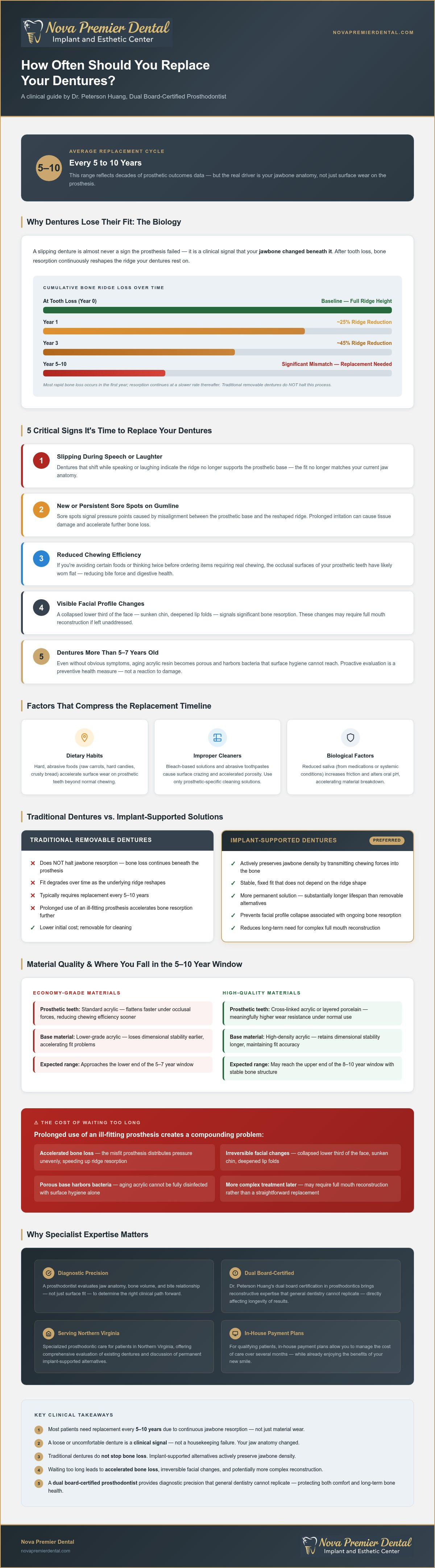
The general clinical consensus places the average replacement cycle between five and ten years. That range isn't arbitrary. It reflects decades of prosthetic outcomes data and accounts for the realistic interplay between material degradation and biological change. Some patients approach the lower end of that window; others, with stable bone structure and meticulous care habits, may reach the upper boundary before a replacement becomes clinically necessary.
The 5-to-10 Year Rule Explained
Every time you chew, your prosthetic teeth absorb mechanical force. Over thousands of meals, even high-quality acrylic and porcelain prosthetic teeth experience microscopic wear that gradually flattens their occlusal surfaces, reducing chewing efficiency and altering the way your jaw closes. Separately, the acrylic resin base becomes increasingly porous with age. Despite diligent cleaning, a porous base can harbor anaerobic bacteria in ways that surface-level hygiene simply cannot address, creating a low-grade biological risk that compounds over time.
Thinking of the five-to-ten year replacement window as a preventive health measure, rather than a reaction to visible damage, is the clinical standard that prosthodontists apply when managing long-term prosthetic outcomes.
Where competitors often cite a single number, such as a blanket "seven to ten years," the clinical reality is more nuanced. High-quality prosthetic teeth made from cross-linked acrylic or layered porcelain resist wear at meaningfully different rates than economy-grade materials. The base material matters equally. A well-fabricated, high-density acrylic base retains its dimensional stability longer than lower-grade alternatives, which means the material composition of your specific prosthesis is a legitimate factor in where you fall within that five-to-ten year window.
Factors That Accelerate Denture Wear
Several behavioral and biological variables can compress that timeline considerably:
- Dietary habits: Regularly consuming hard, abrasive foods, such as raw carrots, hard candies, or crusty bread, accelerates surface wear on prosthetic teeth beyond what normal chewing would produce.
- Improper cleaning agents: Bleach-based solutions and abrasive toothpastes degrade acrylic bases over time, causing surface crazing and accelerated porosity. Only prosthetic-specific cleaning solutions preserve material integrity.
- Biological factors: Reduced saliva production, whether from medication side effects or systemic conditions, increases friction against the prosthetic base and alters oral pH in ways that accelerate material breakdown.
Waiting beyond the appropriate replacement window carries consequences that extend well past comfort. Prolonged use of an ill-fitting prosthesis accelerates bone resorption, and in some cases, produces irreversible changes to your facial profile, including a collapsed lower third of the face, that require far more complex full mouth reconstruction to address. Early, proactive evaluation by a qualified specialist is always the less complicated path.
Why Dentures Lose Their Fit: The Role of Bone Resorption
Most patients assume a slipping denture means something went wrong with the prosthesis itself. The clinical reality is almost always the opposite. The device didn't fail; your jaw changed beneath it. Understanding that distinction is foundational to understanding how often should you replace your dentures and, more importantly, why waiting too long carries consequences that go far beyond discomfort.
Your natural tooth roots did more than anchor your teeth. Every time you bit down, they transmitted mechanical force directly into the surrounding bone, signaling the body to continuously remodel and maintain that tissue. Remove the teeth, and that stimulation disappears entirely. Without it, the body treats the alveolar ridge, the bony structure that once supported your teeth, as metabolically unnecessary. The resorption process begins.
The Biological Reality of Tooth Loss
Alveolar bone loss following tooth extraction isn't a rare complication. It's a predictable biological response. The ridge that your denture rests on gradually flattens and narrows over time, creating a growing discrepancy between the shape of your prosthesis and the anatomy it's supposed to conform to. What your dentist or prosthodontist fitted precisely to your jaw at delivery becomes progressively less accurate with each passing year, not because the denture changed, but because the foundation beneath it did.
This is why "loose dentures" is a clinical signal, not a maintenance failure. Patients who clean their prostheses diligently, store them correctly, and avoid damaging habits can still find themselves dealing with significant fit problems within a few years. The loosening is a symptom of ridge resorption, and no amount of adhesive resolves the underlying cause. Regular evaluations at Nova Premier Dental allow for systematic monitoring of ridge health, so changes are identified and addressed before they become structurally significant.
The Dangers of Ill-Fitting Dentures
Tolerating a poorly fitting prosthesis creates a cascade of clinical problems that extend well beyond sore spots. Chronic friction between an ill-fitting base and soft tissue can trigger epulis fissuratum, a condition where the gum tissue responds to repeated irritation by producing excessive, folded growths along the denture border. These lesions require surgical removal and represent entirely preventable tissue damage.
The nutritional consequences are equally serious. A denture that shifts under pressure makes it genuinely difficult to process fibrous vegetables, lean proteins, and other foods central to a balanced diet. Patients compensate by gravitating toward softer, often lower-nutrient options, a pattern that compounds over time and can contribute to broader systemic health concerns in older adults.
There's also a social dimension that clinical literature acknowledges but doesn't always quantify adequately. A prosthesis that slips during conversation or shifts while eating doesn't just cause physical discomfort; it creates anticipatory anxiety that leads many patients to withdraw from shared meals, social gatherings, and situations where speaking confidently matters. That erosion of quality of life is a legitimate clinical concern, not a cosmetic one.
From a prosthodontic standpoint, the goal is to intervene before any of these consequences take hold. Dr. Peterson Huang approaches denture management as an ongoing clinical relationship, not a single transaction, because preserving the remaining bone structure and soft tissue health requires consistent, expert oversight over time. If you're noticing early signs of fit changes, scheduling a ridge assessment sooner rather than later is always the more conservative and protective path. Explore your options through complete and partial denture services to understand what a properly fitted prosthesis should actually feel like.
5 Critical Signs It Is Time to Replace Your Dentures
Knowing how often should you replace your dentures becomes far more actionable when you understand the specific clinical signals that indicate replacement is overdue. These aren't vague discomforts to monitor indefinitely. Each one represents a measurable change in the relationship between your prosthesis and your oral anatomy, and each carries its own set of downstream consequences if left unaddressed.
Functional Warning Signs
Function deteriorates in predictable patterns. Recognizing these patterns early is the difference between a straightforward replacement and a more complex intervention.
- Foods that were once manageable now cause difficulty. If fibrous meats, raw vegetables, or firm fruits have quietly disappeared from your diet, that's not an adaptation. It's a clinical signal. When prosthetic occlusal surfaces have worn flat, biting efficiency drops measurably, and the jaw compensates with altered chewing patterns that place uneven stress on the remaining ridge.
- The denture drops during speech or laughter. A properly fitted prosthesis stays stable under the dynamic muscle movements of normal conversation. Slippage isn't a social inconvenience; it indicates that the denture base no longer conforms to the ridge anatomy supporting it.
- Speech changes, particularly whistling or slurring sounds. The tongue and lips calibrate their movements around a specific prosthetic shape. When that shape no longer matches the oral environment, articulation suffers in ways that are immediately noticeable to others even when the patient has grown accustomed to it.
- Persistent reliance on adhesives. Using denture adhesive occasionally is one thing. Needing it daily, in increasing amounts, to get through normal activities is a clear indicator that the prosthesis has lost its passive retention and stability.
Any of these symptoms warrants a prompt consultation with a prosthodontist in Northern Virginia rather than a general dental provider. Prosthodontic training is specifically focused on the biomechanics of prosthetic fit and the underlying ridge anatomy driving these changes, which means the diagnostic evaluation is categorically more precise.
Aesthetic and Hygienic Red Flags
Some of the most clinically significant warning signs are the ones patients are most likely to dismiss as cosmetic concerns.
- Deep staining that won't respond to professional-grade cleaning. Surface discoloration from coffee or tea is a maintenance issue. Staining that persists after thorough cleaning indicates that the acrylic base has become excessively porous, meaning it's absorbing organic material at a structural level. That same porosity harbors anaerobic bacteria in concentrations that surface hygiene cannot reach, creating a persistent oral health risk.
- Visible cracks, chips, or crazing on the base or prosthetic teeth. Hairline fractures in acrylic aren't purely structural concerns. They create microscopic channels where bacterial colonies establish themselves. A denture showing these signs needs evaluation for emergency denture repair or full replacement, depending on the extent of the damage.
- A collapsed facial appearance. When the vertical dimension of occlusion decreases over time, the lower third of the face shortens noticeably. The chin appears to move closer to the nose, deep creases form at the corners of the mouth, and the lips lose their natural projection. Patients often attribute this to aging. It's actually a correctable prosthetic problem.
- Persistent odor despite thorough cleaning. A properly maintained prosthesis shouldn't retain odor. When it does, the base material has degraded beyond what cleaning can address, and continued use poses a genuine soft tissue and systemic health risk.
Each of these signs, taken individually, justifies a clinical evaluation. Together, they represent a prosthesis that has exceeded its functional lifespan. The complete and partial denture services at Nova Premier Dental include a comprehensive assessment of both the prosthesis and the underlying ridge, so patients receive a clear, evidence-based recommendation rather than a generalized timeline.
Comparing Traditional Dentures to Permanent Solutions
Every conversation about how often should you replace your dentures eventually arrives at a more fundamental question: whether a removable prosthesis is still the right solution at all. Traditional dentures address tooth loss at the surface level. They restore appearance and some degree of function, but they don't address the biological process driving the need for replacement in the first place. That distinction is clinically significant, and it shapes every recommendation Dr. Peterson Huang makes when evaluating long-term prosthetic strategy at Nova Premier Dental.
Removable dentures rest on the gum ridge. They don't transmit mechanical load into the underlying bone. Without that stimulation, resorption continues uninterrupted beneath the prosthesis, year after year, regardless of how well the denture fits at delivery. This is the structural limitation that no reline, no adjustment, and no adhesive can overcome. The prosthesis sits on a foundation that is actively shrinking, which is precisely why replacement cycles are inevitable with traditional removable solutions.
The Advantage of Implant-Supported Restorations
Dental implants change the equation at the biological level. A titanium implant post integrates directly with the jawbone through a process called osseointegration, essentially functioning as a prosthetic tooth root. Every time you bite down, that force transfers into the bone, replicating the stimulation that natural teeth once provided. Resorption slows dramatically. The ridge maintains its volume and density over time rather than flattening beneath a removable appliance.
The functional difference is equally substantial. Removable dentures typically restore a fraction of natural bite force. Implant-supported restorations, including fixed permanent dentures anchored to multiple implant posts, restore chewing capacity at a level that allows patients to return to foods they'd long abandoned. The prosthesis doesn't shift, doesn't require adhesive, and doesn't create the compensatory chewing patterns that accelerate ridge wear under traditional appliances.
From a long-term value perspective, dental implants represent a fundamentally different investment calculus. A traditional denture requires replacement every five to ten years, with relining procedures in between. An implant-supported restoration, properly placed and maintained, can serve a patient for decades. The cumulative cost of repeated conventional denture replacement, combined with the escalating complexity of treating advanced bone atrophy, frequently exceeds the initial investment in an implant-supported solution. For patients who qualify, Nova Premier Dental offers in-house payment plans so that cost doesn't become a barrier to the most clinically appropriate care.
Cases involving severe bone atrophy require a more comprehensive approach before implant placement is even possible. Full mouth reconstruction addresses the structural deficits that years of ridge resorption produce, restoring the anatomical foundation necessary for stable, long-term outcomes. It's a more involved clinical pathway, but for patients who've worn ill-fitting dentures for years, it's often the only route to a genuinely durable result.
Professional Relining vs. Full Replacement
Not every fit problem requires a new prosthesis. A hard reline, where a clinician resurfaces the denture base with new acrylic material to conform to the current ridge shape, can meaningfully extend the functional life of an otherwise intact prosthesis. It's an appropriate intervention when the prosthetic teeth retain adequate occlusal surface, the base material is structurally sound, and the degree of ridge change is moderate rather than severe.
The clinical threshold for replacement rather than relining involves several converging factors:
- Prosthetic tooth wear: When occlusal surfaces have flattened to the point where chewing efficiency is genuinely compromised, relining the base doesn't restore function.
- Base material integrity: A base showing significant crazing, porosity, or structural fractures isn't a suitable candidate for relining. Resurfacing a compromised substrate doesn't eliminate the underlying material risks.
- Degree of ridge change: Extensive resorption that has fundamentally altered the ridge contour often exceeds what a reline can accommodate. Forcing a reline in these cases produces a prosthesis that still doesn't fit correctly.
DIY repair kits sold at pharmacies occupy a different category entirely. They are not a clinical intervention; they're a temporary measure that frequently creates new problems. Imprecise application alters the occlusal relationship in ways that place uneven stress on the remaining ridge, accelerating the very bone loss they're meant to work around. They also introduce materials that aren't biocompatible at the standard of professional-grade acrylic, raising soft tissue concerns with prolonged use. If your denture needs repair, emergency denture repair from a qualified prosthodontist is always the safer and more protective path.
Determining whether a reline, a replacement, or an implant-supported solution is the right answer for your specific situation requires a thorough clinical evaluation. Dr. Peterson Huang's dual board certification in prosthodontics positions him to make that assessment with a level of diagnostic precision that general dentistry doesn't replicate. Schedule a consultation to understand exactly where your current prosthesis stands and what your long-term options look like.
Specialized Care with Dr. Peterson Huang
There's a meaningful clinical difference between a dentist who places dentures and a prosthodontist who specializes exclusively in prosthetic reconstruction. That distinction becomes most consequential when a patient's situation is complex, when bone loss is significant, when previous prostheses have failed, or when the goal is a result that functions and looks genuinely natural rather than merely adequate. If you've been wondering how often should you replace your dentures and haven't yet spoken with a specialist, that conversation is where the real answers begin.
The Nova Premier Dental Experience
Dr. Peterson Huang brings dual board certification in prosthodontics to every patient evaluation at Nova Premier Dental. That credential isn't incidental. Board certification in prosthodontics requires completing an accredited residency beyond dental school, passing rigorous written and clinical examinations, and demonstrating mastery of the biomechanical, aesthetic, and reconstructive principles that govern complex prosthetic care. Dual certification signals an additional layer of clinical commitment that sets a measurably higher standard than general dentistry can offer.
The diagnostic process reflects that standard directly. Rather than a visual check and a general recommendation, evaluations at Nova Premier Dental incorporate advanced digital imaging to map the current ridge architecture with precision. That imaging informs every clinical decision, from whether a reline is sufficient to whether the case warrants a full oral reconstruction before a new prosthesis can be fabricated. Patients with complex dental histories, including those who've worn ill-fitting dentures for years or who've experienced significant bone atrophy, receive a treatment plan built around their specific anatomy rather than a generalized protocol.
Compassion is built into the clinical approach. Many patients arrive carrying years of embarrassment, discomfort, or anxiety about their dental situation. Dr. Huang's practice is structured to meet that reality without judgment, moving at a pace that keeps patients informed and confident at every stage.
Manageable Investment in Your Smile
Specialist-level prosthodontic care represents a serious investment, and Nova Premier Dental approaches that reality with transparency. For qualifying patients, the practice offers in-house payment plans that allow the cost of treatment to be distributed over several months. That structure means patients can begin the care they need now, rather than deferring treatment while a deteriorating prosthesis continues to accelerate bone loss or soft tissue damage.
The focus here is on long-term health outcomes. A temporary fix, whether an over-the-counter repair kit or a reline that masks a deeper problem, rarely costs less in the long run. When the underlying anatomy continues to change without proper management, the eventual intervention becomes more complex and more involved. Starting with the right clinical evaluation, delivered by a prosthodontist in Northern Virginia with the credentials to match your needs, is consistently the more protective path. Contact Nova Premier Dental to schedule your consultation and take the first step toward a prosthesis that fits your life today, not the jaw you had five years ago.
Your Next Step Toward a Denture That Actually Fits Your Life
The question of how often should you replace your dentures doesn't have a single answer, but this guide gives you the framework to recognize when your situation has crossed a clinical threshold. Bone resorption is continuous and predictable. The warning signs are specific and measurable. And the gap between a removable prosthesis that merely tolerates your anatomy and one that's precisely engineered for it is wider than most patients realize until they experience the difference firsthand.
Three things are worth carrying forward: fit problems are almost always biological, not mechanical; waiting compounds the problem; and the quality of your clinical evaluation determines the quality of every decision that follows.
Dr. Peterson Huang's dual board certification in prosthodontics, combined with a genuine specialization in complex oral reconstruction, means patients receive diagnostic precision that general dentistry simply doesn't offer. In-house payment plans for qualifying patients ensure that getting the right care doesn't have to wait.
Schedule a consultation with Dr. Huang at Nova Premier Dental and find out exactly where your prosthesis stands today. A better fit is closer than you think.
Frequently Asked Questions About Denture Replacement
How many years do dentures usually last before they need to be replaced?
Most dentures last between five and ten years before replacement becomes clinically necessary, though that range depends on material quality, your biological rate of bone resorption, and how consistently you maintain the prosthesis. High-density acrylic bases and cross-linked prosthetic teeth hold up longer than economy-grade alternatives. Your jawbone changes continuously after tooth loss, which means even a well-preserved denture can become a poor fit well before the material itself wears out.
Is it possible to just repair my dentures if they have a small crack?
A small crack doesn't automatically mean full replacement is required. A prosthodontist can evaluate whether the base material retains sufficient structural integrity for a professional repair. What matters is the location of the fracture, the extent of any underlying porosity, and whether the occlusal surfaces are still functional. Over-the-counter repair kits from pharmacies aren't a safe substitute; they alter the bite relationship in ways that can accelerate ridge wear and introduce materials that aren't biocompatible at a clinical standard.
Why do my dentures feel loose even though they are only three years old?
Three years is well within the window where looseness from bone resorption is clinically common. After tooth loss, the alveolar ridge resorbs continuously regardless of how well your denture fits at delivery. Some patients experience more rapid bone changes than others due to systemic health factors, medication use, or the extent of their original tooth loss. A loose denture at three years isn't a sign that something went wrong; it's a signal that your ridge anatomy has shifted enough to warrant a professional evaluation.
What happens if I continue to wear ill-fitting dentures for a long time?
Prolonged use of a poorly fitting prosthesis accelerates the very bone loss that caused the fit problem in the first place. Chronic friction between the denture base and soft tissue can produce a condition called epulis fissuratum, where the gums develop excessive, folded tissue growths that require surgical removal. Beyond the oral consequences, patients often gradually restrict their diets to softer, lower-nutrient foods, which compounds into broader health concerns over time. Understanding how often should you replace your dentures is ultimately about protecting your long-term bone structure, not just your comfort.
Can a prosthodontist make my dentures look more like my natural teeth?
Yes, and this is one of the meaningful distinctions between prosthodontic care and general dentistry. A dual board-certified prosthodontist like Dr. Peterson Huang approaches prosthetic fabrication with a detailed understanding of facial aesthetics, including tooth shape, shade gradation, gum contour, and the vertical dimension that supports natural facial proportions. The result is a prosthesis that reflects your specific anatomy rather than a standardized template. Patients who've worn generic dentures for years are often surprised by how significant that difference looks and feels.
How much does it cost to replace a full set of dentures in Northern Virginia?
Providing a specific cost figure here wouldn't be accurate or fair to you as a patient, because the investment varies considerably based on the materials used, whether relining or full fabrication is required, and whether implant support is part of the treatment plan. What's more useful to know is that Nova Premier Dental offers in-house payment plans for qualifying patients, allowing the cost to be distributed over several months so you can begin treatment now rather than deferring care while your bone structure continues to change. A consultation is the right starting point for an accurate, personalized estimate.
Will dental implants prevent me from needing new dentures in the future?
Implant-supported restorations address the core biological problem that makes traditional denture replacement inevitable. Because implant posts integrate with the jawbone and transmit chewing force directly into the bone, they slow resorption significantly and preserve ridge volume over time. A well-maintained implant-supported prosthesis can serve a patient for decades rather than the five-to-ten year cycle typical of removable appliances. It's a fundamentally different long-term investment, and for patients who qualify, it's often the most clinically protective path available.
What is the difference between a hard reline and a soft reline?
A hard reline involves resurfacing the denture base with new acrylic material that conforms to your current ridge shape, restoring a more accurate fit that lasts for several years with proper care. A soft reline uses a pliable, cushioning material instead, which can provide temporary comfort relief for patients with sensitive or significantly resorbed ridges but doesn't offer the same durability or dimensional precision. A prosthodontist in Northern Virginia can assess which approach is clinically appropriate, or whether the degree of ridge change has exceeded what either reline option can adequately address.
Disclaimer
The information provided on this website and blog is intended for general educational and informational purposes only and should not be considered dental or medical advice, diagnosis, or treatment. Reading content on this website does not establish a doctor-patient relationship with Nova Premier Dental or Dr. Peterson Huang. Dental conditions and treatment needs vary from patient to patient. Individuals should consult directly with a qualified dental professional for personalized evaluation, diagnosis, and treatment recommendations. Do not delay seeking professional dental care based on information found on this website. While we strive to provide accurate and up-to-date information, no guarantee is made regarding the completeness, accuracy, or applicability of the content. Treatment outcomes may vary depending on individual circumstances. If you are experiencing a dental emergency or urgent oral health concern, please contact a licensed dental professional immediately or call 911 in the event of a medical emergency.


