


Article by
Peterson Huang DMD, MS, FACP, FRCDC
Dr. Peterson Huang is a dual board-certified prosthodontist serving Falls Church and Northern Virginia. He has been recognized as a Top Prosthodontist by Northern Virginia Magazine and Arlington Magazine and is affiliated with the Inova Fairfax Hospital Tumor Board. Dr. Huang focuses on dental implants, full mouth reconstruction, and complex restorative dentistry for patients who need advanced, comprehensive care.
What if the subtle sensitivity you feel when drinking cold water or the slight "give" in your bite is actually a warning from your smile? Many patients at Nova Premier Dental initially overlook these minor changes; however, recognizing early dental bridge signs is critical for preventing further tooth loss and maintaining your oral health. Whether you're struggling with difficulty chewing or you're concerned about the gray shadows appearing near an old restoration, these symptoms deserve the attention of a specialist.
It's understandable to feel uncertain about whether you need a bridge or a dental implant. As a dual board-certified prosthodontist in Northern Virginia, Dr. Peterson Huang specializes in these complex restorative decisions. You'll learn the clinical indicators that suggest you're a candidate for a new bridge or that your existing one requires expert replacement. We'll also examine how modern, metal-free materials can resolve aesthetic frustrations. This guide provides the clarity you need to move forward with confidence, ensuring your long-term health is supported by meticulous care and accessible in-house payment plans.
Key Takeaways
- Identify the functional and visual dental bridge signs that indicate a single missing tooth is compromising your bite and jaw alignment.
- Learn why a "rocking sensation" or localized sensitivity in an existing bridge is a clinical emergency; these issues require immediate specialist intervention.
- Discover the primary biological causes of restoration failure, including cement washout and recurrent decay under the abutment teeth.
- Compare the long-term clinical benefits of traditional bridges versus dental implants to determine which restorative path preserves your oral health.
- Understand why a dual board-certified prosthodontist is uniquely qualified to manage complex reconstructions and how in-house payment plans make elite care accessible.
Recognizing the Initial Dental Bridge Signs: Are You a Candidate?
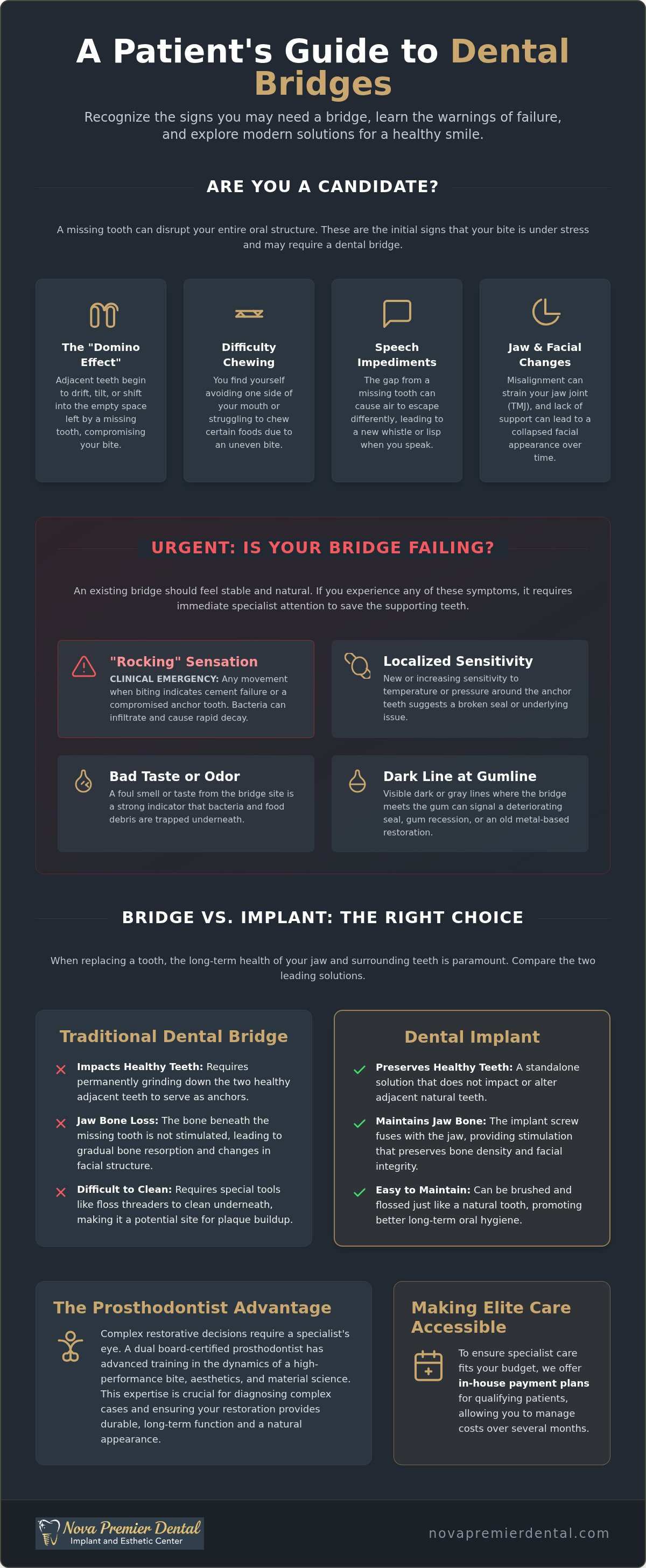
Missing a single tooth might seem like a cosmetic inconvenience, but it triggers a biological chain reaction that compromises your entire oral health. When a tooth is lost, the surrounding structures lose their primary stimulus for stability. This often leads to the "domino effect," where adjacent teeth begin to drift into the void, a process clinically known as tipping or tilting. These shifts are the primary dental bridge signs that indicate your oral architecture is under stress. This movement doesn't just create aesthetic gaps; it disrupts your bite, leading to uneven wear on remaining teeth and potential jaw joint discomfort.
Visually, you may notice gum recession in the empty space or a visible leaning of the teeth next to the gap. Beyond what you see, sensory changes are often the first clues. You might find yourself chewing exclusively on one side or noticing a slight whistle or lisp in your speech. These changes suggest that the missing unit has compromised your mouth's functional harmony. A professional evaluation at Nova Premier Dental is necessary to stop these shifts before they require more invasive full-mouth reconstruction.
The Clinical Necessity of Replacing Missing Teeth
A dental bridge serves as a critical structural placeholder. By filling the gap, it prevents malocclusion, or bite misalignment, which can lead to complex issues like TMJ disorders. Beyond alignment, a restoration helps maintain the vertical dimension of your face. Without support, the jaw can over-close, leading to a collapsed facial appearance. The stability of this solution relies on the health of the abutment teeth, which are the natural teeth on either side of the gap that act as anchors for the fixed bridge.
Determining Your Candidacy for a Fixed Bridge
Not every patient with a missing tooth is an immediate candidate for a bridge. We must first assess the integrity of the proposed abutment teeth; they must be free of significant decay or periodontal disease to support the restoration. We also evaluate the bone density in the region to ensure a stable foundation. Because these variables are complex, consulting a prosthodontist in Northern Virginia is essential. Dr. Peterson Huang brings a specialist’s eye to this evaluation, ensuring that the chosen treatment plan accounts for both immediate aesthetics and long-term structural health. To ensure this elite level of care remains accessible, our practice offers in-house payment plans for qualifying patients, allowing you to manage the cost over several months while already enjoying the benefits of your new smile.
Warning Signs Your Existing Dental Bridge is Failing
A fixed bridge should feel like a natural, immovable part of your anatomy. If you experience a "rocking sensation" when biting down, it's a clinical emergency that requires immediate attention. Any degree of movement indicates that the dental cement has failed or, more concerningly, that the underlying abutment tooth has been compromised by fracture or decay. When the bond between the restoration and the tooth breaks, saliva and bacteria infiltrate the space, creating a microscopic environment where cavities can thrive undetected. Recognizing these dental bridge signs early is the only way to save the natural teeth supporting the structure.
Sensory indicators often precede visual changes. You might notice localized sensitivity to temperature or pressure around the anchor teeth. If you're experiencing a persistent bad taste or a foul odor originating from the restoration site, it's likely that organic material is trapped beneath a compromised seal. Chronic food trapping isn't just an annoyance; it's a sign that the gum architecture has shifted or the marginal fit of the bridge has deteriorated. Whether you were an ideal candidate for a dental bridge a decade ago or received one more recently, these changes suggest the restoration's lifespan is nearing its end.
Visual and Aesthetic Red Flags
Dark lines appearing at the gumline are a common frustration for patients with older restorations. While this can sometimes be the metal framework of a porcelain-fused-to-metal bridge becoming visible as gums recede, it often signals recurrent decay at the margin. You should also inspect the porcelain pontic for visible chips, cracks, or significant wear that changes the texture of the tooth. If the soft tissue around the bridge appears inflamed, puffy, or bleeds during routine cleaning, it indicates a biological complication that needs a specialist's review. If you're concerned about the integrity of your restoration, a fixed bridge evaluation can determine if a replacement is necessary.
Functional Changes in Your Bite
Your bite should remain consistent over time. A sudden shift in how your upper and lower teeth meet suggests that the bridge has moved or the supporting bone structure has changed. You may also notice increased wear on the teeth directly opposing the bridge as the restoration loses its proper alignment. Bridge failure is the loss of marginal integrity between the crown and natural tooth. When this seal is lost, the entire restorative system is at risk. Dr. Peterson Huang uses advanced diagnostics to identify these failures before they lead to tooth loss. To ensure your health remains a priority, we offer in-house payment plans that allow you to manage the cost of a replacement over several months while you enjoy your new smile.
The Clinical Reality: Why Bridges Fail and What It Means for Your Health
Understanding why a restoration fails is just as important as recognizing the initial dental bridge signs themselves. One of the most common biological causes is cement washout. Over time, the medical-grade adhesive that secures the bridge can degrade due to the constant pressure of chewing and the presence of saliva. Once the cement washes out, a microscopic gap forms between the prosthetic and your natural tooth. This allows bacteria to infiltrate a space that's impossible to clean with a toothbrush or floss, leading to silent, rapid decay of the anchor teeth.
Structural fatigue also plays a significant role, particularly for patients who suffer from bruxism or chronic teeth grinding. The repetitive, high-force loading can cause the porcelain to fracture or the metal framework to bend, compromising the fit. When a bridge loses its structural integrity, it often creates a "bridge-to-implant" pipeline. This means the bridge is no longer the optimal solution because the supporting teeth are too damaged to hold a new restoration, making a dental implant the necessary next step to preserve your health. While many restorations last between 7 and 15 years according to industry data, these mechanical stresses can shorten that lifespan significantly.
The Biological Mechanism of Abutment Decay
Bacteria thrive in the dark, oxygen-poor environments created by a failing bridge. Because the decay happens underneath the crown, it's often painless until it reaches the nerve. Standard visual exams often fail to catch this; specialized digital imaging is required to see through the restoration. If you wait until you feel pain, the decay may have already destroyed enough tooth structure to necessitate an extraction. Losing these abutment teeth doesn't just mean the bridge is gone; it means you've lost the foundation for future fixed restorations.
Bone Loss and the Pontic Site
A significant limitation of bridges is that they don't address "disuse atrophy" in the jawbone. Your jawbone requires the stimulation of a tooth root to maintain its density. Under the false tooth (the pontic) of a bridge, the bone begins to resorb or shrink because it's no longer being used. This resorption creates a visible gap between the bridge and the gumline, leading to aesthetic concerns and food impaction. At Nova Premier Dental, Dr. Peterson Huang evaluates these dental bridge signs during a comprehensive oral reconstruction consultation. If bone loss has progressed, we may need to address the deficiency before a more permanent solution is placed. To help our patients access this level of specialized care, we offer in-house payment plans that spread the cost over several months, ensuring your clinical needs are met without delay.
Beyond Replacement: Evaluating Dental Bridges vs. Implants
When dental bridge signs such as structural rocking or marginal sensitivity appear, you're faced with a critical decision: replace the bridge or transition to an implant. Traditional fixed bridges have a 10-year survival rate of approximately 89% to 90%. In contrast, dental implants show a 10-year survival rate of 95% to 97%. This data suggests that while bridges remain a proven solution, implants offer greater long-term predictability. The choice often hinges on whether you wish to preserve the integrity of the teeth adjacent to the gap or if those teeth are already compromised.
Tooth preservation is a central tenet of modern prosthodontics. A bridge requires the reduction of healthy enamel on anchor teeth to accommodate the crowns; this can make them more vulnerable to future decay over time. Implants are considered the "conservative" choice because they replace the missing tooth without altering the neighbors. Maintenance also shifts significantly between the two options. You don't need to navigate complex floss threaders under a bridge when you have an implant. You simply brush and floss it like a natural tooth, which reduces the risk of hygiene-related failure and recurrent decay.
When to Stick with a Bridge
There are specific clinical scenarios where a new bridge remains the most appropriate path. If you have severely limited bone density and prefer to avoid the surgical requirements of bone grafting, a high-end bridge is an excellent alternative. This is particularly true if the adjacent teeth already have large fillings or existing crowns that require replacement anyway. At Nova Premier Dental, we often recommend Zirconia for these cases. This advanced material provides the translucency of natural teeth while offering the high-strength durability needed for long-term functional success.
The Case for Dental Implants
Transitioning to dental implants is often the best way to stop the cycle of recurrent decay. Since the implant post is made of biocompatible titanium, it's immune to the cavities that often plague natural abutment teeth. Implants also stimulate the jawbone through osseointegration, which halts the bone resorption that occurs under traditional pontics. For patients moving away from a failing multi-unit bridge, an implant-supported bridge provides a stable, permanent foundation that feels indistinguishable from your original teeth.
As a dual board-certified prosthodontist in Northern Virginia, Dr. Peterson Huang can help you weigh these complex factors with clinical precision. To ensure this level of specialized care fits your lifestyle, we provide in-house payment plans that allow you to manage the cost over several months. If you're ready to explore a more permanent solution for your smile, contact our Falls Church office today to schedule your consultation.
Specialist Restoration at Nova Premier Dental in Falls Church
At Nova Premier Dental, we understand that restorative dentistry isn't just about filling a gap; it's about rebuilding oral function with microscopic precision. When you notice troubling dental bridge signs, you need more than a general assessment. You require a meticulous diagnostic approach that considers the biological and mechanical factors behind your discomfort. Our Falls Church practice serves as a definitive resource for Northern Virginia patients facing complex reconstructive challenges, providing a level of expertise that prioritizes long-term stability over temporary fixes.
Why a Board-Certified Prosthodontist Matters
Choosing a board-certified specialist is critical when a previous restoration has failed. A prosthodontist completes three additional years of rigorous, ADA-accredited training beyond dental school, focusing exclusively on the restoration and replacement of teeth. Dr. Peterson Huang holds dual board certifications, a signature of elite status that reflects his dedication to the craft of medical reconstruction. This specialized training allows him to manage the most difficult cases, such as recurrent decay under old abutments or significant bone resorption, with a level of detail that general practitioners often cannot match. We're committed to functional beauty, ensuring that every restoration we design feels as natural as it looks.
Your Path to a Restored Smile
Your journey begins with a comprehensive consultation where we use advanced imaging to evaluate the structural integrity of your existing teeth and jawbone. We don't believe in one-size-fits-all solutions. Instead, we design personalized treatment plans that balance functional beauty with clinical health. If your dental bridge signs suggest that a replacement or an implant-supported alternative is necessary, we'll guide you through every step of the process with quiet confidence and transparency. We prioritize your comfort and long-term oral health throughout the reconstruction process.
We believe elite restorative care should be accessible to our community. To support this, we offer flexible in-house payment plans for qualifying patients. These plans allow you to manage the investment in your health over several months. You can comfortably pay for your treatment while already experiencing the functional and aesthetic benefits of your restored smile. Our focus remains entirely on your care and our dedicated relationship with you as a patient, avoiding the coldness of external financial services.
Contact us today to schedule an evaluation with a prosthodontist in Northern Virginia. Addressing your concerns early is the best way to secure the future of your smile.
Secure Your Smile with Specialist Restorative Care
Recognizing early dental bridge signs is the first step toward preserving your long term oral health and facial structure. Whether you're navigating the functional challenges of a missing tooth or suspecting that an existing restoration has lost its marginal integrity, professional evaluation is essential. By addressing these symptoms promptly, you can prevent complex biological issues like recurrent decay and bone resorption. Our practice specializes in transitioning patients from failing restorations to durable, high end solutions that restore both beauty and bite strength.
As a dual board certified prosthodontist in Northern Virginia, Dr. Peterson Huang is recognized for his excellence in complex oral reconstruction. At Nova Premier Dental, we prioritize individualized care through advanced technology and meticulous planning. We also offer in house payment plans for qualifying patients, allowing you to manage the cost of your care over several months while already enjoying the benefits of your new smile. Don't wait for a clinical emergency to take action. Schedule your consultation with Dr. Peterson Huang at Nova Premier Dental today. We look forward to helping you achieve a stable, confident, and healthy future for your smile.
Frequently Asked Questions
How many years should a dental bridge normally last?
A traditional dental bridge typically lasts between 7 and 15 years; however, some clinical studies indicate a 10 year survival rate of approximately 90%. Longevity depends heavily on the health of the supporting abutment teeth and your daily hygiene routine. At our Falls Church practice, we focus on utilizing high end materials like zirconia to maximize the lifespan of your restoration while ensuring it withstands the functional pressures of daily chewing.
Is a loose dental bridge considered a dental emergency?
Yes, a loose bridge is a clinical emergency that requires immediate evaluation. Any movement suggests the cement seal is broken, which allows bacteria to infiltrate the space under the crowns. This can lead to rapid, silent decay of the anchor teeth. If you notice these dental bridge signs, you should contact a specialist right away to prevent permanent tooth loss and avoid the need for more invasive oral reconstruction.
Can a dental bridge be recemented if it falls out?
Recementing is only possible if the underlying abutment teeth are healthy and the bridge itself remains structurally sound. Frequently, a bridge falls out because the supporting tooth has decayed or fractured, making simple recementing impossible. Dr. Peterson Huang must perform a detailed assessment to ensure the foundation is stable before attempting to secure any existing restoration back into place.
Why do my gums bleed only around my dental bridge?
Bleeding specifically around a restoration often indicates localized inflammation caused by plaque accumulation or a poor marginal fit. It's one of the common dental bridge signs that the prosthetic is no longer compatible with your gum architecture. Chronic irritation can lead to periodontal disease or recession, which exposes the tooth roots to decay. Professional cleaning and a specialist's review are necessary to determine if the bridge requires adjustment or replacement.
What happens if I ignore the signs of a failing bridge?
Ignoring failure signs often results in the loss of the supporting abutment teeth. Once the anchor teeth are destroyed by decay or structural stress, you lose the ability to support a new fixed bridge. This leads to bone resorption and may require more complex treatments like dental implants or full mouth reconstruction. Early intervention by a prosthodontist in Northern Virginia is the most conservative way to protect your long term health.
Can a prosthodontist fix a bridge that a general dentist installed?
Absolutely. A significant portion of our practice in Falls Church involves managing and correcting complex restorative cases that have failed elsewhere. A dual board certified prosthodontist has the advanced training required to diagnose why a previous restoration failed and how to engineer a more durable replacement. Whether you're from McLean or Tysons, we provide the specialized expertise needed to resolve difficult mechanical or aesthetic issues with existing dental work.
Are there modern materials that make bridges look more natural?
Modern restorative dentistry utilizes advanced materials like translucent zirconia and lithium disilicate to mimic the optical properties of natural enamel. These metal free options eliminate the dark gray lines often seen at the gumline of older bridges. At Nova Premier Dental, we select materials that provide a balance of high strength and functional beauty, ensuring your new smile is both durable and indistinguishable from your natural teeth.
How much does it cost to replace a dental bridge in Northern Virginia?
Professional fees for bridge replacement in Northern Virginia depend on the number of units involved and the complexity of the underlying biological issues. While we don't provide flat rate pricing without a consultation, we are committed to making elite care accessible for our patients in Fairfax and Arlington. We offer flexible in house payment plans that allow you to manage the cost over several months while you enjoy the benefits of your restored smile.
Disclaimer
The information provided on this website and blog is intended for general educational and informational purposes only and should not be considered dental or medical advice, diagnosis, or treatment. Reading content on this website does not establish a doctor-patient relationship with Nova Premier Dental or Dr. Peterson Huang. Dental conditions and treatment needs vary from patient to patient. Individuals should consult directly with a qualified dental professional for personalized evaluation, diagnosis, and treatment recommendations. Do not delay seeking professional dental care based on information found on this website. While we strive to provide accurate and up-to-date information, no guarantee is made regarding the completeness, accuracy, or applicability of the content. Treatment outcomes may vary depending on individual circumstances. If you are experiencing a dental emergency or urgent oral health concern, please contact a licensed dental professional immediately or call 911 in the event of a medical emergency.


