


Article by
Peterson Huang DMD, MS, FACP, FRCDC
Dr. Peterson Huang is a dual board-certified prosthodontist serving Falls Church and Northern Virginia. He has been recognized as a Top Prosthodontist by Northern Virginia Magazine and Arlington Magazine and is affiliated with the Inova Fairfax Hospital Tumor Board. Dr. Huang focuses on dental implants, full mouth reconstruction, and complex restorative dentistry for patients who need advanced, comprehensive care.
Understanding the cost of porcelain veneers Virginia patients encounter involves evaluating clinical preparation, material selection, and practitioner training. Fees for cosmetic and restorative veneer treatments can vary widely across Northern Virginia, reflecting differences in case complexity, diagnostic protocols, and laboratory fabrication methods. Rather than viewing veneers simply as an isolated cosmetic expense, patients benefit from understanding how comprehensive treatment planning and structural considerations influence the long-term durability of their restorations.
Nova Premier Dental is a private prosthodontic specialty dental office in Falls Church serving Northern Virginia. Dr. Peterson Huang completed specialty training in prosthodontics and holds board certification through the American Board of Prosthodontics and the Royal College of Dentists of Canada. This guide outlines clinical factors that influence treatment costs, diagnostic steps used in treatment planning, and payment information for patients considering dental veneers.
Key Takeaways
- The cost of porcelain veneers depends on the number of teeth treated, preparation requirements, ceramic selection, laboratory services, and the complexity of the bite.
- Prosthodontists complete additional specialty training focused on restoring and replacing teeth and managing complex restorative problems.
- Porcelain and composite resin veneers differ in appearance, stain resistance, repairability, preparation requirements, and cost.
- Dental disease, gum inflammation, bruxism (teeth grinding), and occlusal (bite) problems may need to be addressed before veneers are placed.
- Nova Premier Dental offers in-house payment plans for qualifying patients, allowing treatment costs to be paid over several months.
Factors Influencing the Cost of Porcelain Veneers in Northern Virginia
When researching the cost of porcelain veneers in Virginia, patients frequently encounter a broad range of estimates. Regional pricing in Northern Virginia reflects local economic factors, advanced clinical overhead, and access to specialized dental laboratory technicians. Several clinical variables dictate the final treatment fee:
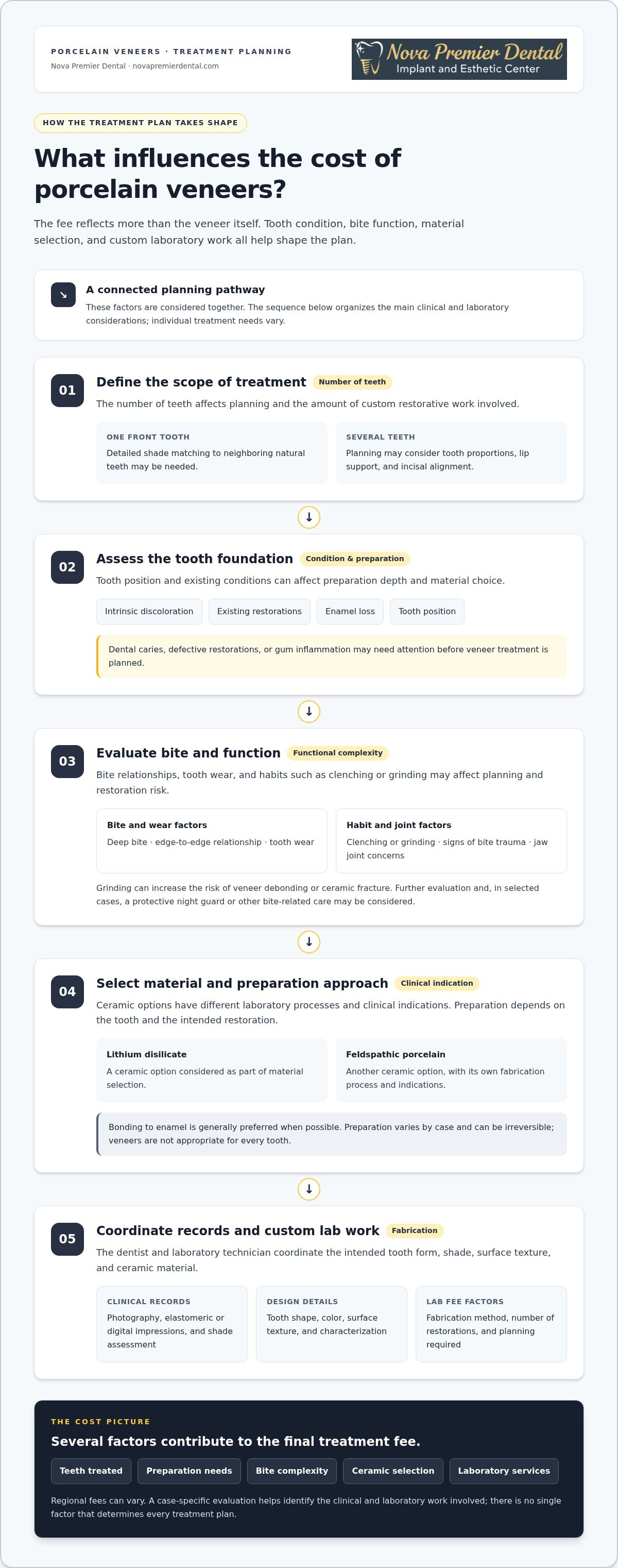
- Number of teeth treated: Restoring one anterior tooth may require detailed shade matching to adjacent natural teeth. Treating several teeth requires additional planning for tooth proportions, lip support, and incisal alignment.
- Substrate condition and preparation depth: Intrinsic discoloration, existing restorations, enamel loss, or tooth position can affect preparation and material selection.
- Ceramic material selection: Different ceramic formulations, such as lithium disilicate or feldspathic porcelain, have different laboratory processes and clinical indications.
- Occlusal and functional complexity: Deep bites, edge-to-edge relationships, parafunctional habits, and tooth wear may require evaluation and management before veneers are placed.
The Role of Custom Dental Laboratories
The dental laboratory and fabrication process can affect treatment cost. Veneers are custom-made restorations, and the dentist and laboratory technician must communicate about tooth form, shade, surface texture, and the intended ceramic material. Laboratory fees may vary according to the fabrication method, the number of restorations, and the planning and characterization required.
According to clinical resources from the American Dental Association (ADA), porcelain veneers are custom-made shells designed to cover the front surface of teeth. Treatment planning may include clinical photography, elastomeric or digital impressions, and shade assessment. The dentist and laboratory technician use these records to coordinate the intended tooth shape, color, and surface characteristics.
Pre-Veneer Restorative Requirements
Porcelain veneers cannot be placed predictably on compromised foundations. Prior to commencing cosmetic treatment, the patient's biological and functional health must be fully evaluated. If underlying pathology is present, preliminary therapies will influence the overall treatment investment:
- Periodontal therapy and gingival recontouring: Gum inflammation should be assessed and treated before adhesive bonding. If the gum line is uneven, gingival recontouring or surgical crown lengthening may be considered when clinically appropriate.
- Foundational restorations: Existing defective restorations, recurrent dental caries, or failing composite bonding may need treatment through targeted restorative dentistry before veneer preparation.
- Occlusal therapy and bruxism management: Clenching or teeth grinding can increase the risk of debonding or ceramic fracture. Patients with signs of occlusal trauma or TMJ/jaw joint disorders may require further evaluation and, in selected cases, a protective night guard or other bite-related treatment.
Prosthodontist vs. General Dentist: Clinical Training and Preparation
Both general dentists and prosthodontists provide restorative care, including porcelain veneers. General dentists play an essential role in preventive oral healthcare, routine restorations, and initial cosmetic evaluations. Many general practitioners manage routine veneer cases with predictable success. However, patients often seek a specialist when cases involve complex functional problems, significant tooth wear, or multi-unit aesthetic rehabilitations.
A prosthodontist is a dentist who has completed additional specialty training in prosthodontics. Prosthodontists complete additional specialty training focused on restoring and replacing teeth and managing complex restorative problems. This training may be relevant when treatment involves extensive tooth loss, complex bite conditions, or multiple types of restorations.
The Clinical Background of Dr. Peterson Huang
At Nova Premier Dental, Dr. Peterson Huang, DMD, MS, FACP, FRCDC, provides prosthodontic evaluation and treatment planning for restorative and reconstructive concerns. His role may include assessing tooth structure, occlusion (bite), gum health, materials, and the relationship between individual restorations.
Rather than treating veneers strictly as cosmetic covers, a prosthodontic approach evaluates how restorations interface with the patient's masticatory system. This involves verifying that the new tooth contours support stable anterior guidance (the way front teeth guide the jaw during chewing movements) without creating destructive interferences that could lead to ceramic chipping or joint pain.
Conservative Preparation and Digital Planning
Preserving healthy tooth structure is an important consideration when planning veneers. Bonding to enamel is generally preferred when clinically possible, but the amount of preparation depends on tooth position, discoloration, existing restorations, the selected material, and the desired result. Veneers are not appropriate for every tooth, and preparation can be irreversible.
Clinical workflows may include intraoral scanning, digital diagnostic models, and photography. A clinician can use these records and, when appropriate, a diagnostic mock-up to assess proposed tooth dimensions before irreversible preparation. These steps help evaluate restorative space and allow discussion of potential sensitivity, tooth vitality, and other limitations.
Material Longevity and Treatment Durability
When evaluating the cost of porcelain veneers Virginia practices present, patients should consider both the initial fee and future maintenance. Porcelain veneers are durable but are not permanent or indestructible. Their service life varies with preparation, bonding, material, oral hygiene, diet, occlusion (bite), bruxism, and routine dental care. Published studies can provide estimates of veneer survival, but results vary by study design, patient selection, material, and follow-up period.
In contrast, less durable alternatives or poorly planned restorations often require early clinical intervention, increasing the overall cost of treatment over time. Common complications that lead to premature replacement include:
- Debonding: Caused by inadequate adhesive protocols, insufficient enamel substrate, or unmanaged shearing forces.
- Ceramic fracture or chipping: Typically resulting from abnormal bite forces, severe bruxism, or insufficient ceramic thickness.
- Marginal discoloration and microleakage: Arising from compromised margins, poor isolation during adhesive cementation, or inadequate home hygiene.
- Recurrent decay: Developing along exposed preparation margins when plaque accumulation is uncontrolled.
Porcelain vs. Composite Resin
Patients comparing aesthetic options frequently consider direct composite veneers alongside indirect porcelain veneers. Understanding the trade-offs between these materials clarifies their differing fee structures:
| Feature | Porcelain Veneers (Ceramic) | Composite Veneers (Resin) |
|---|---|---|
| Maintenance and longevity | May require repair or replacement over time; service life varies by clinical factors | May require polishing, repair, or replacement as wear and staining develop |
| Stain resistance | Generally resists surface staining, although margins and surrounding teeth can discolor | More susceptible to surface staining and changes in polish |
| Repairability | Some damage may be repairable, but fracture or debonding may require replacement | Often more amenable to direct repair or reshaping |
| Fabrication method | Custom fabricated before bonding to the tooth | Usually sculpted and cured directly on the tooth |
| Relative cost | Often has a higher initial fee per tooth | Often has a lower initial fee per tooth |
Composite resin may have a lower initial cost and can be repaired or modified more readily in some situations. Porcelain may offer greater resistance to surface staining and a different optical appearance, but it is more technique-sensitive and can fracture or debond. The appropriate material depends on the tooth condition, occlusion, cosmetic goals, preparation requirements, and willingness to maintain or replace the restoration.
Diagnostic Wax-Ups and Aesthetic Mock-Ups
A predictable restorative outcome relies heavily on the diagnostic wax-up phase. Before modifying natural teeth, the clinician or laboratory technician models the proposed tooth shapes in wax over stone or digital casts of the patient's mouth. This diagnostic preview provides several practical benefits:
- Clinical validation: Allows the clinician to evaluate whether the proposed incisal length and buccal contours provide proper phonetics and lip support.
- Direct intraoral mock-up: A temporary resin trial can be placed directly over the patient's teeth without drilling, allowing the patient to visualize the proposed changes in tooth shape and proportion before treatment begins.
- Preparation guides: Custom reduction guides fabricated from the wax-up ensure that the clinician removes only the precise amount of tooth structure needed for the ceramic, preventing unnecessary over-preparation.
Reviewing clinical documentation and before and after cases of treated restorations can further help patients evaluate the diagnostic rigor and aesthetic standards maintained by the practice.
The Clinical Consultation and Treatment Planning Process
A comprehensive consultation for porcelain veneers goes far beyond providing a fast price quote. Because each patient presents with distinct anatomical and functional considerations, definitive fees cannot be established without an in-depth clinical evaluation. At Nova Premier Dental in Falls Church, the diagnostic evaluation focuses on establishing a realistic, individualized treatment blueprint.
During your initial consultation, the clinical team gathers key diagnostic records:
- High-resolution clinical photography of the teeth, smile line, and facial proportions.
- Digital impressions or intraoral scans to evaluate dental arches and bite relationships.
- Periodontal screening to verify gingival health and bone levels.
- Comprehensive caries detection and evaluation of existing dental restorations.
- Functional screening of the temporomandibular joints and masticatory muscles.
Individualized Treatment Planning
Treatment planning involves analyzing how the upper teeth relate to the lower lip line during smiling, evaluating facial midline orientation, and determining how much tooth display occurs at rest. A patient desiring a subtle rejuvenation may require only four anterior veneers, while another addressing extensive wear from attrition may benefit from comprehensive anterior restoration paired with posterior bite stabilization.
For patients who have received varied treatment proposals from other offices, a consultation can help clarify the diagnosis, alternatives, expected maintenance, and limitations of each option. A restorative plan should account for tooth structure, periodontal health, occlusion, parafunction, and the possibility of future repair or replacement.
Serving Falls Church and Northern Virginia
Located in Falls Church, Nova Premier Dental provides restorative and prosthodontic services to patients in Northern Virginia. Long-term care includes routine examinations and dental exams and cleanings to monitor the teeth, gums, restoration margins, and bite.
Financial Considerations and Payment Information
Because porcelain veneers are generally categorized as elective cosmetic procedures, dental insurance policies rarely provide comprehensive coverage. However, if a veneer is placed to restore a tooth structurally compromised by trauma or significant developmental defects, partial restorative benefits may apply depending on individual plan parameters. The administrative team at Nova Premier Dental assists patients in reviewing their insurance coverage to verify whether any restorative provisions are applicable.
Transparent financial planning is essential when undergoing multi-unit restorative care. Patients should receive an itemized treatment estimate that clearly delineates diagnostic fees, provisional restorations, specialized laboratory charges, and final adhesive cementation appointments before commencing care.
In-House Payment Options
Nova Premier Dental offers in-house payment plans for qualifying patients, allowing treatment costs to be paid over several months.
Scheduling an Evaluation
If you have questions regarding the clinical indications, material options, or investment required for dental restorations, an in-person evaluation is the appropriate next step. You can contact Nova Premier Dental to arrange a consultation with Dr. Peterson Huang at our Falls Church practice. Bringing relevant records, previous diagnostic x-rays, or specific questions regarding your functional and aesthetic goals will help ensure a thorough and informative visit.
Frequently Asked Questions
How much do porcelain veneers cost per tooth in Northern Virginia?
The cost of porcelain veneers varies by the number of teeth treated, diagnostic and preparation needs, ceramic and laboratory selection, and case complexity. An accurate estimate requires a clinical examination and should identify which services and restorations are included.
Does dental insurance cover the cost of porcelain veneers?
Dental insurance policies typically exclude coverage for porcelain veneers when they are completed primarily for cosmetic reasons. In specific situations where a veneer is required to treat severe structural compromise, acute tooth trauma, or extensive decay, some insurance plans may contribute partial restorative benefits. Patients should review their plan's specific exclusions and limitations.
Are in-house payment plans available for veneers at Nova Premier Dental?
Nova Premier Dental offers in-house payment plans for qualifying patients, allowing treatment costs to be paid over several months.
How long do porcelain veneers last before they need to be replaced?
Porcelain veneers may require repair or replacement over time. Longevity depends on factors such as the amount of enamel available for bonding, preparation and cementation, oral hygiene, diet, occlusion (bite), bruxism, and follow-up care. A dentist can discuss expected maintenance based on the individual restoration and clinical circumstances.
Is the fee for veneers different when seeing a prosthodontist?
Fees may differ among providers because of differences in training, diagnostic services, laboratory procedures, materials, and case complexity. Prosthodontic consultation may be appropriate when treatment involves complex bites, extensive tooth wear, multiple restorations, or uncertainty about the available options.
What is typically included in a porcelain veneer treatment estimate?
A comprehensive treatment estimate should outline every phase of care: initial diagnostic records and photography, a diagnostic wax-up or digital simulation, tooth preparation and shade mapping, custom provisional (temporary) restorations, custom dental laboratory fabrication fees, and adhesive bonding protocols along with post-insertion bite adjustments.
Can a patient receive a single veneer, or is a full set required?
A single porcelain veneer can be placed to treat an isolated discolored, malformed, or fractured tooth. However, matching a single central incisor to an adjacent natural tooth is one of the most technically demanding challenges in restorative dentistry. Depending on aesthetic goals, patients often choose to treat the visible teeth within their smile zone (usually 6 to 10 teeth) to ensure uniform color, texture, and symmetry.
What clinical steps are taken if a porcelain veneer chips or debonds?
If a porcelain veneer debonds cleanly without breaking, a dentist can often clean the underlying tooth, re-etch the ceramic, and rebond it using adhesive resin. However, if the porcelain fractures or chips substantially, repair with composite resin is often temporary; full replacement of the restoration is usually indicated to restore optimal strength and aesthetics. A clinical evaluation is necessary to identify whether bite interferences or teeth grinding contributed to the failure.
Disclaimer
The information provided on this website and blog is intended for general educational and informational purposes only and should not be considered dental or medical advice, diagnosis, or treatment. Reading content on this website does not establish a doctor-patient relationship with Nova Premier Dental or Dr. Peterson Huang. Dental conditions and treatment needs vary from patient to patient. Individuals should consult directly with a qualified dental professional for personalized evaluation, diagnosis, and treatment recommendations. Do not delay seeking professional dental care based on information found on this website. While we strive to provide accurate and up-to-date information, no guarantee is made regarding the completeness, accuracy, or applicability of the content. Treatment outcomes may vary depending on individual circumstances. If you are experiencing a dental emergency or urgent oral health concern, please contact a licensed dental professional immediately or call 911 in the event of a medical emergency.


